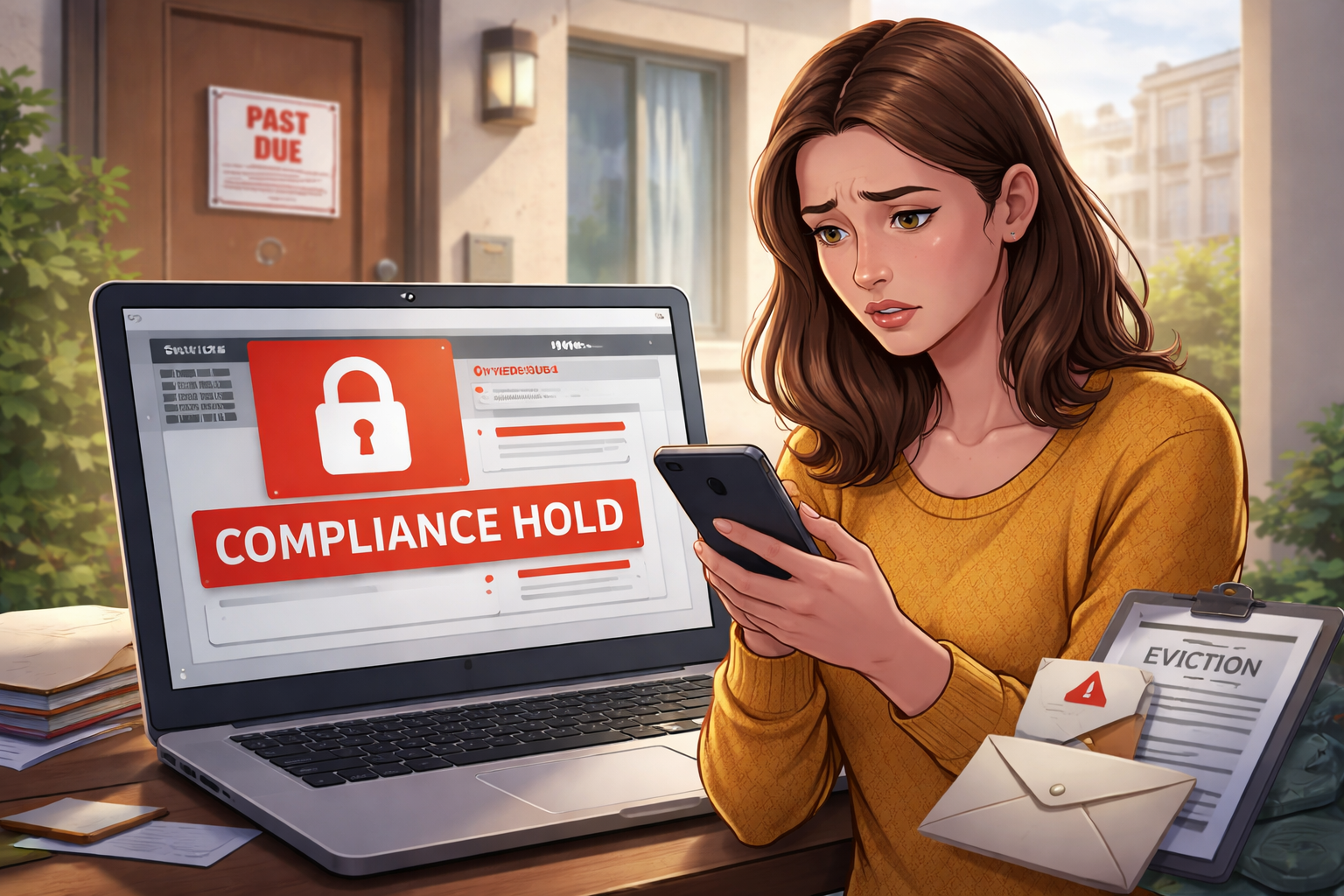
Rent account placed on compliance hold after payment was the exact message sitting on the screen when the problem stopped feeling like a normal rent issue and started feeling dangerous. The payment had already left the bank. The confirmation email had already arrived. The amount matched. Nothing looked late, nothing looked incomplete, and nothing suggested that a bigger account problem was building in the background. Then the portal locked down, the balance looked wrong, and the account status changed in a way that made the situation feel much more serious than a simple posting delay.
The first instinct in that moment is usually to think the portal is just behind. That assumption is what makes this problem worse. A normal delay is one thing. Rent account placed on compliance hold after payment is different because the issue is often no longer about whether money moved. It is about whether the account itself has been restricted, flagged, or blocked from updating normally. Once the account status is frozen by a compliance review, a valid payment may no longer protect you from automated late notices, access restrictions, or even eviction workflow triggers.
If you are seeing Rent account placed on compliance hold after payment, this guide is designed to help you understand where the problem usually starts, how it gets worse, what your landlord may be seeing on the other side, what rights-related risks are involved, and what exact actions should happen next. This article is built to solve the real version of the problem, not the simplified version.
If you want the broader system background first, start with the closest hub below because it explains how rent posting problems and account status conflicts often split into separate tracks:
Start with the core system overview here:
Why This Problem Feels So Wrong So Fast
What makes Rent account placed on compliance hold after payment so unsettling is that it contradicts what tenants think should happen. You pay. The landlord receives notice. The ledger updates. The issue ends. But many rental systems do not work as one clean chain. They are made up of separate tools, separate permissions, and separate rules. The processor that accepts money may not be the same platform that clears the tenant account. The tenant account may not be the same place where compliance flags live. And the compliance team may not be the same people who review payment proof.
That separation creates a dangerous mismatch. Your payment can be real while your account status still says restricted. Your portal can show balance due while the bank shows completed. Your landlord can see a warning label on the account while you are staring at a transaction receipt. That is why this kind of issue often escalates through automation before a human fully understands what happened.
In the United States, many property operations use a mix of payment processors, lease-management platforms, identity-verification tools, fraud-screening systems, and back-office compliance controls. When Rent account placed on compliance hold after payment appears, it often means one of those systems has blocked normal account movement even though the money itself may already be in motion or fully received.
What Usually Triggers The Hold
There is rarely just one cause. Rent account placed on compliance hold after payment can come from several very different triggers, and the right response depends on which kind of hold you are actually dealing with.
Common hold triggers that create this exact problem:
- Identity mismatch between the tenant profile and the payment profile
- Duplicate tenant account or duplicate unit association
- Rental assistance or third-party payer verification review
- Fraud-screening flag after an unusual transaction pattern
- Manual audit opened by the property manager or ownership group
- Lease-status conflict after renewal, transfer, move-out, or roommate change
- Returned-payment risk review even before the bank formally rejects anything
- Name, address, or account-number mismatch during ACH review
Each one creates a different chain reaction. If the hold was triggered by a duplicate profile, the system may stop posting because it no longer knows which account should receive the payment. If the hold was triggered by identity verification, the account may be restricted until documents are reviewed. If the hold was triggered by assistance verification, the platform may stop normal updates while it waits for subsidy or third-party confirmation. If the hold was triggered by fraud screening, the system may treat the account as risky even though the payment is legitimate.
The most important thing to understand is that a compliance hold is often not accusing you of wrongdoing. It is simply freezing the account until the system or staff decide the account can move again.
Why Payment And Account Status Split Apart
Most tenants assume rent is one system. In reality, it is often several systems touching the same account at different moments. One system accepts the payment. Another system updates the tenant ledger. Another system controls portal access. Another system may manage notices, violations, or legal escalation. When Rent account placed on compliance hold after payment shows up, those systems stop moving together.
That is why you can end up with all of the following at the same time:
- Bank says completed
- Portal says restricted
- Ledger still shows due
- Email says review pending
- Notice says action required
Those contradictions are not unusual in this type of dispute. They are a sign that the account is stuck between payment completion and account release. This is also why asking only one question — “Did you receive my payment?” — often gets the wrong answer. The better question is: “What active compliance restriction is preventing my account from being cleared?”
When Rent account placed on compliance hold after payment is involved, the account state matters more than the payment receipt.
How The Problem Changes Depending On Your Situation
Not every tenant with Rent account placed on compliance hold after payment is dealing with the same version of the problem. The surface message may look identical, but the underlying facts can be very different. The following breakdown is where most readers can immediately map their own situation.
Version A: Payment completed, portal access restricted
You paid on time, your bank confirms it, but the portal suddenly limits access or blocks key functions. In this version, the most likely issue is a compliance or profile-status hold that is preventing normal account updates. The payment may be sitting in the system, but the account cannot refresh because the profile is frozen. This version becomes dangerous when you cannot download documents, reply inside the portal, or see real-time notices.
Version B: Payment completed, ledger still shows due
This version looks like a normal posting delay at first, but the hold message changes the meaning. Instead of a simple back-end delay, the ledger may be intentionally prevented from updating until staff release the account. This can result in late-fee triggers, balance due alerts, and incorrect notice generation.
Version C: Payment tied to assistance or third-party support
When part or all of the rent comes from subsidy, local assistance, employer relocation support, or another outside source, the account can be frozen while the system waits for source verification. The tenant may have done nothing wrong, but the platform may treat the account as incomplete until internal matching is finished.
Version D: Duplicate account or roommate change issue
If a roommate moved out, a new tenant moved in, the lease renewed, or a transfer happened between units, the system may detect overlapping account identities. In that situation, Rent account placed on compliance hold after payment can appear because the platform no longer knows which tenant record should own the payment.
Version E: Fraud-screening or unusual transaction review
A larger-than-normal payment, a payment from a new bank account, several payment attempts close together, or a mismatch between payer identity and lease identity can trigger a review. The money may still be valid. The account just gets held while risk checks happen.
This deeper breakdown matters because it affects what evidence you gather and who you contact. A subsidy-related hold requires a different explanation trail than a fraud-screening hold. A duplicate-profile hold requires account correction, not just payment proof. A ledger hold may require written escalation before the system releases anything.
What The Landlord Or Property Manager May Be Seeing
One of the most frustrating parts of Rent account placed on compliance hold after payment is that the landlord’s side may not look like your side at all. You may see a completed payment. They may see “restricted,” “under review,” “do not clear,” or “manual verification required.” Some staff members may only see the violation or hold label without seeing full payment detail. Others may see payment detail but lack authority to release the account.
That gap is why these situations often produce bad conversations. A tenant says, “I paid.” A manager says, “Your account is not clear.” Both statements may technically be true within different systems.
If the landlord or manager is relying on the account-status screen rather than the raw payment history, they may continue treating the account as unresolved until the hold is formally removed.
This is where many tenants lose time. They keep sending the same screenshot of the bank charge, while the property side keeps repeating that the account is still under review. The missing piece is not more proof that money moved. The missing piece is a direct request to identify and clear the specific hold type.
If your situation is moving toward a status problem rather than a simple payment problem, this related article helps explain how account flags can create escalation even when the tenant believes everything is compliant:
When This Starts Turning Into A Legal Or Rights Issue
Rent account placed on compliance hold after payment becomes much more serious when the hold starts affecting access, fees, notices, or reporting. A hold is not just a technical inconvenience if it leads to a pay-or-quit notice, a default label, added fees, or a collections threat. At that point, the question is no longer just “Why is the system delayed?” It becomes “What is the landlord doing while the account remains frozen?”
In practical terms, the biggest risks include:
- Late fees continuing to accumulate despite valid payment
- Automated notices going out while the hold remains active
- Eviction workflow beginning before the account is released
- Restricted portal access limiting your ability to respond
- Collections or credit-reporting threats if the balance remains coded as due
Once real-world consequences attach to the hold, every day matters more.
For general housing and tenant process information, the U.S. Department of Housing and Urban Development has official consumer-facing housing guidance here: U.S. Department of Housing and Urban Development.
What To Do In The First 24 Hours
If you are in the middle of Rent account placed on compliance hold after payment, the first 24 hours should be used to build a clean record and force the issue into the right channel. This is not the time to send vague messages. It is the time to document the account and ask precise questions.
Immediate action checklist:
- Download the bank confirmation showing date, amount, and transaction reference
- Take screenshots of the portal message, hold notice, restricted access, and any incorrect balance
- Save all emails or texts showing confirmation, warnings, or violations
- Write down the exact date and time you noticed the hold
- Contact property management in writing, not only by phone
- Ask exactly what compliance flag is active and what is required to clear it
- Contact the payment platform or portal support if they are separate from the landlord
- Request written confirmation that the payment itself was received or is pending review
Notice what is not on that list: paying again. Sending angry messages. Waiting for the system to “catch up.” Assuming the next business day will fix it. Those reactions often make the situation worse or create a second dispute on top of the first one.
Mistakes That Usually Escalate The Damage
Some rent problems stay small when handled early. Rent account placed on compliance hold after payment often does the opposite. It starts in a narrow back-end issue and becomes a bigger conflict because the tenant or landlord responds to the wrong symptom.
- Paying a second time before the first payment is traced
- Arguing only about payment proof without asking what hold code exists
- Ignoring portal restrictions because the bank already shows completed
- Failing to ask for written clarification
- Waiting until a court-related or eviction-style notice arrives
- Assuming on-site staff can remove a hold when the review is handled by another team
The wrong move in this type of dispute is treating it like a basic late-posting issue when the account itself has been frozen.
How To Frame Your Message The Right Way
When you write to management, the goal is not to vent. The goal is to force the right review path. A useful written message should clearly state that payment has been completed, the account is under compliance hold, the current status is creating risk, and you are requesting the exact reason for the hold plus the steps required to clear it.
The key is to separate the two issues in your wording:
- Issue one: payment proof exists
- Issue two: account status remains restricted
That framing prevents staff from giving you a one-line answer that ignores the real problem. It also builds a better record if the account later shows lease default, fees, or notice activity.
If The Hold Clears But The Balance Still Looks Wrong
Sometimes the hold gets removed and the account still does not look right. That usually means the second half of the problem has started: payment release happened, but ledger reconciliation is still incomplete. At that point, the issue shifts from compliance hold to posting and portal mismatch.
If that becomes your next step, this related article fits naturally because it covers the situation where payment appears complete on one side but the rental system still shows unresolved status:
Key Takeaways
- Rent account placed on compliance hold after payment is not the same as a normal payment delay
- The payment can be valid while the tenant account remains frozen
- Different hold triggers require different resolution paths
- Landlords and tenants may be seeing different system messages at the same time
- Late fees, notices, or escalation can continue if the hold is not actively cleared
- The right question is not only whether payment was received, but what hold is blocking account release
- Written documentation matters immediately
FAQ
Why would my account be on compliance hold if my rent payment already cleared?
Because the payment processor and the account-status system may be separate. Your money can move successfully while the tenant account remains restricted for identity, review, audit, subsidy, or fraud-related reasons.
Can I still get late notices if the payment was real?
Yes. If Rent account placed on compliance hold after payment is still active, the account may continue triggering automated notices or late status until the hold is removed and the ledger is released.
Should I make another payment to be safe?
Usually no. A second payment can create a second dispute. First confirm whether the original payment is valid and what specific hold is blocking the account.
What evidence matters most?
The strongest package usually includes your bank confirmation, transaction number, screenshots of the hold message, the account balance screen, and all written notices or emails connected to the restriction.
Who do I need to contact?
Usually both the property-management side and the payment or platform support side if they are separate. One may confirm payment, while the other controls account release.
Rent account placed on compliance hold after payment is one of the easiest rent problems to misunderstand because the payment proof makes it look like the dispute should be over. But the real danger starts when tenants assume proof of payment automatically means proof of account clearance. In many rental systems, those are two separate events.
The next move should be immediate and specific. Gather your payment proof, capture the hold message, send a written request asking what exact compliance restriction is active, and demand the steps needed to clear the account now. Do not wait for the system to fix itself, and do not let the conversation stay stuck at “but I already paid.” The real issue is removing the hold before it turns into fees, default status, or eviction activity. :contentReference[oaicite:0]{index=0}