
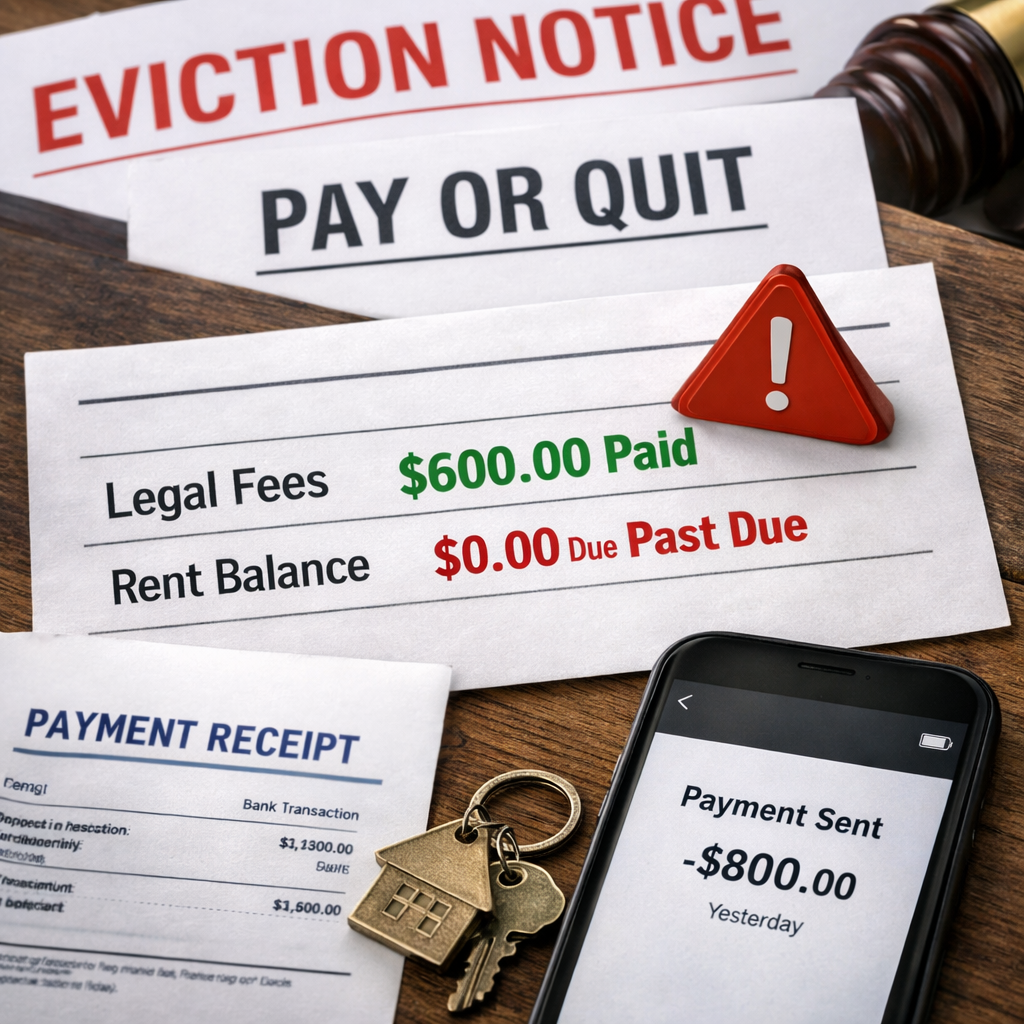
Landlord applied rent payment to legal fees before rent was not a phrase I had ever typed into a search bar before that morning. I had paid the account the night before. I had the bank confirmation. I had the portal screenshot. So when I opened the email and saw “remaining rent balance due” followed by a warning about legal action, I assumed it had to be a lag, a batch delay, some harmless mismatch that would disappear by afternoon.
It did not disappear. The rent line still showed overdue. The amount I had paid was gone from my available balance, but the account itself looked barely improved. Then I saw the part that changed everything: legal fees had been reduced first. That was the moment the situation stopped feeling like a routine posting problem and started feeling dangerous. The money had been accepted, but it had not been applied in the way any normal tenant would assume.
Landlord applied rent payment to legal fees before rent is one of those account problems that can quietly push a tenant deeper into risk even after a real payment has been made. The danger is not only the money movement itself. The danger is the timing that follows it. If the system eats the payment in the wrong order, the landlord’s ledger can continue showing unpaid rent, which means late fees may keep running, notices may stay active, and an eviction file may keep moving as if nothing meaningful was paid at all.
If you want the broader system background first, this hub is the closest match because it explains how rent posting logic creates bigger downstream problems:
Why This Happens So Fast
Landlord applied rent payment to legal fees before rent usually happens because the account is no longer being treated like a simple monthly rent ledger. Once a file has crossed into a more aggressive stage, the software often changes priority rules. It may not care what the tenant intended. It may care only what the balance waterfall says should be paid first.
In practice, that waterfall often looks something like this: court costs, filing fees, attorney charges, prior late fees, older carryover balances, and only then current rent. That order can exist in lease language, management policy, collections policy, or internal software setup. Sometimes it is obvious in the ledger. Sometimes it is buried inside a resident portal that only shows the final outcome, not the allocation logic.
The most important point is this: payment acceptance does not mean rent satisfaction. A tenant can make a real payment, receive a real confirmation, and still have a real unpaid-rent problem if the account allocates that payment somewhere else first.
What the Account Usually Looks Like
When landlord applied rent payment to legal fees before rent, the account often starts sending mixed signals that confuse people into waiting too long.
You may see one or more of these signs:
- The portal says payment completed, but the monthly rent line still shows past due.
- The balance drops only slightly even though the payment felt large.
- Legal fees or attorney fees suddenly show paid or reduced.
- A pay-or-quit notice remains active after payment.
- Late fees continue appearing after the date you thought the issue was resolved.
- The property manager says “the payment posted” while also saying “rent is still unpaid.”
That last one creates the most confusion because both statements can be true at the same time. The payment posted. It just did not post where you thought it would.
Where the Risk Gets Worse
Landlord applied rent payment to legal fees before rent becomes much more serious when legal action has already started, even informally. At that point, tenants often think they are buying time by paying, when in reality they may only be clearing side balances while the core rent delinquency remains alive.
This creates a brutal sequence:
- You pay to stop the problem.
- The system applies money to legal fees.
- Rent still looks unpaid.
- The notice remains valid from the landlord’s point of view.
- More time passes.
- The tenant assumes the account is correcting.
- The filing or next notice arrives anyway.
That is why this issue is so dangerous: the account can keep moving forward while the tenant thinks the emergency has already been addressed.
The Deeper System Problem
Landlord applied rent payment to legal fees before rent often reflects how landlord systems are built around recoverability, not fairness from the tenant’s perspective. If management has already spent money on notices, counsel, filing, or compliance action, the system may try to recoup those amounts before treating new money as current rent.
That is especially common when the account has any of the following conditions:
- an active eviction or pre-eviction status code
- a legal ledger bucket separate from rent
- older unresolved charges already aging in the account
- manual notes from management restricting account overrides
- third-party legal vendor integration
Some tenants imagine a person manually choosing to create harm. Sometimes that happens. But a lot of the time this is less dramatic and more mechanical. The property manager may only be looking at a screen that tells them the payment was allocated according to policy. That does not make the result acceptable. It just means the fix usually requires precision, not emotional argument.
Detailed Situation Breakdown
Situation 1: Full Payment, Rent Still Due
You paid what you believed would cure the rent balance, but the ledger applied all or most of it to legal fees first. This is the most dangerous version because it creates the strongest false sense of safety.
Situation 2: Partial Split Without Warning
Part of the payment went to legal fees and part went to rent. The tenant sees some rent reduction and assumes the rest is a lag. In reality, the remaining rent balance may still be enough to support further action.
Situation 3: Fees Added Before Posting Finalized
You submitted the payment while trying to catch up, but before settlement or overnight posting completed, legal charges were added. The system then routed your money according to the updated ledger, not the balance you thought you were paying.
Situation 4: Portal Shows One Thing, Office Says Another
The resident portal may show a generic completed payment while the internal office ledger shows category-level allocation. This leaves the tenant relying on the wrong screen.
Situation 5: Payment Made After Notice Deadline
Even if the landlord later accepts money, the account may treat legal costs as first-priority recovery while still preserving the argument that rent was not cured within the required window.
Situation 6: Older Balance Is Sitting Behind the Current Month
The tenant believes the newest month is the issue, but the system first applies money to prior legal or fee balances from an earlier delinquency cycle. The visible “current” problem is not the real starting point.
Landlord applied rent payment to legal fees before rent is not a single pattern. It is a family of allocation problems. The only way to know which one you are facing is to get the ledger and read the order line by line.
What to Check in the Lease and Ledger
If landlord applied rent payment to legal fees before rent, do not rely only on the portal total. You need the underlying structure. Ask for the full ledger and compare it against the lease.
Look for these items specifically:
- Does the lease allow payments to be applied to fees before rent?
- Are legal fees separately listed or hidden inside a broader charge code?
- Did the landlord add legal costs before or after your payment date?
- Did your payment reduce rent principal at all?
- Is the notice based on current rent, older rent, or combined charges?
- Was any portion of the payment manually reclassified after submission?
The question is not just “Did I pay?” The question is “What exact balance did my payment legally and technically satisfy?”
If your account is also showing a default or violation status after payment, this related article helps with that angle:
What the Landlord May Say
Landlord applied rent payment to legal fees before rent often comes with frustrating but predictable explanations from management.
You may hear:
- “That is just how the system applies payments.”
- “The legal balance had to be cleared first.”
- “We cannot override it.”
- “Your payment posted, but the rent remains unpaid.”
- “You still owe the base rent amount.”
Some of these statements may be partly true, but they are not the end of the discussion. Whether the system did it automatically is different from whether the landlord can justify it under the lease, local law, or the specific notice timeline. A software rule is not the same thing as a final legal answer.
Tenant Rights and the Official Starting Point
As a general federal starting point, the Consumer Financial Protection Bureau explains that renters may have local, state, and federal rights when facing debt collection and eviction-related pressure, and that state or local protections may apply depending on the situation. :contentReference[oaicite:1]{index=1}
For that reason, your next step should not be guessing. It should be documentation. Use one official resource as a starting point here:
Official source: CFPB renter rights and debt collection guidance
This article is not legal advice, and landlord applied rent payment to legal fees before rent can play out differently by lease language and state rules. But it is a mistake to assume that the landlord’s ledger presentation automatically ends the issue in their favor.
What to Do in the Next 24 Hours
If landlord applied rent payment to legal fees before rent, speed matters more than volume. A long emotional email is less useful than a short written demand with documents attached.
Do this immediately:
- Request the full ledger in writing.
- Request a written breakdown showing how your payment was allocated.
- Ask whether any part of your payment was applied to legal fees, attorney fees, filing fees, or old charges before current rent.
- Ask whether the landlord claims the rent is still unpaid despite the payment.
- Ask whether any notice, filing, or court timeline is still active.
- Preserve screenshots from the portal, bank, receipts, emails, and notices.
Then force the central point: “I need confirmation of the exact charge categories satisfied by my payment and whether current rent remains alleged unpaid.” That wording gets closer to the real problem than “Why is my account weird?”
Mistakes That Can Trap You
Landlord applied rent payment to legal fees before rent gets more expensive when tenants react the wrong way.
- Do not send another payment blindly before understanding the first allocation.
- Do not rely on a phone call with no written follow-up.
- Do not assume “payment completed” means the notice is cured.
- Do not argue only about fairness without first pinning down the ledger facts.
- Do not ignore the legal-fee line because you think it is secondary.
The biggest trap is paying twice while still failing to cure the category that the landlord claims supports eviction.
Key Takeaways
- Landlord applied rent payment to legal fees before rent can leave rent technically unpaid even after money was accepted.
- The resident portal may hide the real allocation logic.
- Legal fees, filing fees, and older balances may be prioritized ahead of current rent.
- The danger is not only the charge order but the eviction timeline that continues while you think the problem is solved.
- The ledger, not the generic confirmation screen, is what matters most.
FAQ
Can a landlord accept my payment and still say rent is unpaid?
Yes. If landlord applied rent payment to legal fees before rent, the landlord may argue that money was accepted but not credited to the rent category needed to cure default.
Does a portal payment confirmation prove my rent was paid?
Not by itself. It proves payment was made, but not necessarily how it was allocated inside the ledger.
Should I pay the remaining rent right away?
You may need to act quickly, but first confirm the first payment’s allocation and whether the landlord is still treating rent as unpaid. Acting blindly can make the ledger more confusing.
What if the office says the system cannot be changed?
Ask for that position in writing and ask them to identify the specific charges satisfied by your payment. “System limitation” is not a complete answer.
Is this the same as a normal posting delay?
No. A normal delay is about timing. This problem is about priority and category assignment.
Recommended Next Reading
If your payment posted only after the legal process was already moving, read this next because timing and account allocation often collide:
Landlord applied rent payment to legal fees before rent is fixable in some situations, but only when the tenant stops treating it like a vague portal glitch and starts treating it like a ledger-priority dispute with timing consequences. The first real win is not getting someone to apologize. It is getting a written allocation trail that shows exactly where your money went.
That is the part I wish I had understood earlier. I kept looking at proof of payment as if proof alone would protect me. It did not. What mattered was the order. What mattered was whether the account still showed rent unpaid after the system finished distributing my money. Once you see that clearly, your next move becomes much more precise.
So do not just log in and stare at the balance again. Request the ledger. Demand the category breakdown. Confirm whether the landlord still claims unpaid rent. If they do, address that exact point immediately in writing, before the file advances another step without you.