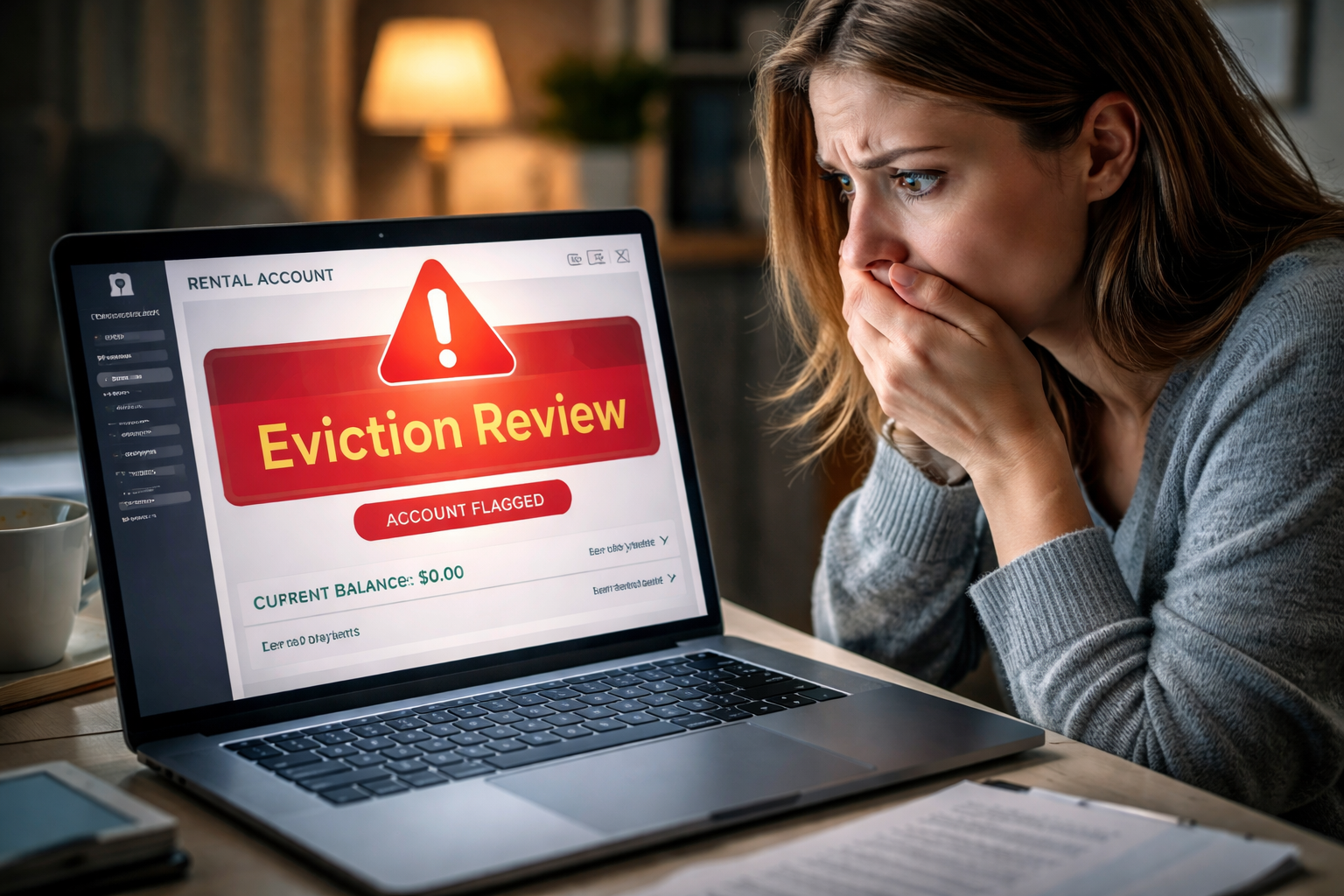
Tenant account flagged for eviction despite active lease compliance was the phrase that described what I was staring at before I fully understood how serious it was. It did not start with a sheriff notice taped to a door. It started with a portal message, a leasing office comment, or a balance screen that suddenly looked wrong. The lease was still active. The payments were current, or at least they were supposed to be. There had been no warning about a violation. But somehow the account had moved into a category that sounded much bigger than a simple billing error.
The reason this throws people off is that it does not feel like the usual kind of housing problem. If rent is late, at least the disagreement is obvious. If a lease ended, at least there is a date to point to. But when a tenant account flagged for eviction despite active lease compliance appears, the problem is often invisible at first because the system has already made an internal decision before anyone explains why. By the time you notice it, the issue may already be sitting in a delinquency queue, a legal review queue, or a property manager dashboard that treats your account as a risk.
If you want the closest background guide first, this hub explains how posting errors move through rent systems and why internal mismatches can snowball faster than tenants expect.
Why This Happens Before Anyone Talks to You
Most tenants assume an eviction-related label only appears after a person reviews the file and decides something is wrong. In many properties, that is not how it works. The first trigger is often automated. A rules engine or property management workflow checks account status at a specific cutoff time. If the system sees an unpaid balance, a broken payment plan, an unresolved chargeback, an unposted subsidy, a missing ledger correction, or a lease condition marked incomplete, the account may be moved to a collection or eviction-review status even if the real-world situation is more complicated.
That is why tenant account flagged for eviction despite active lease compliance can happen to people who never thought they were close to an eviction problem. The system may not be asking, “Did this tenant try to comply?” It may only be asking, “At the exact moment this account was evaluated, did the record show an unresolved default condition?” Those are very different questions. A tenant can be compliant in reality and still appear noncompliant in the software if the ledger, lease file, and workflow rules are out of sync.
This becomes even more likely in larger apartment operations where leasing, accounting, payment processing, and legal review are separated. A local manager may see one thing. Corporate accounting may see another. The portal may display a simplified version of the balance. The legal workflow may rely on an overnight export. None of those views are guaranteed to match in real time.
What “Active Lease Compliance” Usually Looks Like
People often use the phrase loosely, but for this issue it helps to think about active lease compliance in practical terms. Usually it means the lease is still in effect, there has been no signed move-out, no documented termination, no unresolved lease violation that was properly noticed, and no actual rent default that should have placed the file into an eviction pipeline. It can also include situations where rent support, a subsidy, or a pending correction should have prevented the account from being treated as delinquent.
So when tenant account flagged for eviction despite active lease compliance appears, you are dealing with a mismatch between the account narrative and the account coding. The story of the account says one thing, but the internal classification says another. That gap matters because staff often act on the classification first.
Quick self-check
Look at your situation and ask:
Is the lease still active right now?
Are you current under the payment arrangement that actually applies to your unit?
Did a recent payment, subsidy, ledger fix, or adjustment fail to reflect properly?
Has anyone given you a written notice explaining the exact reason for the eviction-related status?
If the answers are “yes, yes, yes, and no,” then the issue may be classification error rather than true lease default.
The Most Common Branches of This Problem
The phrase tenant account flagged for eviction despite active lease compliance can describe several different breakdowns. They look similar from the tenant side, but the fix is different depending on which branch you are in.
Branch 1: Payment timing mismatch
Your rent was initiated on time, but the landlord system measured delinquency before the payment moved from pending to posted. This is common when online payments are accepted close to cutoff, near weekends, or near month-end processing windows. The tenant thinks the obligation was satisfied. The workflow only sees that the balance existed when the snapshot ran.
Branch 2: Wrong allocation inside the ledger
The money was received, but it was applied to an older balance, a fee bucket, a concession reversal, a utility charge, or even another unit or resident code. From your perspective, the account should have been current. From the ledger perspective, current-month rent still appeared open.
Branch 3: Lease status mismatch
The lease remained active, but some internal field changed incorrectly. A failed renewal upload, resident transfer event, move-out preparation flag, or compliance review hold may have made the system behave as if the occupancy status was unstable. In that state, even a small unresolved charge can push the account toward legal review.
Branch 4: Assistance or third-party payment mismatch
Part of the rent was supposed to be covered by a housing agency, employer program, relocation support, or another payer. The funds may have been delayed, unapplied, attached to the wrong household identifier, or still sitting in suspense. The tenant stayed compliant with their share, but the account was still treated as short.
Branch 5: Reversal or return event after apparent success
A payment originally looked successful but later reversed, was marked NSF, or was clawed back by the processor. Sometimes the tenant never sees the reversal clearly. Sometimes the bank and landlord descriptions do not match. The account can move into a default queue before the tenant understands that the original credit no longer exists.
Branch 6: Human note did not stop automated workflow
A leasing agent may have written “resident is current” or promised that the issue would be fixed, but the legal or collections workflow kept moving because the note was not tied to the stop-code required by the system. This is one of the most frustrating versions because the tenant was told not to worry while the escalation continued.
What the Landlord Side May Be Thinking
It helps to understand the landlord side without assuming bad faith right away. Property staff are often judged by delinquency reports, aged receivables, and how quickly accounts move through policy steps. If the system says your account belongs in an eviction-review queue, the employee may not feel authorized to override it casually. In some operations, the person you speak to cannot change the ledger, cannot remove a legal code, and cannot see the full chain of events that created the problem.
That is why tenant account flagged for eviction despite active lease compliance can continue longer than it should. The person you reach may genuinely believe the matter is “just waiting to update,” while another department is already preparing the next step. Verbal reassurance is not the same as a corrected ledger or a removed escalation code.
If your situation overlaps with an incorrect unpaid label, this supporting article can help you compare the account behavior you are seeing.
How to Tell Whether You Are Early or Already Escalated
Not every internal flag means formal eviction has begun. But you do need to figure out where the account sits right now. There is a big difference between “internal review,” “pre-legal,” “notice pending,” “notice served,” and “file referred.” Tenants often lose time because they assume all of these labels mean the same thing.
Look for clues. Did the portal change wording? Did a balance suddenly include legal fees, filing fees, or notice fees? Did staff begin using phrases like “cannot accept partial payment” or “speak with legal”? Did you receive a pay-or-quit notice, cure notice, or written demand? These signs help show whether tenant account flagged for eviction despite active lease compliance is still an internal problem or has already crossed into formal action.
The earlier you identify the stage, the more options you usually have to correct the file before the record hardens. Once legal fees are added or a filing is made, even an obvious account error can take longer to unwind.
What to Ask For in Writing
This part matters more than most tenants realize. Do not ask only, “Can you fix this?” Ask for specific account records and specific confirmations. A good written request usually asks for the current ledger, the exact balance claimed due, the date the account was coded for escalation, the reason code or description used internally, and confirmation of whether any notice or filing has already been generated.
When tenant account flagged for eviction despite active lease compliance is the issue, your goal is not just to argue that you are right. Your goal is to identify the exact account field, balance line, timing event, or status code that made the system think you were not. Once you isolate that, the conversation gets more concrete and less emotional.
Ask for these items
Current full ledger, not just the resident portal balance
Date and reason the account was placed into eviction or legal review
Whether any notice has been generated, served, or only prepared
Whether any payment, subsidy, or adjustment is pending or in suspense
Written confirmation once the flag or code is removed
Mistakes That Make the File Worse
The biggest mistake is assuming payment proof alone will stop the process. It may prove something important, but it does not automatically correct the ledger category, remove a stop code, reverse a legal referral, or update a stale export. Another mistake is relying on a phone call with no written follow-up. Another is sending only screenshots from the tenant portal when the real issue sits in the backend ledger.
People also make things worse by arguing only at the fairness level. Fairness matters, but the staff member handling your request may respond better when you point to the operational mismatch: the lease is active, the account should not have been coded delinquent, the payment was applied incorrectly, the subsidy is unapplied, the fee bucket is wrong, or the notice pipeline must be paused until the record is corrected.
That is how you shift tenant account flagged for eviction despite active lease compliance from a vague complaint into a file that someone can actually repair.
The Immediate Action Plan
Start with the account record, not with a long story. Pull your lease, payment confirmations, assistance documents if any, portal screenshots, and all recent emails. Request the ledger and escalation reason in writing. Ask whether any notice has already been generated. Ask whether the account is coded for legal, pre-legal, collections, or eviction review. Then match their answer against your documents.
If the issue is timing, ask them to confirm the payment received date, posting date, and the date the delinquency snapshot was taken. If it is allocation, ask which charges your payment was applied to. If it is lease status, ask what status the lease record currently shows and whether any move-out, renewal, or transfer code is sitting open. If it is assistance, ask whether the third-party payment is pending, unapplied, or rejected. Specific questions expose specific breakdowns.
Near the end of this process, you may also want the next-step article below if the dispute starts moving toward notices, collections, or broader account damage.
Key Takeaways
Tenant account flagged for eviction despite active lease compliance is usually a classification problem before it is a courtroom problem.
The issue often begins when software evaluates a ledger snapshot, not when a person fully reviews your situation.
Lease compliance, payment compliance, and system classification are not always the same thing.
You need the full ledger, the escalation reason, and written confirmation of any correction.
The safest move is to force the account narrative and the account coding to match before the workflow advances.
FAQ
Does this always mean an eviction was filed?
No. Sometimes it is only an internal status, but you should verify that immediately rather than assume.
Can this happen even if my lease is still active?
Yes. An active lease does not prevent a bad ledger state or workflow trigger from pushing the account into review.
What if the office says it is just a mistake?
Get that in writing and ask whether the internal flag, code, or referral has already been removed.
Is a portal screenshot enough proof?
Usually not. The portal often shows less detail than the backend ledger that staff rely on.
What should I do first?
Request the full ledger, the reason for escalation, and confirmation of whether any notice or filing exists.
Tenant account flagged for eviction despite active lease compliance is the kind of problem that gets worse when you treat it like a harmless portal glitch. It may have started with one wrong field, one late sync, one unapplied credit, or one automated rule that ran at the wrong moment. But once the account is categorized the wrong way, other actions can stack on top of it quickly.
So act like the record matters, because it does. Pull the lease. Pull the ledger. Match the dates. Ask what code caused the escalation. Ask whether anything formal has already been generated. Then make them answer in writing. The goal is not just to calm the situation down. The goal is to correct the record before a wrong account status becomes a much bigger housing problem.
Official source for general renter rights background: HUD renter rights overview.