
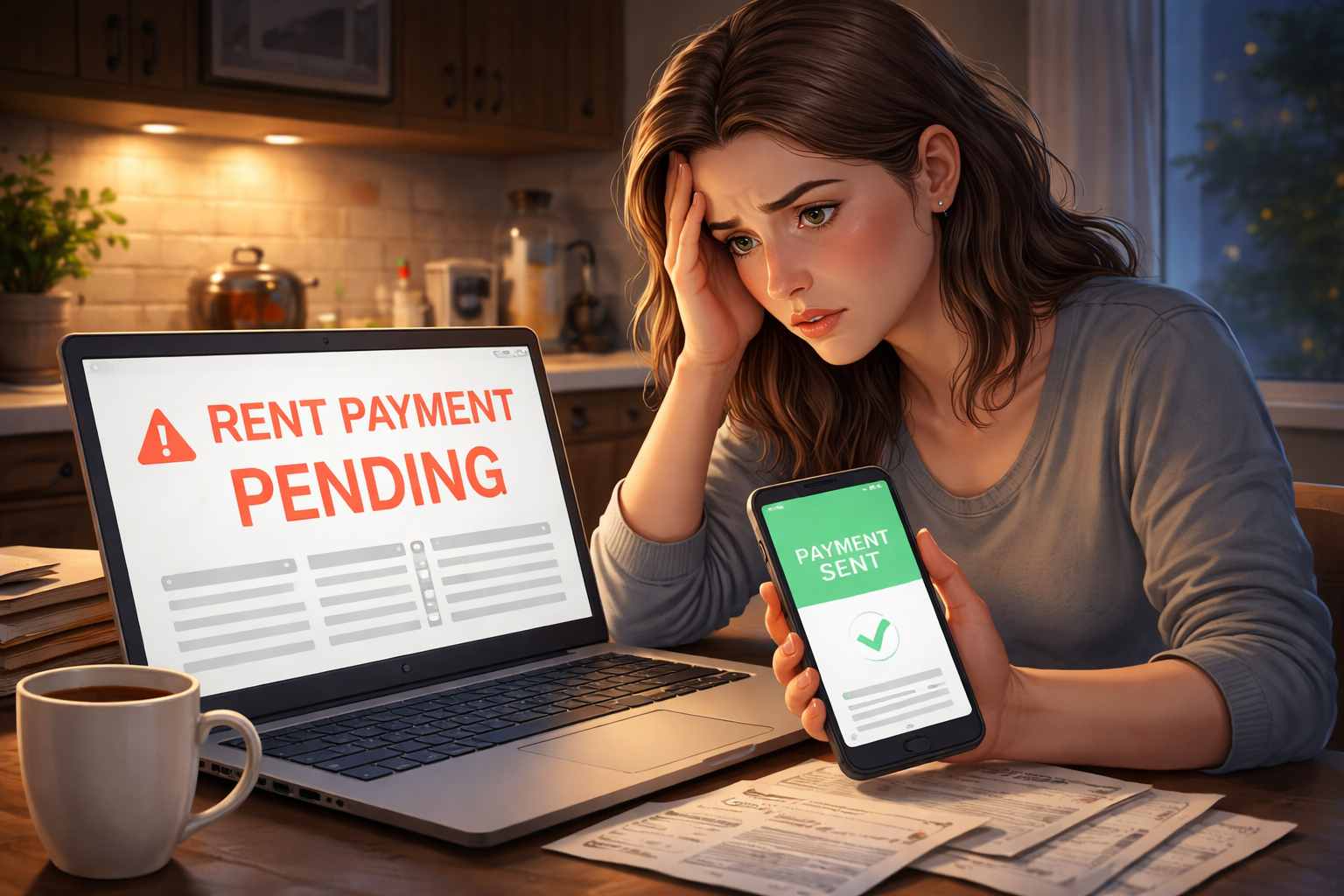
Rent payment processing delay is the phrase I ended up searching only after I stared at the tenant portal longer than I should have. I had already paid. I had the confirmation screen. The bank account showed the amount leaving. But the portal still showed the full balance due, and that small detail changed the whole mood of the day. The problem was no longer whether I had tried to pay. The problem was that the system still acted like I had not paid at all.
That is the moment this situation becomes serious. Not dramatic on the surface, but serious in the way rent problems always are. A payment that is “in process” can still trigger a late fee, a warning email, a pay-or-quit notice, a bad ledger entry, or an argument with management if nobody freezes the account or manually notes what happened. Rent payment processing delay feels temporary when you are the tenant, but many landlord systems do not treat it as temporary unless someone intervenes early and documents it clearly.
If you want the broader framework first, this hub explains how rent posting problems move through landlord systems and why tenants often get blamed for delays they did not create:
Why this delay feels small at first
At the beginning, rent payment processing delay often looks harmless. The portal may say “pending,” “submitted,” “processing,” or nothing at all. Your bank may show the charge as pending or completed. The leasing office may tell you to wait another day. None of that sounds like a crisis. But that calm period is exactly where tenants lose control of the timeline.
The danger is not the first hour. The danger is the gap between your proof of payment and the landlord’s ledger.
That gap matters because landlords usually act off the ledger, not off your bank screenshot. If the internal ledger still says unpaid, their staff may proceed as though the rent is late. That can happen even when the payment is on its way, even when the money has already moved, and even when nobody is trying to do anything wrong.
What is actually happening behind the scenes
Rent payment processing delay usually happens between separate systems that do not update at the same speed. Tenants often imagine one straight line: click pay, money moves, rent posts. Real systems are messier than that.
In many properties, the payment passes through several layers:
- Your bank account or card issuer
- An ACH network or card network
- A third-party rent payment processor
- The landlord’s property management software
- The rent ledger or resident portal display
Every handoff creates another chance for delay. One system may confirm receipt while another still waits for settlement. One platform may show a payment token while the ledger waits for batch posting overnight. One processor may hold the transaction for review while the bank already shows the money moving.
This is why a tenant can be telling the truth, the landlord can also be describing what they see truthfully, and the account can still be wrong at the same time.
The most common versions of rent payment processing delay
Paid after cutoff time
You paid on the due date, but after the processor’s daily cutoff. The transaction may not begin formal processing until the next business day, which can create a late-looking balance even though you acted on time.
Weekend or holiday hold
You paid Friday night, on a holiday, or during a long weekend. The resident portal may accept the payment immediately while the banking side does not start full processing until normal business operations resume.
ACH debit in transit
Your bank shows a deduction or pending debit, but settlement is still moving through ACH timing. The landlord system may not recognize the payment as final yet.
Card authorization without final posting
A card payment may show authorization first, but the rent ledger may wait for final capture or settlement before updating the balance due.
Fraud or risk screening
A processor flags something unusual: amount size, account pattern, location mismatch, repeated attempts, changed bank details, or suspicious timing. The transaction can be paused even though the tenant only sees “submitted.”
Portal accepted, ledger not updated
The payment portal recorded the transaction, but the property management system has not synced or posted the entry to the tenant ledger yet.
Manual review backlog at management office
Some payments, especially assistance-related or irregular payments, may require staff review before being matched to the account correctly.
All of these are forms of rent payment processing delay, but they do not create the same risk. Some clear on their own within hours. Some cause late fees, notice generation, or misapplied balances unless someone steps in quickly.
How to tell which version you are in
You do not need a perfect technical diagnosis on day one, but you do need enough information to know what kind of delay you are dealing with.
- If your bank only shows “pending,” the payment may not have fully settled yet.
- If your bank shows completed but the portal still shows due, the issue may be posting or sync.
- If the portal says processing for more than two business days, that is no longer a routine same-day delay.
- If management says they see nothing at all, the transaction may still be upstream at the processor or banking level.
- If you received a confirmation number, that means you have proof of initiation, not necessarily proof of final ledger posting.
The key is to stop asking only “Did I pay?” and start asking “Which system still has not recognized the payment?”
What landlords usually see during this problem
Tenants often assume management can see whatever the tenant sees. That is usually false. In many buildings, the leasing office only trusts the accounting ledger or property management dashboard. If the ledger still shows the charge unpaid, staff may not treat the rent as received. They may not see your bank status. They may not see your payment processor screen. They may only see an open balance and an aging rule.
That matters because rent systems are often automated around dates. A balance that remains open past a trigger point can create:
- Automatic late fees
- Collections flags
- Pay-or-quit notices
- Internal delinquency notes
- A resident account hold or escalation
This does not always mean the landlord is acting maliciously. Sometimes the system is simply doing what it was configured to do. But the effect on the tenant is the same. If nobody interrupts the bad data early, the account starts building consequences on top of a payment that may already be moving correctly.
What you should do in the first hour
The first response matters more than most tenants realize. Do not wait silently and hope the ledger catches up before anyone notices. That passive approach is what turns a routine rent payment processing delay into a more expensive problem.
Start with a clean evidence set:
- Screenshot the payment confirmation screen
- Save the confirmation number
- Download or screenshot the bank transaction
- Capture the tenant portal showing the balance still due
- Note the exact date and time you submitted payment
Then send a short written notice to the property manager or leasing office. Keep it factual. Include the amount, submission time, payment method, and confirmation ID. Ask them to note the account and hold any automated penalty action until the payment finishes processing.
You are not trying to win an argument in that first message. You are creating a timestamped paper trail before the system hardens against you.
When the delay is probably normal
Not every rent payment processing delay means something is wrong. There are situations where a short wait is expected.
Usually normal
- Payment made late Friday evening
- Payment made on a bank holiday
- ACH payment submitted and less than two business days have passed
- Portal shows processing but no negative action has started yet
- Management acknowledges the payment is in transit
In these situations, you still document everything, but you may be looking at a timing issue rather than a broken system.
When the delay is becoming dangerous
The tone changes when the account starts generating consequences while the payment is still in limbo. That is when rent payment processing delay moves from inconvenience to account-risk problem.
Danger signs
- More than three business days have passed
- The portal still shows full balance due
- A late fee appears
- You receive a demand, warning, or pay-or-quit notice
- Management says no payment exists despite your proof
- You are told to pay again before the first payment is resolved
If you are in that group, you need escalation, not just patience.
If your portal shows a posted-looking payment but the balance is still wrong, this related guide can help you separate a processing problem from a ledger problem:
Mistakes that make the account worse
The most common bad move is sending a second payment too early. Tenants panic when management says unpaid, so they submit another payment to avoid fees or notices. Then the original payment posts later, and the tenant ends up overpaying, chasing refunds, or fighting to reverse fees and misapplied credits.
Another bad move is making everything verbal. A phone call can be useful, but if there is no email or portal message confirming what happened, you lose the record that often matters most later.
A third mistake is arguing only from emotion. Saying “I already paid” is understandable but incomplete. The stronger position is: payment initiated on this date, confirmation number attached, bank proof attached, request to freeze penalties pending completion.
In rent disputes, the side with the cleaner timeline usually has the advantage.
What tenant rights issues can appear here
Because landlord-tenant rules vary by state and city, the safest approach is to focus on documented account treatment rather than broad legal claims. In practical terms, tenants generally need to protect themselves against incorrect fees, incorrect notices, and incorrect nonpayment records when a payment is already in motion.
That means your immediate goal is not to make the biggest legal argument. Your immediate goal is to stop the account from being treated like a real nonpayment when the facts show the transaction is already underway.
For general tenant rights and protections, you can review official federal housing guidance from the U.S. Department of Housing and Urban Development (HUD):
How to escalate without losing credibility
If the payment is still unresolved after a reasonable processing window, escalate in layers.
- Ask the property office to verify whether the processor sent a payment token or batch file
- Ask whether the account can be manually noted to prevent automatic fees
- Contact the payment processor or bank for settlement status
- Send a follow-up email summarizing what each side said
- Ask for a corrected ledger once the payment posts
Stay specific. Avoid vague statements like “your system is broken.” Use trackable facts. Date paid. Amount. Confirmation ID. Bank status. Current ledger status. Requested action.
If management says the money never arrived
That is a different level of problem. Once management denies receipt entirely, you may be moving beyond a simple processing lag into a receipt, posting, or processor handoff issue. At that point, the conversation should shift from “please wait” to “please investigate this transaction against the account.”
If you are now hearing that the rent was never received even though your bank shows movement, read this next before the situation expands:
Key Takeaways
- Rent payment processing delay is often a handoff problem between systems, not proof that you failed to pay.
- Bank movement and ledger posting are not the same event.
- Short delays can be normal, especially around cutoffs, weekends, and ACH timing.
- Once fees, notices, or repeated denials appear, the issue is no longer routine.
- Early written documentation is one of the best ways to protect the account.
- Do not send a second payment until the first one is clearly traced.
FAQ
How long should rent payment processing delay last?
Many routine delays clear within one to three business days, especially for ACH. Longer than that deserves direct follow-up and documentation.
Can a landlord still charge a late fee during rent payment processing delay?
In practice, it can happen if the ledger still shows unpaid. That is why early notice and written proof matter so much.
Does a confirmation screen prove the landlord received the rent?
Not always. It usually proves the payment was initiated, not that it fully settled and posted to the ledger.
Should I pay again if the portal still says due?
Usually no, not until the first transaction is traced clearly. A second payment can create overpayment and a harder accounting mess.
What is the biggest risk here?
The biggest risk is not just delay. It is automated account action based on an incorrect unpaid balance while your payment is still moving through the system.
Rent payment processing delay is the kind of problem that tricks people into waiting because it looks temporary. Sometimes it is temporary. But a temporary delay can still create permanent account damage if the ledger keeps moving in the wrong direction while you stay silent.
So do this now: save your proof, notify management in writing, request that fees or notices be paused, and trace the payment through the exact system that has not updated yet. That is the move that keeps a processing delay from turning into a rent dispute you never should have had in the first place.