
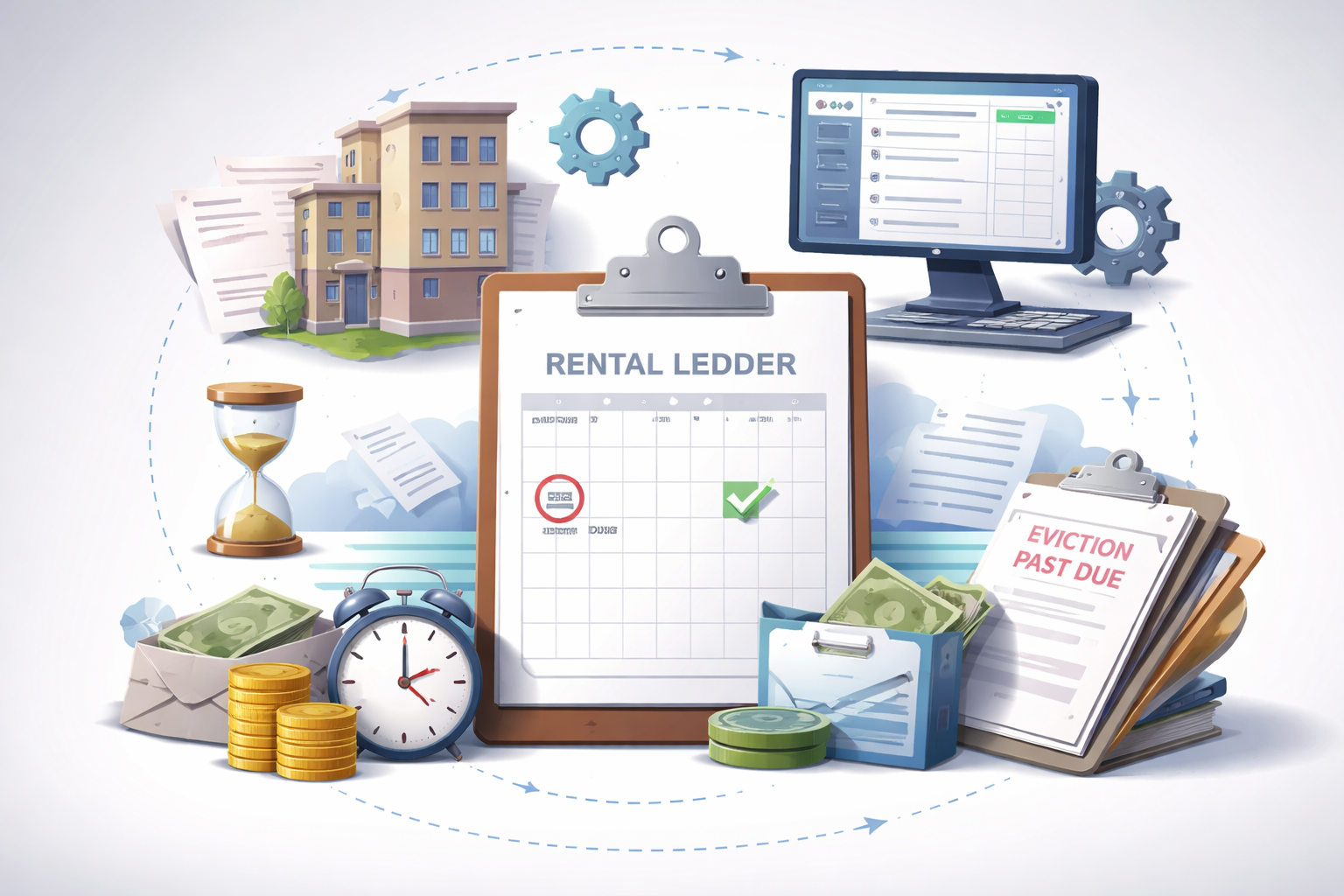
How Rent Payment Grace Periods Are Applied and Tracked Across Landlord Systems is not a narrow question about whether rent was paid on the first, the third, or the fifth day of the month. In most U.S. landlord platforms, grace periods are handled as system states tied to lease rules, posting logic, ledger status, and downstream collection workflows. That is why a tenant-facing portal can show one thing while the internal account status reflects something more restrictive.
At the surface level, a grace period looks simple. A lease says rent is due on one date and late after another. But landlord systems do not usually operate from surface language alone. They convert lease wording into due-date objects, delinquency thresholds, charge sequencing rules, and timestamp comparisons. The operational question is rarely “Was a payment made?” and more often “What account state existed at the exact system checkpoint that controls late status?”
How Rent Payment Grace Periods Are Applied and Tracked Across Landlord Systems also varies by platform design. Some property management systems evaluate late status in daily batches. Others evaluate it in near real time. Some use payment initiation time for certain internal notes but rely on ledger posting time for fee assessment. Some treat weekends differently; others do not. The result is that grace periods are less like static waiting periods and more like rule-controlled timing windows inside a billing system.
This makes the topic structurally different from articles focused on a single dispute outcome. A payment-posting article usually looks at whether money reached the right account. A late-fee article usually looks at whether a charge was appropriate. An eviction article usually looks at notice timing. By contrast, How Rent Payment Grace Periods Are Applied and Tracked Across Landlord Systems sits above those outcomes and explains the timing framework that makes those outcomes possible.
How rent payment posting errors happen and what tenants should do next
Rent payment posted to portal but balance still shows due
Late fee charged in error for rent
Pay or quit notice after online rent payment
Rent payment pending but landlord says unpaid
Key Takeaways
How Rent Payment Grace Periods Are Applied and Tracked Across Landlord Systems depends on more than one date or one visible payment event. Most landlord platforms compare lease-based deadlines against internal timestamps, ledger status, and allocation rules. A grace period is usually enforced through system logic, not informal interpretation.
In practice, that means five things matter more than many tenants expect: the exact lease rule loaded into the system, the timestamp the platform treats as authoritative, whether the payment posted or only entered a pending state, whether the money satisfied current rent or some other balance bucket, and whether the delinquency engine had already advanced the account to the next status tier. Those design choices explain why timing disputes can emerge even when the visible facts seem straightforward.
Lease Rules Are Converted Into Billing Logic Before the Grace Period Ever Starts
How Rent Payment Grace Periods Are Applied and Tracked Across Landlord Systems begins with configuration, not with payment. Before any rent cycle opens, the platform has usually been given a lease rule set that includes rent due date, recurring charge amount, grace period length, late fee method, and escalation sequence. What appears in the lease as ordinary language is converted into system fields that define how the account behaves each month.
That conversion matters because systems do not enforce lease text directly. They enforce structured values. A lease might say rent is due on the first and late after the fifth, but the platform may store that as due date = 1, grace days = 4, cutoff time = 11:59 p.m. local time, late fee rule = flat fee or percentage, and delinquency status trigger = next calendar checkpoint. Once the lease language becomes structured billing data, the system follows its configured logic consistently even when the tenant experience feels inconsistent.
Many portfolios also do not use identical lease templates across all units. A large management company may have different grace period configurations for market-rate units, affordable housing units, subsidized units, or inherited properties from acquisitions. That means two tenants in the same city can experience different timing behavior even if the due date appears similar on the surface.
Actual example: One building uses a 3-day grace period with same-day late assessment after cutoff. Another uses a 5-day grace period with overnight batch evaluation. Both appear to have similar rent terms but produce different late-status timing.
What to Understand
Lease wording is only the starting point. The system actually acts on configured due dates, grace-day counts, cutoff rules, and escalation settings loaded into the billing platform.
The System Clock Does Not Always Match the Tenant’s Clock
How Rent Payment Grace Periods Are Applied and Tracked Across Landlord Systems depends on which clock the platform treats as authoritative. A tenant may think in calendar days and visible submission time. The platform may think in business-day cutoffs, server timezone, batch closure time, or posting date. That gap is one of the main reasons grace period disputes feel confusing.
In many systems, the relevant timestamp is not when a resident clicked “submit.” It is the timestamp that the payment processor returned, the timestamp the property ledger accepted, or the timestamp the delinquency engine checked the account. Each of those can differ by hours, and sometimes by a full day if a batch closed before the payment entered the reconciliation file.
This is one of the most important structural points: grace periods are enforced against the system’s recognized time marker, not the tenant’s subjective sense of having acted before the deadline. Even when both parties are describing the same transaction, they may be referring to different timing events.
For online portals, this distinction is even sharper. A confirmation email can be generated immediately, while actual ledger recognition occurs later. The resident sees proof of action. The system still sees an account awaiting posted funds.
Actual example: Rent is submitted at 10:42 p.m. on the final grace-period day. The portal issues confirmation instantly. The processor batch closes after 10:00 p.m., so the ledger marks the item for next-day posting.
What to Check
The relevant timing question is not only “When was payment made?” but also “Which system timestamp controls grace-period compliance in this platform?”
Posting Pipelines Separate Payment Initiation From Ledger Recognition
How Rent Payment Grace Periods Are Applied and Tracked Across Landlord Systems becomes clearer once the payment pipeline is separated into stages. A modern rent transaction may pass through authorization, risk screening, ACH origination or card capture, gateway acknowledgment, property ledger import, and final posting. These are not cosmetic steps. Each stage can affect whether the account is viewed as current, pending, or delinquent.
Landlord systems generally care most about the stage that changes ledger status. If a payment is authorized but not yet posted, the account can remain open for delinquency evaluation. If a transaction is pending external confirmation, the portal may display activity without removing the unpaid-rent flag from the internal account state. Grace-period tracking is usually tied to posted accounting events, not merely to transaction intent.
ACH transactions make this especially visible because they often do not settle instantly. Card payments may authorize quickly but still be subject to processor timing, fraud review, or batch close rules. Cash equivalents, money orders, and certified funds may enter through manual workflows that depend on staff posting discipline.
This structural design explains why the same rent amount can be “received,” “recorded,” and “posted” at different times inside the same system. Those are not interchangeable labels. They describe different process stages.
Actual example: A resident initiates ACH on day 5 of a 5-day grace period. The processor marks it accepted, but the property ledger does not post until day 6 after overnight import.
Property manager says rent not posted to account
Landlord says rent was never received but bank shows payment
Late Fee Engines Evaluate Account State, Not Just Payment Presence
How Rent Payment Grace Periods Are Applied and Tracked Across Landlord Systems is closely tied to late fee design. A late fee engine does not usually ask only whether there was a payment. It asks whether the account was still in a collectible rent-due state at the evaluation checkpoint. That means the system looks at outstanding rent, allocation order, and status category at the moment the grace period closes.
Some systems assess late fees once, immediately after the grace period. Others assess only after the first delinquency batch. Some apply flat fees; others apply percentages capped by local rules. But the common structure is that the engine reads the account state after applying its own payment-allocation logic.
If funds were present but routed to prior balances, fees, concessions reversal buckets, or non-rent charges, the current rent line can remain open and the late fee engine can still classify the account as late. That is why grace-period tracking cannot be understood without also understanding balance hierarchy.
In practice, this means tenants often focus on total dollars paid while the system focuses on which charge code remained unsatisfied at cutoff. Those are not the same inquiry.
Actual example: A resident pays an amount equal to monthly rent, but the system first satisfies a prior month utility reimbursement and a ledger fee, leaving the current month rent partially open at the grace-period checkpoint.
What to Understand
Late fees are commonly tied to unpaid current-rent status, not simply to whether money entered the account during the grace period window.
Partial Payments Interact With Grace Period Rules in Highly Structured Ways
How Rent Payment Grace Periods Are Applied and Tracked Across Landlord Systems becomes more technical when partial payments are allowed, restricted, or auto-reallocated. A platform may accept a partial payment operationally while still treating the account as unpaid for grace-period purposes. That difference is built into rule design.
Some landlords allow partial acceptance but do not suspend late-fee assessment. Some reject partial payments electronically if the amount does not meet a configured minimum. Others accept them and apply them to the oldest open balance first. In each design, the grace period clock continues according to rule.
A partial payment is usually an account event, not a grace-period reset event. Unless the system is specifically configured to pause delinquency or create a payment arrangement state, the grace-period logic typically continues running toward the standard cutoff.
This is why a payment can appear meaningful from a cash-flow perspective yet have limited impact on internal timing status. The system recognizes money, but it may not recognize cure of the current rent obligation.
Actual example: A tenant pays 70 percent of rent within the grace period. The system accepts the payment but keeps the remaining 30 percent coded as unpaid current rent, triggering late status once the checkpoint passes.
Landlord applied partial payment but still charged full late fee
Landlord applied rent payment to old balance instead of current month
Weekends, Holidays, and Batch Schedules Create Edge Cases That Look Inconsistent
How Rent Payment Grace Periods Are Applied and Tracked Across Landlord Systems often looks inconsistent around weekends and holidays because the billing engine and the banking system do not always move together. A grace period may be defined in calendar days, while posting activity depends on business-day processing. That difference creates edge cases even when the rules were applied exactly as configured.
Some platforms extend deadlines when the final grace day lands on a non-business day. Others do not extend the grace period but delay specific downstream actions. Still others allow payments to be initiated on weekends while holding ledger posting until the next business morning. Each design can produce a different account history from the same tenant behavior.
Edge cases are not necessarily system errors. They are often the result of two valid timing frameworks operating at once: contractual deadline logic and operational posting logic.
Because of that, batch schedules matter more than many people assume. A nightly delinquency job that runs at 1:00 a.m. can move an account into late status before a morning posting file arrives, even if the resident believed the weekend submission solved the problem.
Actual example: Grace period ends Sunday. The resident submits payment late Sunday afternoon. The ACH file is not imported until Monday. The delinquency batch closes the Sunday account state first.
What to Check
Calendar treatment, batch close time, banking-day dependency, and whether the platform uses submission time or posted time at the cutoff all shape the final result.
Grace Period Expiration and Delinquency Escalation Are Related but Not Identical
How Rent Payment Grace Periods Are Applied and Tracked Across Landlord Systems does not end once the grace window closes. After that checkpoint, the account usually moves into a delinquency framework that may include late charges, notices, collection flags, legal review queues, or eviction-related milestones. But those later steps are distinct from grace-period tracking itself.
This distinction matters because many dispute narratives merge them into a single event. In reality, the system usually treats them as separate states. Grace period expiration changes the account from current to late-eligible or delinquent. A different ruleset then determines whether notices issue, whether legal status advances, and whether collections reporting begins later.
Grace period expiration is a status transition, not the full enforcement sequence. That status transition can exist even before any visible notice is generated.
For system design purposes, this means a payment can arrive after grace expiration but before further escalation. The account history can then show both a late-state event and a later posting event without contradiction. The system is recording sequence, not making a narrative judgment.
Actual example: Rent posts on day 7. The grace period expired on day 5. The system records late-fee eligibility on day 6 and payment receipt on day 7, leaving both events in the ledger history.
Rent payment posted after eviction filing
Landlord filed eviction but rent was paid
Portal Displays Often Simplify the Underlying Ledger and Hide Timing Nuance
How Rent Payment Grace Periods Are Applied and Tracked Across Landlord Systems is often misunderstood because the resident portal is a simplified interface. Portals are built for usability. Ledgers are built for accounting control. The portal may show current balance, recent payment activity, and one or two alert messages. The ledger may contain pending items, reversed entries, imported batches, charge-code categories, and audit notes that the resident never sees.
Because of that design gap, the resident-facing portal can suggest that the rent issue is resolved even while the internal billing engine still sees a pending or not-yet-cured condition. This is especially common where the platform displays “payment received” before the payment has fully changed the account’s delinquency state.
The portal is a communication layer, not always the authoritative accounting layer used for grace-period enforcement. That is why portal screenshots alone do not always explain late-fee timing.
Some platforms also cache balances or refresh on delay intervals, which means the visible account summary may lag behind actual ledger movement by hours. That lag becomes more important near grace-period deadlines and end-of-day batch windows.
Actual example: The resident portal displays a zero-dollar pending payment note, but the internal ledger still lists current rent as open until the nightly posting cycle completes.
Reversals, Returns, and Audit Trails Can Retroactively Change the Timing Story
How Rent Payment Grace Periods Are Applied and Tracked Across Landlord Systems does not always end with successful posting. Transactions can be reversed, returned, rejected, or charged back. When that happens, the system may revisit the account history and restore delinquent status based on final settlement outcome rather than initial apparent success.
This is why audit trails matter. A well-designed landlord platform preserves the sequence: payment initiated, accepted, posted, reversed, returned, or reapplied. Those events are not just for back-office review. They determine whether the system ultimately treats a grace-period condition as satisfied or unsatisfied.
A payment that looked timely at first can stop counting as an effective grace-period cure if the final settlement event fails. This is not a contradiction inside the system; it is the result of the ledger moving from provisional recognition to final recognition.
That logic is particularly relevant for ACH returns and payment reversals. The resident may focus on the original transaction date. The system, by contrast, updates the account when the returned-payment event reaches final status.
Actual example: Payment is shown as received within the grace period, but the bank later returns the ACH. The system reverses the posting and reinstates late-account status based on the failed settlement.
Rent payment marked as returned after clearing bank
Landlord charged back rent after accepting payment
Why This Topic Stands Apart From Individual Rent Dispute Articles
How Rent Payment Grace Periods Are Applied and Tracked Across Landlord Systems is best understood as a framework article, not as a narrow scenario post. It is not primarily about whether a specific late fee was fair, whether an eviction notice came too soon, or whether a payment should have been allocated differently. Those are downstream dispute topics already addressed in other articles.
This article sits at a higher structural level. It explains how a landlord platform turns lease terms into timing logic, how that logic interacts with posting pipelines, how delinquency states are advanced, and why edge cases appear around processing cutoffs. That makes it useful as an authority page that supports many of the narrower scenario pages already on the site.
Its distinct value is that it explains the system architecture behind multiple rent-payment disputes instead of repeating the facts of any single dispute pattern. From an indexing perspective, that separation helps because the article answers a broader systems question than the existing case-based posts.
For a general reference point, the U.S. Department of Housing and Urban Development provides a general overview of tenant-rights concepts that helps frame how timing and housing obligations can operate within formal rental rules.
Closing Structural Summary
How Rent Payment Grace Periods Are Applied and Tracked Across Landlord Systems is ultimately a timing-and-status issue, not simply a payment issue. The controlling variables usually include lease configuration, authoritative timestamp selection, ledger posting stage, allocation hierarchy, late-fee rule design, and delinquency batch timing. When those variables are understood together, many rent timing disputes become more legible at the system level.
That is why similar transactions can produce different results across properties or platforms. A payment made on the same calendar day can be compliant in one system and late in another because the systems are comparing different timing events or different ledger states. In other words, the grace period is not just counted. It is computed, tracked, and enforced through a chain of operational decisions embedded in the landlord platform.
Rent payment applied to wrong unit explained
How unpaid rent is reported and sent to collections