
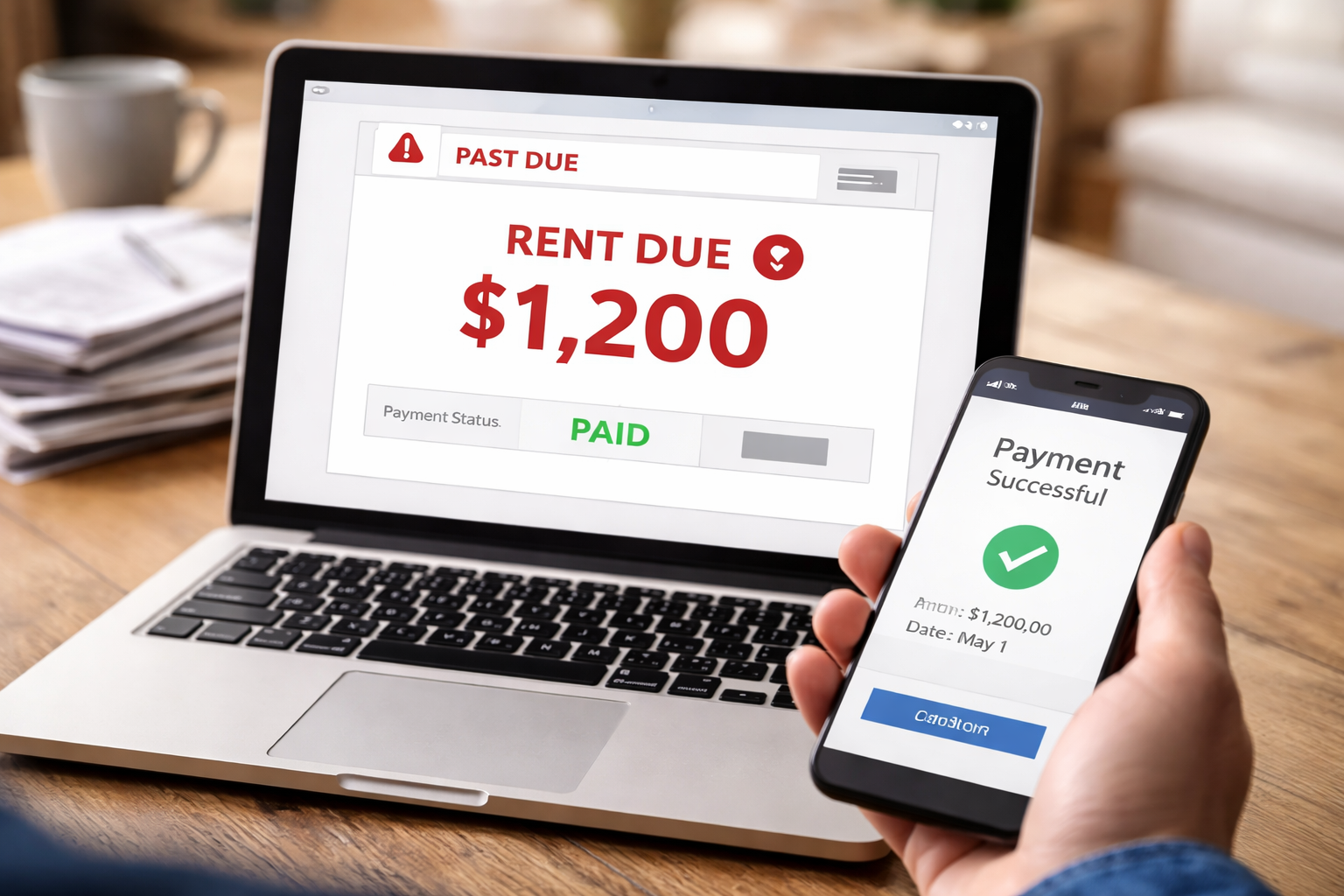
Rent Payment Accepted but Not Reflected Due to Processing Cutoff Timing was the first thing I thought when I saw the portal screen freeze on the same balance after I had already paid. The confirmation email was there. The payment page had moved to “accepted.” My bank app showed the transaction. But the account itself still looked like I had done nothing. The due amount stayed in red, the deadline stayed the same, and the late fee warning sat there like the system was waiting to punish me anyway.
I refreshed more times than I want to admit. Then I opened the payment receipt again just to make sure I had not missed something obvious. Same timestamp. Same amount. Same property name. It was one of those moments where the problem is not dramatic on the surface, but you instantly know it can turn into one. Rent Payment Accepted but Not Reflected Due to Processing Cutoff Timing is exactly the kind of issue that can quietly become a late fee dispute, a ledger mismatch, or even an eviction notice problem if you wait too long for the system to catch up.
Rent Payment Accepted but Not Reflected Due to Processing Cutoff Timing usually begins in a narrow gap between authorization and ledger posting. That gap is where tenants get confused, managers rely on incomplete screens, and automated rules keep moving even though the money has already started moving too. The most important thing to understand is that an accepted payment and a posted rent payment are not always the same event inside landlord systems.
If you want the broader framework first, this hub explains how rent posting problems often begin, how they spread across account records, and why the visible portal status can lag behind the actual money movement:
Why “Accepted” Is Not the Same as “Posted”
Rent Payment Accepted but Not Reflected Due to Processing Cutoff Timing happens because most property systems do not move money in one step. First, the system receives your payment request. Then it validates the method. Then it marks the payment as accepted or submitted. Only after that does the money get pushed into a posting queue, settlement file, or daily batch that updates the rent ledger.
That means you can have four different statuses floating around at the same time:
- your bank shows pending or completed,
- the payment processor shows accepted,
- the tenant portal shows submitted,
- the landlord ledger still shows unpaid rent.
When tenants think the problem is “the system lost my payment,” the real issue is often that the payment is sitting between systems rather than missing entirely.
This is why Rent Payment Accepted but Not Reflected Due to Processing Cutoff Timing is different from a bounced payment or a rejected payment. Your money may have started moving correctly. It just has not reached the system that controls your balance, fees, and compliance deadlines.
How Processing Cutoff Timing Creates the Delay
Processing cutoffs are invisible to most renters. Landlords usually do not advertise them clearly, and tenant portals rarely explain them in a way that matters at the moment you pay. But those cutoffs shape how fast your payment actually hits the ledger.
Many systems have daily internal deadlines. If you pay before that cutoff, the payment may be included in the same day’s posting run. If you pay after it, the payment gets moved into the next run. That can push a same-day payment into next-day posting. If the next day is a weekend or holiday, the delay can get longer.
Rent Payment Accepted but Not Reflected Due to Processing Cutoff Timing often shows up in these patterns:
- payment made on the due date in the evening,
- payment made on a Friday night,
- payment made before a holiday weekend,
- ACH payment initiated late in the day,
- high-volume payment periods such as the 1st through 5th of the month.
The portal may make the payment feel immediate, but the accounting side may still be operating on batch logic from an earlier era.
The Real Risk Is Not the Delay Itself
The worst part of Rent Payment Accepted but Not Reflected Due to Processing Cutoff Timing is not that the balance stays visible for a few more hours. The real problem is what other automated rules do while that balance remains open.
Property systems can trigger:
- late fees,
- default notices,
- pay-or-quit notices,
- internal delinquency flags,
- collection workflow prep,
- manual review by a leasing office or manager.
If those rules run off the ledger and the ledger has not updated yet, the system may treat you as late even though your payment was accepted. Rent Payment Accepted but Not Reflected Due to Processing Cutoff Timing becomes serious when the posting delay overlaps with a lease deadline or an enforcement timeline.
In many rental systems, the payment interface and the enforcement interface do not move at the same speed.
Detailed Case Breakdown
Case A — Same-Day Evening Payment
You paid on the due date, but after normal business hours. The processor accepted the payment immediately, yet the rent ledger did not update the same night. This is one of the most common versions of Rent Payment Accepted but Not Reflected Due to Processing Cutoff Timing. The danger here is that the tenant assumes “same day” means “on time” in every system. But some landlord systems care about posting date, not payment initiation timestamp.
Case B — Friday Night or Weekend Payment
You paid late Friday, Saturday, or Sunday. The portal accepted it, but ledger posting may wait until Monday or even Tuesday depending on the processing method. This version creates the biggest emotional whiplash because the payment looks successful, but the balance stays visible across multiple calendar days.
Case C — ACH Accepted, Settlement Delayed
You used bank transfer or ACH. The processor confirmed submission, but the settlement window remained open. The property software may not apply rent until the ACH reaches a later stage. This often creates a longer gap than card payments, especially around holidays or banking slowdowns.
Case D — Portal Accepted, Ledger Sync Failed
The payment was accepted correctly, but the portal and the accounting ledger did not synchronize properly. Here, Rent Payment Accepted but Not Reflected Due to Processing Cutoff Timing starts looking like a timing issue but turns into a technical posting issue after 24 to 48 hours.
Case E — Payment Sat in a Batch Queue
During high-volume periods, accepted payments may wait in a large posting queue. This is common in larger apartment portfolios that process many units through a centralized accounting platform. The payment is real, but the queue is slow.
Case F — Balance Updated Internally but Not in the Portal
Sometimes the manager-side ledger updates first, while the tenant-facing screen lags behind. This creates conflicting information. You may be safe internally even though the portal still looks wrong. But you should never assume that without written confirmation.
Case G — Payment Applied After Fee Assessment
The system accepted your payment but assessed the late fee before the posting run completed. When the rent finally posted, the fee remained attached. This often leads tenants to think the payment posted incorrectly, when in reality the order of automated events caused the issue.
Case H — Payment Accepted Before a Notice, But Notice Still Generated
The account had not updated before the notice workflow ran. As a result, you receive a pay-or-quit notice or delinquency message even though the payment had already been accepted. This is one of the most dangerous versions because paperwork begins moving before the ledger catches up.
Rent Payment Accepted but Not Reflected Due to Processing Cutoff Timing can look identical on the front end while coming from very different back-end causes. That is why you should diagnose the timing pattern first before deciding whether you are dealing with a normal delay, a posting problem, or a dispute issue.
What the Property Manager Is Probably Looking At
Tenants usually focus on the confirmation screen and the bank charge. Property managers usually focus on the ledger, delinquency dashboard, and transaction history inside their management software. Those are not always synchronized in real time.
When you call or email, the manager may see:
- no posted rent credit yet,
- an account still marked delinquent,
- a pending transaction note with no ledger effect,
- no override on fees,
- an automated notice already queued.
That is why some managers respond with frustrating language like “we do not show payment yet” even when your bank clearly shows money moving. Rent Payment Accepted but Not Reflected Due to Processing Cutoff Timing is partly a system issue and partly a visibility issue. They may not be denying your proof. They may be looking at a screen that has not caught up.
The person answering you may not have direct control over batch posting or processor settlement, but they do control whether your documentation gets attached to the account record.
What To Do in the First Hour
If you are dealing with Rent Payment Accepted but Not Reflected Due to Processing Cutoff Timing, the first hour matters more than people realize. This is when you preserve the evidence that later proves the timeline.
- Save the payment confirmation page.
- Screenshot the timestamp, amount, and method used.
- Save the confirmation email or text.
- Screenshot your bank or card transaction.
- Take a screenshot of the portal balance still showing due.
Then send a short written message to the landlord or property manager stating that the payment was accepted, include the timestamp, and attach proof. Keep the tone factual. Do not over-argue. Do not speculate. Do not accuse anyone of fraud unless the facts truly support that later.
Your immediate goal is not to win an argument. Your goal is to lock the timeline into the written account record before the system creates fees or notices.
What To Do After 24 Hours
If Rent Payment Accepted but Not Reflected Due to Processing Cutoff Timing is still unresolved after 24 hours, begin sorting it by payment type and calendar context.
- If you paid late in the day, check whether the next business day has passed.
- If it was a weekend or holiday, measure by business days, not calendar days.
- If it was ACH, allow for settlement lag but continue documenting.
- If fees or notices appeared, dispute those in writing immediately even if you are still waiting on posting.
At this stage, ask the manager one precise question: whether the payment is pending in processing, missing from the ledger, or under review. That distinction matters.
If the portal says posted but the balance remains wrong, this related guide helps you move into the next layer of the problem without confusing it with a simple timing delay:
When This Stops Being a Timing Issue
Not every case of Rent Payment Accepted but Not Reflected Due to Processing Cutoff Timing stays in the timing category. Sometimes the delay reveals a deeper problem.
It may no longer be just cutoff timing when:
- the balance is still wrong after 48 hours on a normal business week,
- the payment was applied to fees or an old balance instead of current rent,
- the payment vanished from the portal history,
- the landlord claims there is no record despite your confirmation receipt,
- the payment later shows returned or reversed without explanation.
At that point, you may be dealing with misapplication, ledger error, processor reversal, or internal reconciliation failure. Rent Payment Accepted but Not Reflected Due to Processing Cutoff Timing can be the opening symptom of a larger account problem, which is why documenting early matters so much.
Mistakes That Quietly Damage Your Position
There are several mistakes tenants make because the situation feels temporary and fixable. Some of those mistakes make the account harder to correct later.
- Waiting several days without sending written notice.
- Assuming the bank transaction alone proves the rent ledger should update instantly.
- Ignoring late-fee notices because you “already paid.”
- Making a second payment too quickly without understanding whether the first one will post.
- Calling repeatedly but not creating a written trail.
The most dangerous mistake is letting a timing issue evolve into a documented delinquency issue because you assumed the software would reconcile itself.
How To Protect Yourself If Fees or Notices Appear
If Rent Payment Accepted but Not Reflected Due to Processing Cutoff Timing leads to a pay-or-quit notice, late fee, or delinquency warning, respond to that event separately. Do not assume your earlier payment message covers it.
Send a written reply attaching the original payment proof and state that the payment was accepted before the notice or fee was generated. Ask that the account be reviewed based on the acceptance timestamp and processing delay. Keep copies of everything.
This becomes especially important when accepted payment and notice timing collide. If that is where your situation is heading, this related article is the right next read:
Key Takeaways
- Rent Payment Accepted but Not Reflected Due to Processing Cutoff Timing usually means the payment was received by one system but not yet applied by the ledger.
- Cutoff times, weekends, ACH settlement, and batch queues are common causes.
- The real risk is what happens while the ledger still shows a balance due.
- Evidence matters most in the first hour, not after the situation escalates.
- If the issue lasts too long, treat it as a possible posting or ledger problem rather than a simple delay.
FAQ
Does accepted mean my rent is officially paid?
Not always. In many systems, accepted means the payment request passed the first stage, but ledger posting may still happen later.
Can I still get a late fee if the payment was accepted on time?
Yes. If the fee engine runs before the rent ledger updates, the fee may still appear even though your payment was already in process.
Should I make a second payment if the balance still shows due?
Usually no, not until you know whether the first payment is pending, delayed, or failed. A second payment can create overpayment or a harder dispute.
How long is too long to wait?
You should document immediately. If the issue remains after the next business-cycle window, especially 24 to 48 hours in a normal week, push for account review.
What if my bank shows completed but the landlord says unpaid?
That often means the money moved on the bank side, but the landlord ledger has not posted it correctly yet or the account needs reconciliation.
Rent Payment Accepted but Not Reflected Due to Processing Cutoff Timing feels small when it begins because the payment is already moving and the portal still looks almost normal. But this is exactly the kind of account problem that can widen fast when deadlines, automated fees, and notices keep running on their own schedule. Once you understand that the visible ledger is the system that controls consequences, not the confirmation screen, your next steps become much clearer.
Do not sit back and hope the portal catches up before someone notices the balance. Save the proof, send the written notice, and make the manager respond to the actual payment timeline now. That is the action to take today. It is the fastest way to stop Rent Payment Accepted but Not Reflected Due to Processing Cutoff Timing from turning into a bigger rent dispute than it needs to be.
For general consumer protection guidance on documenting payment issues and disputes, review this official FTC resource:
FTC guidance on billing and payment disputes.