
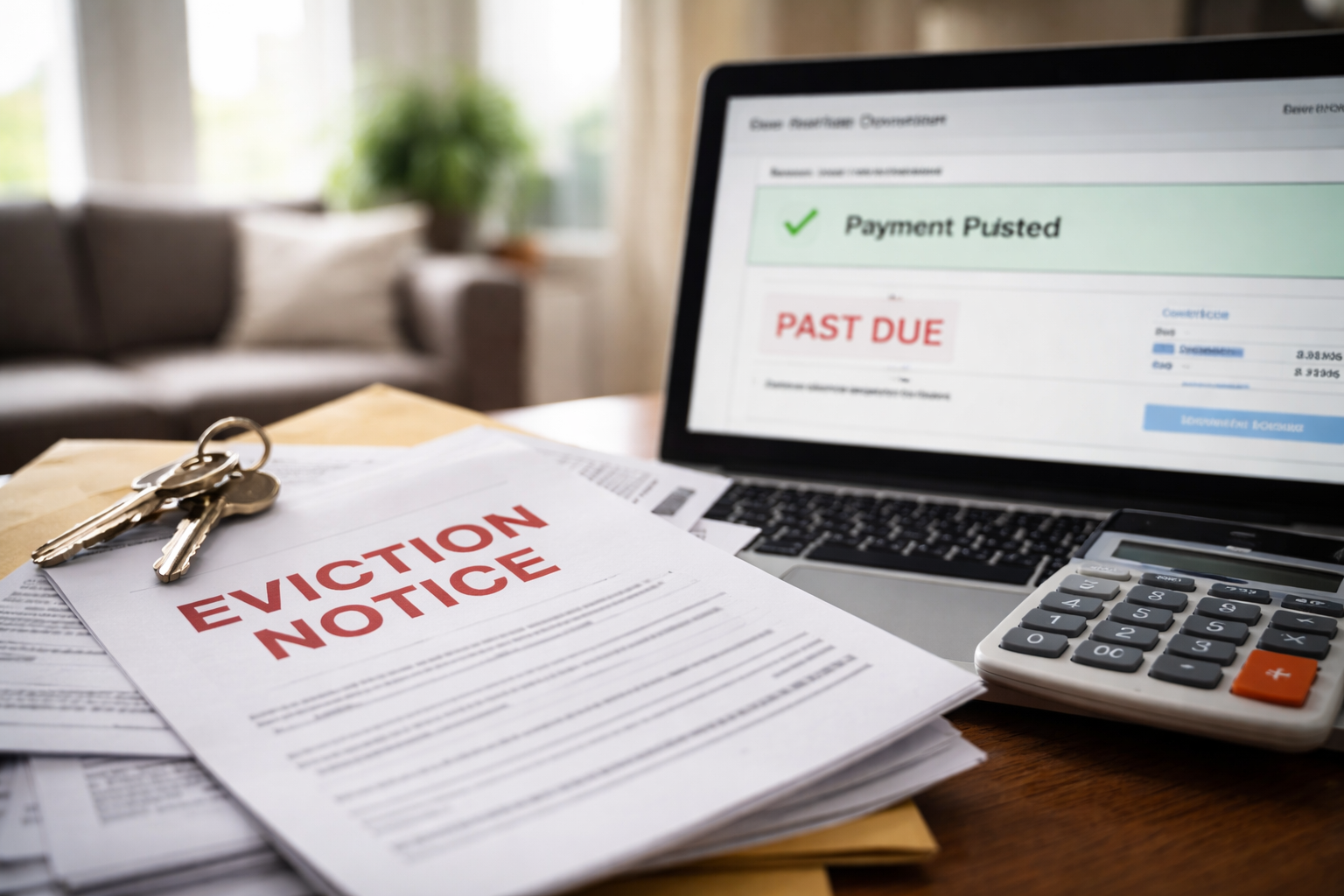
Rent Payment Posted After Eviction Filing was the first thing I saw when I logged into the portal again. The balance had changed. The payment line was there. The date was there. The account looked different enough to make me think the problem had finally settled down. Then I looked back at the notice I had already received and realized the filing had gone through before the system showed the payment as posted. That was the moment the situation stopped feeling like a normal rent issue and started feeling like two separate tracks moving at the same time.
Rent Payment Posted After Eviction Filing is the kind of problem that makes people hesitate because the screen looks better than the real situation. The portal may show progress. The landlord may still say the matter is active. The court process may already have started. What makes this situation dangerous is not just the payment delay itself, but the false sense that a posted payment automatically erases what already happened before it appeared on the ledger. It often does not.
If you want to understand the billing side before you compare it to the legal side, start here first:
Why this happens at all
Rent Payment Posted After Eviction Filing usually happens because rent systems do not move at the same speed as enforcement decisions. A tenant may submit a payment online, through ACH, through a portal, through a money order delivery channel, or through a third-party processor. That payment may sit in a pending status, then clear, then post. Meanwhile, a landlord or property manager may be working from a notice deadline, an internal delinquency report, or a legal queue that already marked the account for action.
That means one side of the system is asking, “Did the tenant cure the balance before the required cutoff?” while the other side is simply showing, “A payment eventually posted.” Those are not the same question. A posted payment tells you money hit the ledger. It does not always tell you whether the default was cured at the time the landlord chose to act.
In many real-world situations, the sequence looks like this:
- Rent becomes late
- A notice is issued
- The tenant submits payment
- The processor holds the payment for review or clearing
- The landlord files before the ledger updates
- The payment finally posts after filing
That is why Rent Payment Posted After Eviction Filing can feel irrational from the tenant’s perspective. You see payment. The landlord sees missed timing. The court sees a case number that already exists.
What the landlord may be looking at
Many tenants assume the landlord is looking at the exact same portal view they are. Often that is not true. A property manager may have access to internal notes, cutoff reports, exception queues, legal status markers, batch processing timestamps, and balances broken into separate categories such as base rent, late charges, legal fees, utilities, or prior balances.
So when Rent Payment Posted After Eviction Filing appears on your screen, the landlord may still be seeing one or more of the following:
- payment posted after notice expiration
- partial cure only
- rent covered but fees still open
- account already sent to legal vendor
- filing costs added after payment submission
- manual approval needed before withdrawal
This is where many tenants lose time. They think a lower portal balance means the case must already be over. The landlord may think the case remains open until all required amounts are resolved and the legal side confirms withdrawal.
How to match your situation exactly
Rent Payment Posted After Eviction Filing can lead to very different outcomes depending on the timeline. The details matter more than people expect. The real question is not just whether you paid, but when you submitted it, when it cleared, when it posted, what amount it covered, and when the filing actually occurred.
Timeline Branch 1 — You submitted the full rent before the notice deadline, but the system posted it late.
This is often the strongest fact pattern for a tenant. Your argument is that you acted within the required period and the delay happened in processing, not because you failed to pay. In this branch, proof of initiation time matters more than your memory of when you clicked the button. Save bank confirmation, portal confirmation, and any transaction ID.
Timeline Branch 2 — You submitted the payment before filing, but after the notice deadline.
This is weaker. The landlord may argue that the right to file had already matured once the cure deadline passed. Even though the payment came before filing, it may still have been late under the notice. You still need to document everything, but the legal leverage may be narrower.
Timeline Branch 3 — The payment posted the same day the filing was made.
This is where timestamp detail matters. Morning filing and afternoon posting can look very different from overnight batch posting tied to a payment authorized the prior day. Do not guess. Build the timeline exactly.
Timeline Branch 4 — You paid only part of the amount due.
If the payment did not fully cure what the landlord claims was required, the filing may continue. This can happen even when the tenant honestly believed they were paying the amount shown in the portal.
Timeline Branch 5 — Your payment was applied somewhere unexpected.
The payment may have posted, but to the wrong category, wrong unit, wrong month, old arrears, fees first, or future rent first. In that branch, the issue is not just timing. It is allocation.
Rent Payment Posted After Eviction Filing becomes much easier to evaluate once you know which branch you are actually in. Until then, every conversation with the landlord stays vague, and vague conversations waste the little time you have.
When the posted payment does not really fix the balance
One of the most frustrating versions of Rent Payment Posted After Eviction Filing happens when the tenant sees payment posted and assumes the account is now current, but the landlord says the case is still moving because the posted payment did not satisfy the balance the way the tenant expected.
That can happen for several reasons:
- the payment was applied to older arrears first
- late charges were paid before current rent
- legal filing costs were added after submission
- the portal balance updated slowly and then reversed categories later
- the landlord treats acceptance as use-and-occupancy only, not settlement
A posted transaction is not the same as a resolved account. That distinction is where this problem becomes more serious than a normal ledger error.
If you suspect the money went to the wrong bucket instead of solving the current month, read this next:
What to collect before you contact anyone
When Rent Payment Posted After Eviction Filing happens, you need more than a screenshot of a lower balance. You need documents that let you reconstruct the sequence without relying on memory. This matters because once the conversation turns formal, the side with the clean timeline usually has the advantage.
- portal screenshot showing posted payment and date
- bank record showing authorization or withdrawal date
- payment confirmation email or receipt number
- copy of notice with deadline date
- copy of filing notice, summons, or case reference if received
- full rent ledger, requested in writing
- any message from management about refusal, acceptance, or conditions
Do not wait until after a hearing date is near to gather this. Small details disappear fast in tenant portals. Screens change. Pending lines vanish. Balances recalculate. Notes get summarized. You need your own record set now.
The conversations that usually go wrong
Rent Payment Posted After Eviction Filing often gets worse because the tenant starts with the wrong kind of message. They write something emotional, too broad, or too vague. They say they “already paid” without identifying the exact date, amount, and status. The manager responds with a general statement like “legal has it now,” and the tenant walks away thinking nothing else can be done.
A stronger approach is to ask precise questions in writing:
- What date does your office show for payment submission?
- What date does your office show for payment posting?
- What balance was required to stop filing?
- Was the payment applied to current rent, old balance, fees, or something else?
- Has the eviction filing been withdrawn, paused, or left active?
- Are additional legal or administrative charges now included?
Specific questions force specific answers. That matters because you are trying to pin down system facts, not win an argument by tone alone.
Detailed self-check by situation
If you paid online through ACH:
Check the authorization time, not just the day money left your bank. ACH timing often creates the delay that leads to Rent Payment Posted After Eviction Filing. Look for portal language about “processing,” “pending,” or “subject to review.”
If you paid by money order or certified funds:
Check when the landlord actually received and logged it. Receipt date and ledger posting date may not be the same. If the office held the item without prompt posting, document that gap.
If you paid through a third-party app or service:
Do not assume the landlord received funds the same day you sent them. Some services display “sent” well before the landlord sees completed delivery.
If you are in subsidized or assisted housing:
Separate your share from any housing subsidy portion. The landlord may be tracking the tenant portion for default while the overall ledger looks different from what you expected.
If you have repeated late-payment history:
Be especially careful. The landlord may already have tighter internal handling on your account, and your current posted payment may not erase prior status or added costs.
Rent Payment Posted After Eviction Filing is rarely solved by one generic explanation because the transaction path matters. The more exactly you classify your own situation, the less likely you are to miss the real problem.
Mistakes that quietly make this worse
There are a few common mistakes that turn Rent Payment Posted After Eviction Filing from a difficult situation into a much harder one.
- Ignoring the court paperwork because the portal balance improved
- Assuming management “must know” the payment posted
- Failing to request the full ledger
- Relying on phone calls without written follow-up
- Paying again without understanding how the first payment was applied
- Arguing generally instead of documenting timing precisely
The most expensive mistake is confusing account activity with case status. Those are not always linked automatically.
What your rights may depend on
Rent Payment Posted After Eviction Filing is a U.S.-focused issue, but the exact outcome depends on state and local rules, the wording of the notice, the type of tenancy, and how the landlord handled acceptance of payment after filing. In some places, proof that you cured in time may matter greatly. In others, acceptance after filing may not erase the legal process unless formal withdrawal happens. In still other places, the treatment of partial payments changes everything.
That is why the safest general principle is this: do not assume a posted payment protects you unless you also confirm the filing status. You need both sides of the problem addressed.
For a general official overview of eviction process information in the U.S., see USA.gov eviction guidance.
Key Takeaways
- Rent Payment Posted After Eviction Filing is a timing conflict between billing systems and legal action.
- A posted payment does not automatically mean the eviction filing has been stopped or withdrawn.
- The strongest evidence is a documented timeline showing submission date, posting date, notice deadline, and filing date.
- Allocation matters. A payment can post without actually curing the balance the way you assumed.
- You need written confirmation of case status, not just a changed portal balance.
FAQ
Does Rent Payment Posted After Eviction Filing mean the landlord accepted my payment and dropped the case?
Not necessarily. Acceptance or posting of payment may reduce the ledger balance without automatically ending the filing.
What matters more, the day I submitted payment or the day it posted?
That depends on the facts and local rules, but in many disputes both dates matter. Submission timing can be critical, especially if the delay happened in processing rather than because you waited too long.
Can a landlord keep the payment and still move forward?
In some situations, yes. This can happen where only part of the balance was cured, fees remained, or the legal process was not formally withdrawn.
Should I pay again if the landlord says the first payment did not stop the case?
Do not rush into a second payment until you confirm how the first one was applied and what amount is actually being claimed now.
What if the portal looks current but I still have a hearing notice?
Treat the hearing notice as active until you receive written confirmation that the filing has been withdrawn or resolved.
What to do right now
Rent Payment Posted After Eviction Filing is not the kind of issue you should leave sitting for a few days while hoping the system catches up. Start by building the timeline in one place: when the notice expired, when you submitted payment, when your bank shows movement, when the portal posted it, and when the filing notice was created or delivered.
Then send a written message to management asking whether the filing remains active, how the payment was applied, and whether any additional amounts were added after filing. Ask for the full ledger. Ask for the exact balance they say was required to stop the action. Do not phrase this as a general complaint. Phrase it as a request for exact account and status information.
If the landlord insists the payment posted but did not resolve the account, you may also need this related situation because it often appears alongside filing disputes:
Rent Payment Posted After Eviction Filing feels confusing because it gives you two stories at once. One story is in the ledger. The other is in the legal process. The ledger story says money arrived. The legal story says the matter already moved forward. Your job is to force those two stories onto one documented timeline and get written clarity before the gap gets more expensive.
Do that now. Save the proof. Request the ledger. Confirm the case status. Match every date. Do not rely on the portal alone, and do not assume payment visibility means legal safety. That is how this issue stops being a panic moment and starts becoming a problem you can actually address in an organized way.