
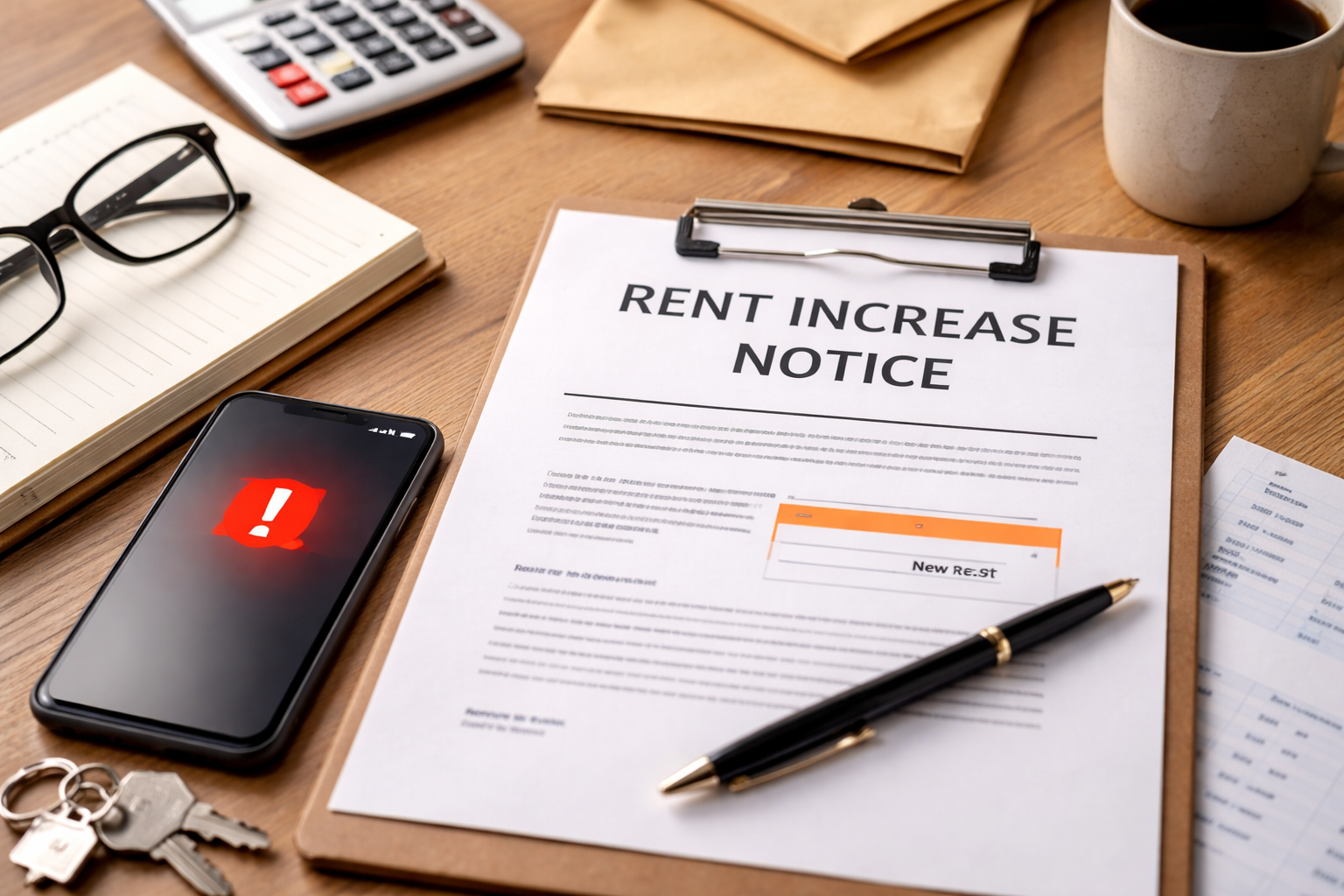
Rent increase notice what to do first is not a question people ask when everything is going well.
It shows up in the middle of an ordinary week, usually when you are not prepared to make housing decisions. The notice itself is often calm, neutral, and administrative. That calm tone is misleading. Behind it is a decision that affects your monthly cash flow, your stability, and your future options.
Rent increase notice what to do first is not about reacting emotionally or quickly.
It is about preventing a single early mistake from locking you into a position you cannot easily undo. Many renters later realize that the increase itself was not the main problem. The problem was how they responded in the first few days.
Why the First Reaction Matters More Than the Increase Amount
Rent increase notice what to do first is a timing issue before it is a financial one.
Landlords and property managers do not only look at whether you pay. They observe how you respond. Speed, tone, and behavior are all signals.
Responding too quickly often signals acceptance.
Responding emotionally signals instability.
Saying nothing can be interpreted as quiet compliance.
Once one of those signals is sent, your leverage weakens. This happens even when the increase might be negotiable or legally questionable.
- Paying the higher rent even once can establish a new baseline
- Verbal agreements are difficult to dispute later
- Emotional messages reduce credibility in formal negotiations
The Three Facts You Must Verify Before Replying
Rent increase notice what to do first always starts with verification, not discussion.
Before you agree, negotiate, or argue, you need clarity on three facts.
These facts determine whether the notice is enforceable or challengeable.
- Lease structure: fixed-term or month-to-month
- Notice period: legally required days before the increase takes effect
- Delivery method: written notice that is dated and properly served
If even one of these elements is incorrect, the notice may not be valid.
Many renters never check this because the amount itself seems “normal for the market.”
Why Rent Increases Happen (And How That Helps You)
Rent increase notice what to do first becomes clearer when you understand why the increase exists.
In most cases, rent increases are not personal. They are triggered by systems:
- Annual pricing algorithms used by property management software
- Property tax and insurance adjustments
- Expiration of promotional or capped rent periods
- Changes in ownership or management policies
When the increase is system-driven, negotiation is about structure and timing, not confrontation.
Understanding this changes how you frame your response.
What the Landlord Is Evaluating Behind the Scenes
From the landlord’s perspective, the notice is also an assessment tool.
They are evaluating:
- Your likelihood of paying on time
- Your potential to escalate into a dispute
- The cost of keeping you versus replacing you
Rent increase notice what to do first from their point of view is watching how you behave under pressure.
Calm, documented communication signals lower risk than silence or aggression.
Tenant Rights You Should Confirm (Without Legal Jargon)
Rent increase notice what to do first must include checking your legal protections.
In many U.S. states and cities:
- Rent cannot increase during an active fixed-term lease
- Minimum notice periods are mandatory
- Retaliatory rent increases are prohibited
- Rent-controlled units have strict caps
For official, up-to-date guidance:
When housing stability is involved, rely on official sources, not anecdotes.
What to Do After You Confirm the Increase Is Legal
Rent increase notice what to do first becomes strategic once legality is confirmed.
At this stage, your goal is to protect predictability and cash flow.
- Request written confirmation of new rent terms
- Ask about phased or delayed increases
- Offer longer lease commitments in exchange for stability
- Clarify renewal deadlines in writing
Negotiation works best before renewal paperwork is finalized.
Case Split: Identify Your Exact Situation
Rent increase notice what to do first depends on which category you fall into.
- Month-to-month renter: notice timing is your main leverage
- Fixed-term renter: effective date determines legality
- Rent-controlled unit: percentage caps define outcomes
- Corporate landlord: escalation paths often exist
Misidentifying your category leads to the wrong response.
Billing Errors That Appear During Rent Changes
Rent increases often coincide with billing system updates.
This is when duplicate charges, misapplied payments, or incorrect balances appear.
If these errors are not corrected immediately, renters are often blamed later.
A common example:
Resolving billing issues early prevents them from being used against you.
Mistakes That Quietly Remove Your Options
- Paying the higher rent before confirming legality
- Agreeing verbally without documentation
- Missing response or renewal deadlines
- Assuming all increases are automatically valid
Rent increase notice what to do first is about avoiding irreversible decisions.
Key Takeaways
- Rent increase notice what to do first is verification before reaction
- Legality depends on lease structure and notice timing
- Written communication preserves leverage
- Billing accuracy matters during transitions
FAQ
Can I ignore a rent increase notice?
Ignoring it often reduces leverage and may be treated as acceptance.
Should I negotiate immediately?
Only after confirming the notice is legally enforceable.
Is moving always the cheaper option?
Often no. Negotiation is frequently less expensive than relocation.
Rent increase notice what to do first is not about rushing into action.
The most important thing you can do right now is slow the process down.
Take time to confirm legality, document everything in writing, and choose a response that preserves leverage instead of sacrificing it for short-term relief.
Your next step is deliberate, not emotional.
Respond in writing, with facts, after verification — because what you do in this moment shapes every option you will have later.