
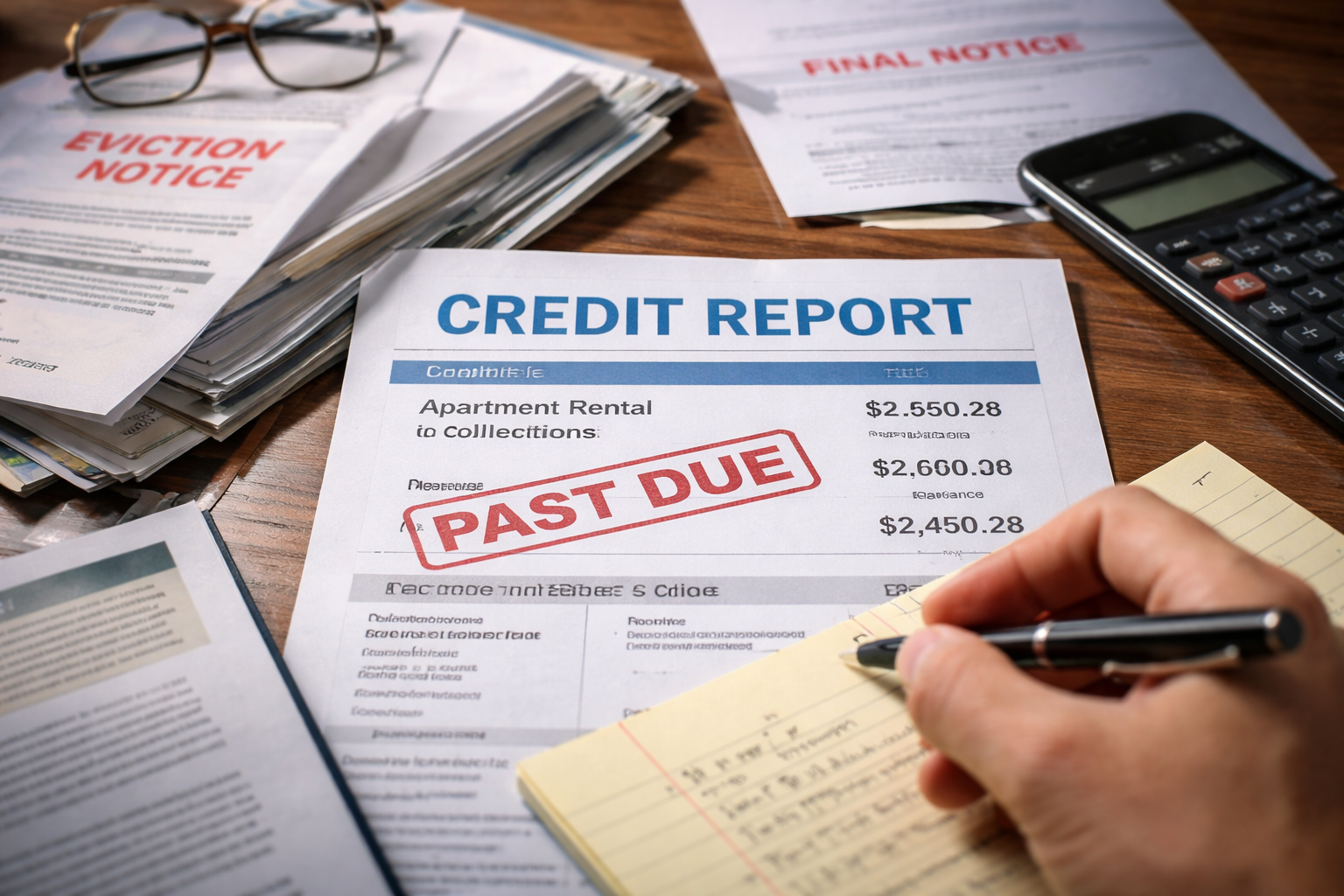
Landlord reported rent to credit bureau — I didn’t hear it from my landlord first. I found out from a credit alert on my phone before breakfast. The notification was short, almost casual, like it didn’t understand what it was saying: “New collection account added.” I opened my report expecting a credit card issue. Instead, I saw my former apartment’s name attached to a balance I didn’t recognize.
I sat there rereading the line like it might change if I stared long enough. No warning letter. No final invoice I could remember. Just a new entry that could quietly wreck loan approvals for months. When a landlord reported rent to credit bureau, you’re not “figuring it out later” anymore—you’re in damage-control mode right now.
If you’re here because a landlord reported rent to credit bureau, the goal is simple: (1) confirm who reported it and why, (2) validate whether the amount is real, and (3) take actions that can correct or remove inaccurate reporting. The steps below are designed so you can move fast without making admissions that hurt you later.
If your credit report shows a collection agency (not your landlord directly), read that guide first. This article focuses on what to do specifically when the credit bureaus are already involved after a landlord reported rent to credit bureau.
New Problem Intent or Just a Situation Version?
This keyword is closer to a new problem intent than a simple “unpaid rent” variation. “Unpaid rent” is a rent dispute. “Sent to collections” is escalation. But landlord reported rent to credit bureau is a different stage: your credit file is now part of the battlefield.
- Unpaid rent searches usually want negotiation or payment options.
- Collections searches usually want validation letters and stop-contact strategy.
- Credit bureau reporting searches want removal/correction and credit impact control.
So yes—this is a stronger, higher-urgency intent that deserves its own page. It can overlap conceptually with collections content, but it should be structured around bureau disputes, validation proof, and credit-status corrections—the parts most articles skim.
Why a Landlord Ends Up on Your Credit Report
When a landlord reported rent to credit bureau, it usually happened through one of these routes:
- The landlord hired a collection agency that reports to Experian/Equifax/TransUnion.
- A property management company uses a reporting platform that can submit negative payment data.
- A move-out balance (fees, damages, early termination) was classified as unpaid and escalated automatically.
From the landlord’s perspective, reporting increases leverage. From the system’s perspective, reporting turns the dispute into a standardized data record that lenders may treat as “true” until corrected.
But a reported record is not the same thing as a correct record. Your job is to force verification with documentation.
Match Your Situation Before You Talk to Anyone
Pick the closest scenario. Then follow the exact action plan for that scenario.
A) Accurate missed rent (you know you were late or short)
Goal: minimize credit damage and get the status updated properly after payment.
B) “Move-out balance” dispute (cleaning, damage, lease termination fee)
Goal: force itemization + proof, then dispute the amount if it’s inflated or unsupported.
C) Paid but still reported (you have receipts)
Goal: correct the “status” and balance to reflect payment, then push for deletion if possible.
D) Wrong person / wrong unit / identity mix-up
Goal: fastest possible bureau dispute with identity and occupancy proof.
E) No notice, no final statement, and the first time you heard about it is the credit report
Goal: validate the debt in writing and dispute any missing documentation or incorrect dates.
Don’t start with an emotional call. Start with the correct paper trail for your scenario.
Two Things to Do in the First 30 Minutes
If a landlord reported rent to credit bureau, do these two things before you contact the landlord, the property manager, or the collection agency:
- Pull your reports and screenshot the entry (name of furnisher, account number, dates, and amount).
- Build a simple timeline: lease start/end, move-out date, last payment date, security deposit amount, and any final statements you received.
That timeline becomes your “truth anchor” when someone tries to rewrite the story.
Proof Checklist That Makes Your Dispute Strong
You don’t need a mountain of paperwork. You need the right paper.
- Lease agreement and any addendums (fees, early termination clauses)
- Payment proof (bank statement lines + confirmation emails/screenshots)
- Move-out notice and keys-return proof (email, portal submission, receipt)
- Move-out inspection notes and photos (if you have them)
- Security deposit statement and itemized deductions (if provided)
- Any written communication about the disputed balance
If the landlord cannot produce itemized proof, your leverage goes up fast—especially for “fee-based” balances.
Official External Guide to Dispute Credit Report Errors
For a clean, official overview of how credit reporting disputes work in the U.S., use this CFPB resource. It helps you keep your dispute factual and structured.
Use that guide to stay focused on documentation, dates, and exact errors—not opinions.
What to Say (Short Scripts That Don’t Hurt You)
When a landlord reported rent to credit bureau, the wrong words can accidentally lock you into responsibility. Use controlled language:
- “I’m requesting written validation and itemization of this reported balance.”
- “I dispute the accuracy of the reported amount and the reporting dates.”
- “Please provide the documents you used to calculate this balance.”
- “I’m also disputing this entry through the credit bureaus.”
Avoid saying “I owe” or “I’ll pay” until you have proof and a written agreement about how the credit file will be updated.
Scenario Action Plans (Follow the One You Chose)
Scenario A: The balance is accurate
If a landlord reported rent to credit bureau for a legitimate missed rent amount, your best outcome is damage control:
- Ask for the payoff amount in writing.
- Ask how the status will update after payment (paid collection vs deletion).
- Pay only after you receive written confirmation of the update terms.
Paying without written update terms often leaves you with a “paid collection” still hurting your score.
Scenario B: The balance is mostly fees (cleaning/damages/termination)
This is where landlords often overreach. When a landlord reported rent to credit bureau based on fee disputes, demand itemization:
- Request the itemized ledger (dates, amounts, descriptions).
- Request photos, invoices, and move-out inspection proof for damages/cleaning.
- Challenge vague line items (“turnover,” “admin,” “misc repairs”) without proof.
If the documentation is weak, your dispute should target “accuracy” and “verifiability.”
Scenario C: You already paid (but it’s still showing)
If a landlord reported rent to credit bureau and you have proof of payment:
- Get a written “zero balance” statement from the reporting party.
- Dispute the “status” and “balance” with each bureau using that proof.
- Keep copies of every submission and confirmation number.
Paid does not automatically mean corrected. Corrected requires documentation and follow-through.
Scenario D: Wrong person or mixed file
If a landlord reported rent to credit bureau but it’s not your rental:
- Dispute immediately with bureaus: “not mine” + identity proof.
- Include proof you did not live there (different address history, lease elsewhere).
- Request re-investigation and deletion due to misattribution.
This is one of the fastest-removal categories when documented properly.
Scenario E: No notice and no final statement
If a landlord reported rent to credit bureau and you never saw a final bill:
- Request written validation and the full ledger.
- Dispute missing documentation and incorrect dates.
- Dispute any “first delinquency” date that doesn’t match your timeline.
Incorrect dates can extend how long the record hurts you. Date accuracy matters.
If your reported balance is tied to move-out timing—extra days charged, notice period disputes, or billing after you left—this is the closest supporting read.
Dispute Strategy That Actually Works
Most people lose time because they dispute in the wrong order. If a landlord reported rent to credit bureau, use this sequence:
- Validate with the reporting party (get itemization and proof).
- Dispute with the bureaus (focus on exact errors: amount, dates, status, ownership).
- Follow up with additional proof if the bureau response is vague or incomplete.
Your bureau dispute should list specific inaccuracies, not “this is unfair.” Example: “The reported balance is incorrect because payment was made on X date; the status should be paid/zero. Attached: receipt and bank record.”
Mistakes That Make a Bad Situation Permanent
- Calling and “explaining” without documents (you end up debating feelings, not facts).
- Agreeing to a payment plan before validation (you can unintentionally confirm the debt).
- Paying immediately without written update terms (you may keep the negative mark anyway).
- Only disputing with one bureau (the entry can remain on others).
- Letting deadlines slide because it feels stressful (time never helps you here).
Silence is not neutral. Silence is permission for the record to harden.
How to Keep This YMYL-Safe and Still Effective
This is practical dispute guidance, not legal advice. If the amount is large, you’re facing eviction-related filings, or you receive court papers, consider professional help. The core idea stays the same: document first, then dispute with precision.
Your strongest tool is not anger—it’s a clean, verifiable paper trail.
If the balance is partially valid and you’re trying to prevent future damage or resolve it efficiently, negotiation strategy matters—especially when you want written terms for how reporting will update after resolution.
FAQ
Can a landlord legally report rent to credit bureaus?
Often yes—usually through a collection agency or reporting service. Legally allowed reporting is still required to be accurate and verifiable.
Will paying automatically remove the negative entry?
Not automatically. It may update to “paid,” but removal typically requires a separate agreement or a successful dispute showing inaccuracy.
How fast should I act after a landlord reported rent to credit bureau?
Immediately. The sooner you validate and dispute, the easier it is to correct wrong amounts and wrong dates before the entry becomes entrenched across systems.
What if the amount is small but the credit damage is big?
That’s common. A small reported collection can still hurt. Focus on accuracy, documentation, and correction/removal pathways.
What if the landlord reported rent to credit bureau but I never got an invoice?
That’s a validation problem. Request the ledger and documentation. If they can’t verify, dispute the entry with the bureaus using your timeline.
Key Takeaways
- Landlord reported rent to credit bureau is a credit-stage escalation, not just a rent dispute.
- Match your scenario first (accurate rent, fee dispute, paid already, wrong person, no notice).
- Collect the right proof: lease, payments, move-out documentation, itemized charges.
- Validate in writing, then dispute with bureaus using specific inaccuracies (amount/dates/status).
- Never pay without written confirmation of how the credit file will be updated.
When I saw that entry, my first instinct was to call and argue. I’m glad I didn’t. The better move was to take ten minutes, pull the reports, build the timeline, and treat it like a documentation problem.
If a landlord reported rent to credit bureau on your file, do this today: screenshot the entry, request written validation and itemization, and file a precise bureau dispute with the exact errors you can prove. Action today protects your next apartment application, your next car loan, and your next “yes” from a lender.