
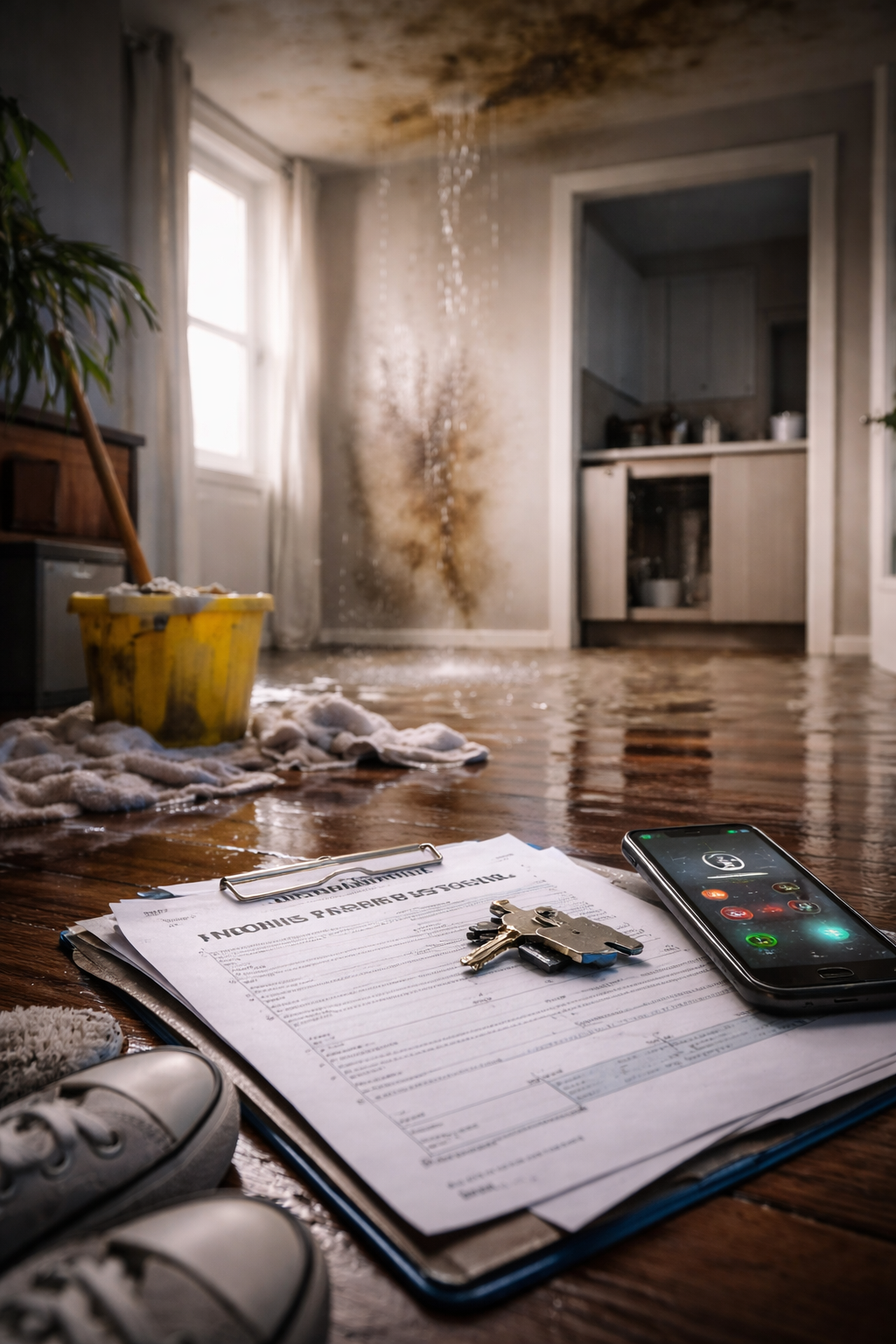
Landlord or tenant responsible for water damage — the question hits the moment you see it: the dark stain spreading under the baseboard, the warped plank near the bathroom door, the ceiling bubble that wasn’t there last night. You’re not thinking about “maintenance.” You’re thinking about the bill that’s coming.
I remember standing there with my phone flashlight pointed at the floor, trying to decide whether to call my landlord first or start cleaning. Water damage is one of those problems where a few hours of delay can turn a manageable repair into a fight over thousands. And when the fight starts, it rarely starts with facts. It starts with assumptions.
This guide is built for U.S. renters and landlords who need a practical answer, fast. If you’re asking landlord or tenant responsible for water damage, you don’t need theory — you need a clean way to sort liability, protect your finances, and stop the damage from getting worse.
Many “who pays” disputes follow the same logic across different problems. If you want the best quick comparison for responsibility rules, this hub-style post helps:
Use it to see how courts and leases often separate property failures from occupant-caused issues.
The One Question That Decides Most Cases
When people search landlord or tenant responsible for water damage, they expect a simple rule. In real disputes, the deciding question is usually:
Was the damage caused by the property’s failure, or by preventable tenant behavior (including delay in reporting)?
That’s it. Everything else — the photos, the texts, the repair invoice — is evidence used to answer that question.
A Fast Decision Tree (Match Your Situation in 60 Seconds)
Quick Liability Sorting:
1) Did the water come from inside walls/roof/structural plumbing?
→ Often points toward landlord responsibility.
2) Did the water come from tenant-controlled use (overflowed tub, left faucet running, aquarium spill)?
→ Often points toward tenant responsibility.
3) Did you report the leak as soon as you noticed signs (drip, damp smell, stain)?
→ Fast reporting protects your position.
4) Did the landlord delay repairs after notice?
→ Landlord delay can shift later damage back to the landlord.
If you’re unsure, start acting like it will be reviewed later: document first, communicate in writing, then escalate.
Detailed Case Splits (This Is Where Most People Win or Lose)
Below are the most common U.S. scenarios. If you want a clear answer to landlord or tenant responsible for water damage, match your situation to the closest case and follow the steps under it.
What it looks like: water under flooring, damp drywall, ceiling stain below an upstairs bathroom, sudden wet carpet with no obvious source.
Typical responsibility: usually landlord (building systems).
What decides it: whether the tenant reported early warning signs (drips, stains, musty odor).
Best move: document immediately + send written notice + request emergency repair.
Case B: Roof/Window Leak (Storm, flashing failure, old seals)
What it looks like: water near exterior walls, window frames, ceiling corners after rain, peeling paint, recurring stains.
Typical responsibility: usually landlord (exterior envelope).
What decides it: repeat history and notice. If it’s a recurring leak and you reported it, landlord is exposed.
Best move: include weather timing + photos of entry points + request inspection in writing.
Case C: Landlord-Provided Appliance Failure (water heater, dishwasher, supplied washer)
What it looks like: puddle near appliance, slow drip, leak line failure, flooding from a unit you didn’t install.
Typical responsibility: usually landlord unless misuse is proven.
What decides it: whether you used it normally and didn’t ignore warning signs (odd noises, visible drips).
Best move: shut off water if safe + take photos of valves/hoses + request urgent service.
Case D: Tenant-Caused Overflow (bathtub, sink, toilet misuse)
What it looks like: overflow during use, clogged toilet from improper items, water left running.
Typical responsibility: often tenant, especially if negligence is clear.
What decides it: whether it was accidental and promptly reported, and whether damage spread to other units.
Best move: be factual, report immediately, and ask for an itemized breakdown (don’t accept vague numbers).
Case E: “Small Leak” Not Reported (the silent liability trap)
What it looks like: stain you noticed weeks ago, soft spot near tub, musty smell you ignored, small drip you kept “meaning to mention.”
Typical responsibility: can become shared liability. This is where tenants get blamed even when the original cause is landlord-side.
What decides it: the timeline. If your messages show delay, landlords argue “failure to mitigate.”
Best move: create a written timeline now and report immediately; don’t guess dates — use screenshots/photos to anchor time.
Case F: Neighbor Unit or Shared Plumbing Issue
What it looks like: water coming from ceiling, shared wall, hallway, or adjacent unit.
Typical responsibility: often landlord (building systems) but can involve the neighbor’s liability if they caused it.
What decides it: source tracing by maintenance/contractor and whether you allowed access promptly.
Best move: request a source report in writing; ask what unit/system caused it and keep your communications calm and consistent.
Notice what’s consistent: the outcome for landlord or tenant responsible for water damage often depends less on “what feels fair” and more on timelines, notices, and whether someone failed to act reasonably.
What Landlords and Property Managers Look For
To resolve landlord or tenant responsible for water damage, property managers usually review:
- When you first noticed the issue (and whether you can prove it)
- When you notified them (text/email/portal timestamp)
- Whether you tried to stop the water or prevent spread (reasonable mitigation)
- Whether access was provided for repairs
- Whether the issue is linked to tenant misuse (overflow, prohibited items, tampering)
Your best leverage is calm evidence. Even one clear photo + one clear written message can outperform a long phone call.
Do This Today (The 45-Minute “Protect Your Wallet” Plan)
Action Plan:
1) Take wide and close photos (include a clock screen or today’s newspaper app for date context).
2) If safe, stop the source (shutoff valve, move items, towels to contain).
3) Notify landlord in writing (email/portal/text) with: where, when discovered, what you see, and request for repair.
4) Ask for the next step in writing: inspection time and who is coming.
5) Save everything in one folder: photos, messages, work orders, receipts.
The goal is to lock the timeline before the blame starts.
When you’re in the middle of an incident, it’s easy to forget that landlord or tenant responsible for water damage becomes a document game quickly.
A Simple Message Template That Works
Copy this into your email/portal message (edit details only):
Message Template:
“Hi, I discovered water damage in (location) at (time/date). The area is (describe: wet flooring / ceiling stain / dripping). I took photos and I’m requesting an urgent inspection and repair. Please confirm the earliest time someone can come and whether I should take any additional steps to prevent further damage.”
It’s calm, factual, and creates a record. That matters when resolving landlord or tenant responsible for water damage.
If the water damage is tied to recurring maintenance delays, this post helps you structure escalation without sounding emotional:
It’s especially useful if the landlord stalls and the damage spreads over days.
Insurance Angle (The Part People Miss Until It’s Too Late)
In many U.S. rentals, insurance splits like this:
- Landlord insurance often covers the building structure (subject to policy and deductibles).
- Renters insurance often covers the tenant’s personal property (subject to policy terms).
Even when the landlord is responsible for repairs, your personal belongings may require your renters insurance. And if you have no renters insurance, you can still pursue reimbursement — but it’s harder, slower, and more conflict-heavy.
Official overview of renters insurance basics (good, neutral reference):
Mistakes That Make You Look Responsible (Even When You Aren’t)
- Only calling (no written notice)
- Waiting “to see if it dries”
- Cleaning up without photos
- Letting access delays happen (missed appointments, unanswered messages)
- Accepting a vague charge (“water damage fee”) without itemization
For disputes, itemization is not optional. It’s how you prevent made-up numbers.
If You’re a Tenant and They Try to Charge You
If your landlord claims you’re responsible, don’t argue in circles. Ask for:
- the exact claimed cause (overflow, misuse, delay, etc.)
- the timeline they believe happened
- photos or contractor notes supporting their cause statement
- an itemized invoice (labor, materials, dates)
This keeps the landlord or tenant responsible for water damage question anchored to verifiable facts.
FAQ
Can a landlord automatically deduct water damage costs from my security deposit?
They often try, but deductions typically require a reasonable basis and itemization. Keep your documentation and request written detail.
What if the leak came from inside the wall but I noticed it late?
Report immediately and be honest about when you noticed signs. Late reporting can complicate things, but quick action and evidence still help.
If the upstairs neighbor caused the leak, who pays?
The landlord usually coordinates repairs for the building. Liability may later be pursued against the neighbor if negligence is shown, but your priority is documenting and getting repairs fast.
Should I withhold rent because of water damage?
This varies by state and can backfire if done incorrectly. Use written notice, request repairs, and follow a documented escalation path instead of improvising.
Key Takeaways
- landlord or tenant responsible for water damage is decided by cause + negligence + timeline, not by who is louder.
- Document first: photos, messages, and a clear discovery timestamp protect you.
- Report in writing immediately; delays are the biggest liability trap for tenants.
- Ask for itemization if charges appear; vague “fees” are where disputes explode.
- Use insurance strategically: building vs personal property is often split.
When water damage turns into a money dispute (deposit deductions, repair bills, or surprise charges), this next guide helps you dispute overcharges cleanly:
It’s the simplest framework for pushing back without escalating into chaos.
Here’s the honest truth: the question landlord or tenant responsible for water damage feels personal because the cost is personal. But it’s usually decided by something unemotional — whether the situation was preventable, and whether someone acted reasonably once it was discovered.
If you’re dealing with this right now, don’t wait for perfect clarity. Take photos, stop the spread if it’s safe, and send written notice today. That single move protects you whether the final answer is landlord responsibility, tenant responsibility, or shared responsibility. And it keeps the conversation focused on facts — exactly where you want it when money is on the line.