
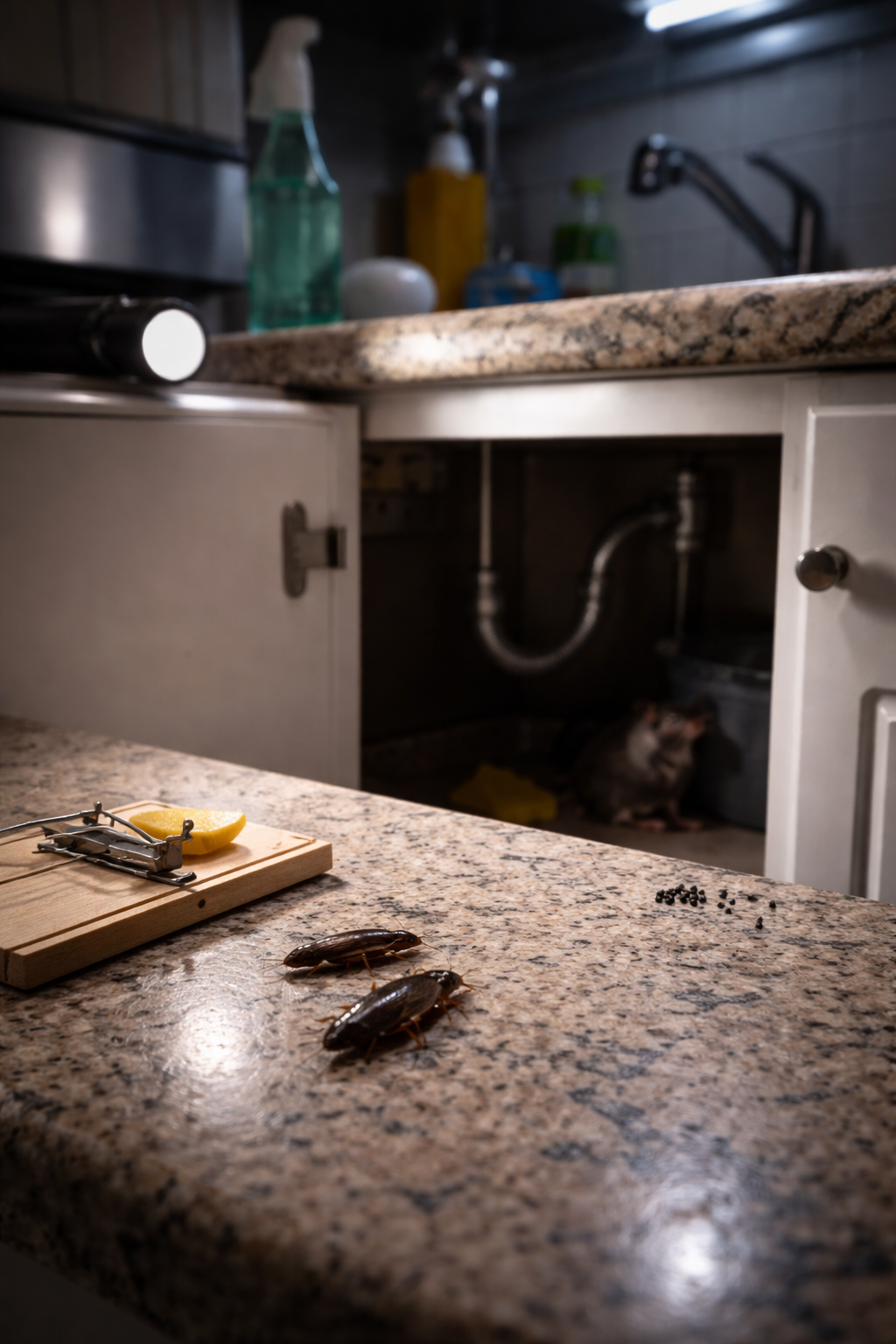
Landlord or tenant responsible for pest control — the question didn’t feel like “tenant law” until the exact second I saw something move across the kitchen floor. Not a shadow. Not a crumb. A quick, deliberate line of motion along the baseboard like it had its own map.
I stood there with the light on, scanning corners like I was suddenly responsible for a building I don’t even own. My first thought wasn’t “gross.” It was financial. If this is a real infestation, who pays — me or the landlord? And the second thought was even worse: If I do the wrong thing tonight, am I going to accidentally accept blame?
Here’s the uncomfortable truth: landlord or tenant responsible for pest control is not just a legal question — it’s a timeline question. In many disputes, the first 24–48 hours decide whether you look like a careful renter or the cause of the problem.
If you’re already tracking responsibility issues across repairs and habitability, start here first for a quick “who pays” baseline (different issue, same responsibility logic).
What This Dispute Really Comes Down To
Across most U.S. rentals, the same core test shows up again and again:
Was the infestation caused by the building (structure/system/other units), or was it introduced or worsened by tenant behavior?
That’s the entire battlefield. Not feelings. Not “I’m clean.” Not “I’ve never had this before.” Evidence.
So when you type landlord or tenant responsible for pest control, you’re really asking: “What proof do I need so this doesn’t become my bill?”
Your 24-Hour “Do Not Get Blamed” Checklist
Before you spray, before you trap, before you deep-clean everything into invisibility, do this:
- Take clear photos/videos of pests + where they appear (kitchen, bathroom, bedroom).
- Record date/time and save it (screenshots help).
- Check for entry points: gaps under sinks, holes near pipes, broken screens.
- Write a short, calm message to landlord/management within 24 hours.
- Ask one specific thing: “Please schedule professional pest inspection/treatment.”
Do not clean away the proof before you document. You can still clean after the evidence is saved.
In a real dispute, “I told them” is weak. “I emailed on Tuesday at 9:14 AM with photos” is strong.
That paper trail is your shield when landlord or tenant responsible for pest control becomes a blame game.
Roaches vs. Mice vs. Bedbugs (Responsibility Shifts)
Not all pests are treated equally — and responsibility often changes depending on the pest type.
CASE SPLIT (FAST READ)
• Roaches: often building-wide, especially in multi-unit housing
• Mice/Rats: usually structural entry points + building maintenance
• Bedbugs: often treated like a “source investigation” problem
• Ants: can be tenant-cleanliness OR structural gaps (depends on pattern)
The more “building/system” the pest is, the more landlord responsibility increases.
Now let’s go deeper — because “pattern” is what decides who pays.
You Just Moved In (0–30 Days)
If you’re within the first month, your angle is different. landlord or tenant responsible for pest control in the first 30 days is frequently argued as a move-in condition issue.
What makes landlords vulnerable here is simple:
If pests appear immediately after move-in, it looks like the problem existed before you arrived.
What to do in this case:
- Send a message that includes: “I moved in on (date). I noticed pests on (date).”
- Attach photos and request professional treatment.
- Ask if adjacent units are being treated (you don’t need proof yet — you need the question in writing).
- If you have a move-in checklist, add “pests observed” and keep a copy.
Do not say “maybe it’s my fault” or “I might have caused it.” Just report facts.
Single-Family Home vs. Apartment Building
One of the biggest variables in landlord or tenant responsible for pest control is whether you live in a single-family rental or a multi-unit building.
Pests can travel through walls, plumbing lines, shared hallways, trash areas.• Building-wide treatment is often required
• Landlord/HOA typically controls common areas
• Your unit may not be the source even if you see pests firstSINGLE-FAMILY RENTAL
• Fewer shared vectors
• Responsibility may hinge on property maintenance (sealing gaps, yard, drainage)
• Lease language is often more specific
In apartments, you’re not just protecting yourself — you’re documenting that the building has a system issue.
landlord or tenant responsible for pest control in apartments often becomes: “Is management treating the whole building or just blaming one tenant?”
“I’m Clean” Isn’t Proof — Patterns Are
Cleanliness matters, but it is not the argument you want to rely on.
What actually convinces landlords, inspectors, and judges is pattern evidence:
- Pests appear even when food is sealed and trash is removed.
- Pests appear in bathroom/pipe areas (suggests plumbing entry points).
- You see pests daytime (often indicates a larger infestation).
- Neighbors mention similar issues (even casually).
When pests appear in “structural zones,” responsibility leans landlord.
So the smarter question isn’t just landlord or tenant responsible for pest control. It’s: “What pattern does this look like?”
Bedbugs (The Highest-Stakes Pest)
If you suspect bedbugs, slow down. This is where renters lose money by moving too fast.
Why bedbugs change everything:
- They are often tied to introduction sources (travel, used furniture, adjacent unit).
- Landlords may demand proof it didn’t come from you.
- Treatment can be expensive and repeated.
Do not throw out furniture before documenting. A landlord can say, “You removed the evidence.”
Do this instead:
- Photograph bites only as secondary evidence (not proof by itself).
- Look for signs: mattress seams, bed frame cracks, dark spots.
- Request a professional inspection in writing.
- Avoid DIY “bedbug bombs” — they can spread the problem deeper into walls.
In many real disputes, landlord or tenant responsible for pest control becomes: “Who pays for repeated treatments?” So your early documentation matters even more.
How Lease Clauses Quietly Trap Tenants
Some leases include language like:
“Tenant responsible for pest control after move-in.”
That sounds absolute — but it usually isn’t.
A lease clause cannot always override habitability laws. But it can shift the argument onto you to prove the infestation wasn’t your fault.
So read for these patterns:
- “Tenant must maintain sanitary conditions” (normal)
- “Tenant responsible for extermination” (dangerous if vague)
- “Landlord responsible unless tenant caused infestation” (more balanced)
- “Tenant must report within X days” (important timeline)
landlord or tenant responsible for pest control becomes harder when the lease adds deadlines you didn’t know existed.
Do Not Pay First (It Can Look Like Acceptance)
This is a common renter mistake: you pay an extermination bill “just to make it go away,” then try to argue later.
Paying can be interpreted as agreeing the problem was yours.
If you receive a bill, respond with calm structure:
- Ask for the exterminator’s report and findings.
- Ask whether other units/common areas were treated.
- Ask what evidence shows tenant-caused origin.
- Restate: “I reported promptly on (date) and requested professional inspection.”
This keeps the dispute factual — where you have the advantage.
If the Landlord Delays: Your Escalation Ladder
When pests are active, delays can feel like neglect. But escalation works best step-by-step.
ESCALATION LADDER (USE IN ORDER)
1) Written notice + photos
2) Follow-up after 48–72 hours (keep it polite, firm)
3) Request timeline + vendor appointment
4) Ask about building-wide treatment if multi-unit
5) Contact local housing code enforcement/health department (if severe)
Escalation is strongest when your messages are calm and consistent.
If the broader pattern is “landlord ignoring habitability,” this guide helps you escalate repairs safely.
landlord or tenant responsible for pest control often becomes easier to win when you can show the landlord had notice and did nothing.
What to Say (Copy-Paste Template That Doesn’t Backfire)
Use a message that reports facts without admitting blame:
SAMPLE MESSAGE
“Hi [Name], I noticed pest activity in my unit on [date/time] in [location]. I’m requesting professional inspection and treatment as soon as possible. I’ve attached photos/videos for reference. Please confirm the next available appointment and whether any adjacent areas/units are being evaluated. Thank you.”
Notice what’s missing: no apology, no speculation, no blame.
This is the safest posture for a landlord or tenant responsible for pest control dispute.
Official Government Resource on Pest Responsibility
For an official perspective on landlord vs tenant pest responsibilities, the U.S. Department of Housing and Urban Development (HUD) provides guidance explaining that landlords are generally responsible for eradicating infestations, while tenants must properly maintain sanitation and report the issue promptly.
Absolute “Do Not Do This” Mistakes
DON’T DO THESE
• Only call — no written notice
• Spray aggressively before documenting
• Throw away infested items immediately (bedbugs especially)
• Pay an extermination invoice without a report
• Withhold rent without understanding your state rules
Most renters lose because they moved fast in the wrong direction.
Key Takeaways
- landlord or tenant responsible for pest control usually depends on infestation origin and evidence.
- Document first, then clean. Report within 24 hours.
- Multi-unit buildings often mean building-wide responsibility.
- Do not pay extermination bills before verifying findings.
- Escalate step-by-step with calm written proof.
FAQ
Is the landlord always responsible for pest control?
No. landlord or tenant responsible for pest control depends on cause, lease clauses, and how quickly you reported it.
What if pests were there when I moved in?
Report immediately with dates. Early appearance supports that the issue existed before you arrived.
Can I hire my own exterminator and deduct from rent?
That depends on state rules. In many places you must notify first and follow legal steps.
What if the landlord says it’s my fault without proof?
Ask for the inspection report and building-wide treatment records. Keep everything in writing.
What’s the safest first action?
Written notice with photos within 24 hours. It protects you in almost every landlord or tenant responsible for pest control dispute.
landlord or tenant responsible for pest control stops being a search query the moment you see the problem with your own eyes. In that moment, most people either freeze or react emotionally.
The renters who protect themselves best do one simple thing first: they create a clean record before the conflict begins.
So tonight, take the photo. Send the message. Request professional inspection. Then clean what you can without destroying evidence.
Because when someone tries to pin the cost on you later, your written timeline is what makes the answer clear.