
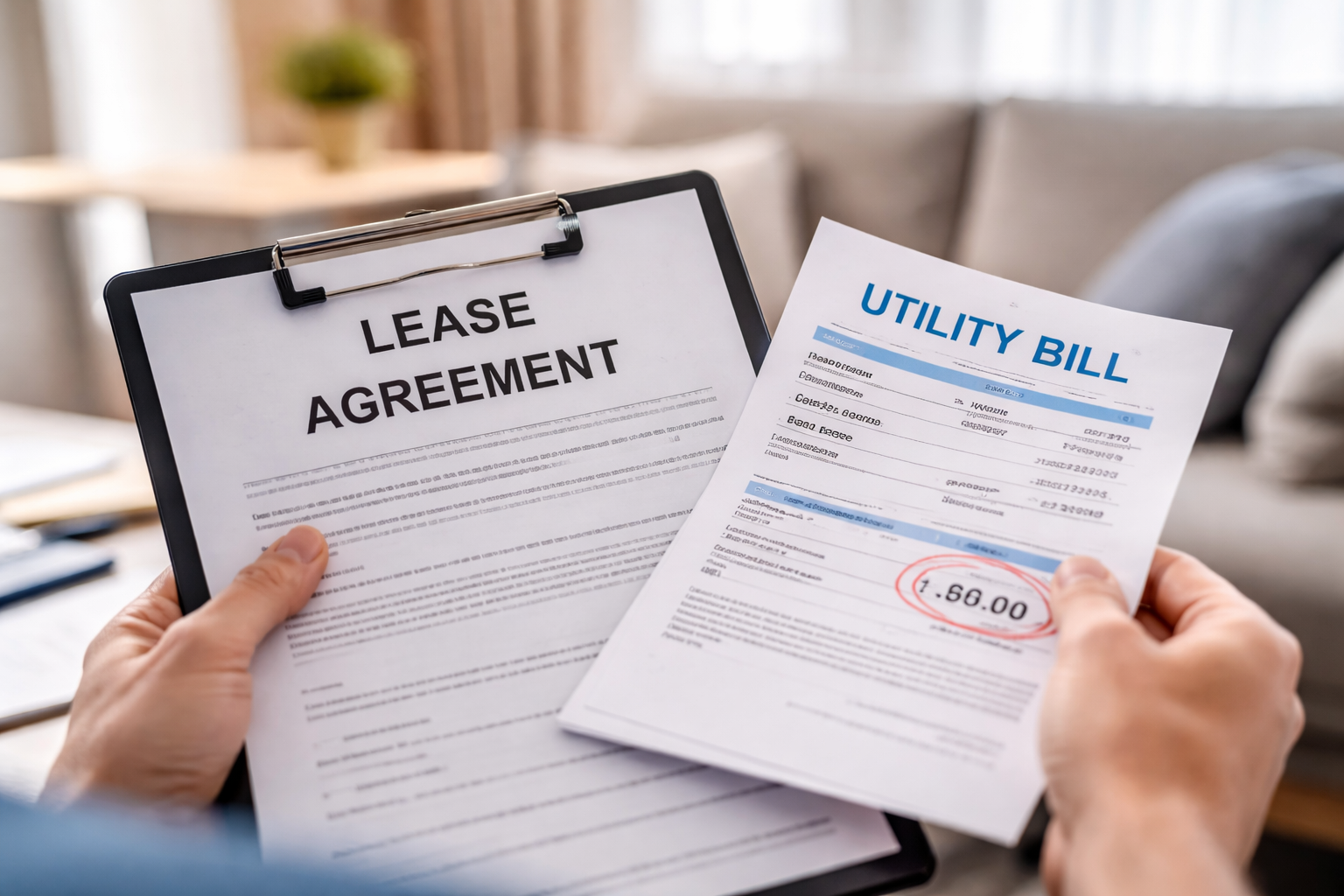
Landlord billed utilities separately even though lease says included was the first thought that hit me when I opened the resident portal and saw a balance that had not been there before. Rent was exactly where I expected it to be, but underneath it sat a new utility line that made no sense against the lease I had already signed and saved. I did not discover it through a formal notice. I found it the way tenants often do, by logging in to make sure nothing had changed and realizing something important had changed anyway.
For a minute I thought maybe I had misread the screen. Then I pulled up the lease, found the utilities section, and read it again. The wording still said included. The charge still sat there. That is when the problem becomes more serious than one monthly bill. When landlord billed utilities separately even though lease says included, the dispute is no longer only about a charge. It becomes a conflict between the signed contract and the account ledger, and once those two stop matching, every future month becomes less predictable. The real danger is not just paying one wrong bill. It is letting the wrong bill become part of the account history.
If this happened to you, slow down before you send a frustrated message that is too broad to work. In a landlord billed utilities separately even though lease says included dispute, the strongest position usually comes from a narrow comparison: what the lease says, what the landlord charged, when the charge first appeared, and whether any signed later document actually changed responsibility. Most tenants lose ground when they argue about fairness first instead of proving the mismatch first.
If you want the broader context for how landlord ledgers, account coding, and payment disputes can spiral into bigger problems, this hub is the best foundation before you go further.
Key Takeaways
- The signed lease matters first. A resident portal or management policy does not automatically override it.
- Not every utility charge is labeled clearly. Some landlords use terms like allocation, reimbursement, recovery, service billing, or common-area utility fee.
- The exact variation matters. Water, sewer, trash, gas, electric, admin fees, and building-wide allocations each need a slightly different review.
- Do not rely on phone calls. In writing is where billing disputes become real evidence.
- Move quickly if the charge begins affecting late fees or nonpayment notices. Once the disputed amount is folded into the total balance, the risk becomes larger.
Why This Happens More Often Than Tenants Expect
When landlord billed utilities separately even though lease says included, many tenants assume the landlord is openly ignoring the lease. Sometimes that is true, but many disputes start in a more mechanical way. A property changes management software. A building switches to a third-party utility billing vendor. A bulk utility arrangement gets converted into an allocation model. A renewal workflow changes account settings without someone reviewing older leases carefully. A staff member sees a unit in the system marked for utility billing and assumes the lease must already allow it. By the time the charge appears on the portal, the account is already behaving as if the change were normal.
That matters because it changes how you should respond. If the charge started because of a system configuration error, you want the landlord to recognize quickly that the account treatment does not match the contract. If the charge was intentional, you want the landlord to point to the specific clause or addendum they think authorizes it. In either direction, your leverage comes from narrowing the issue. You do not need to prove bad intent to win the first stage of this dispute. You need to prove that the billing record and the signed document are saying different things.
Another reason these disputes drag on is that utility language is often scattered across multiple documents. The main lease may say one thing. A utility addendum may say another. A renewal may introduce a different arrangement. A welcome packet may mention a third-party billing company. A resident handbook may refer to service fees that are not clearly defined in the lease itself. If landlord billed utilities separately even though lease says included, your job is not to read one sentence and stop. Your job is to rebuild the whole billing structure from the signed paperwork.
First review checklist
- The exact utilities paragraph in the lease
- Any utility or services addendum
- The renewal agreement, if one exists
- The first month’s ledger and the current ledger
- The wording attached to the new charge
- Any building-wide notice about billing changes
- Any vendor name listed next to the utility charge
If you cannot find a signed document supporting the separate charge, that absence is one of your strongest facts.
Read the Lease for Billing Authority, Not for General Meaning
Many tenants read the lease in a common-sense way. That is natural, but in a landlord billed utilities separately even though lease says included dispute, you need to read it as if you are tracing account authority. The question is not simply whether the lease sounds favorable. The question is whether there is any phrase the landlord can later rely on to justify the charge.
For example, “utilities included in rent” is strong language, but you still need to see whether another paragraph limits that promise. If a later section says the tenant may be responsible for submetered service, building allocation, excess usage, trash handling, or administrative utility fees, then the dispute becomes more specific. If the lease says “owner pays water and sewer” but is silent on electric and gas, that is a different problem from a lease that says all utilities are included. If the lease says included during the initial term but reserves the right to rebill at renewal, then timing becomes the central issue.
Words that seem small often control the result. “Included” is not always the same as “paid by owner.” “Provided” is not always the same as “not separately billed.” “May be allocated” can change an otherwise favorable paragraph. “Subject to utility addendum” means you cannot stop reading at the main lease. If landlord billed utilities separately even though lease says included, the dispute turns on whether the landlord can point to actual billing authority, not whether the portal looks official.
That is why your written message should never just say, “This seems wrong.” It should identify the exact lease language, the date the charge first appeared, the amount charged, and your request for either reversal or a copy of the signed document authorizing the billing method.
Different Billing Patterns Need Different Responses
The phrase landlord billed utilities separately even though lease says included covers several different fact patterns, and the deeper you understand which one you are in, the faster you can write an effective dispute.
Situation branch 1: Water, sewer, or trash suddenly added
This often points to a building-level allocation method or a third-party utility billing vendor. Look for an addendum describing allocation, ratio billing, occupancy formula, or utility recovery. If there is no signed support, the landlord has a harder time defending the change.
Situation branch 2: Electric or gas billed by landlord instead of direct provider
This may mean the building converted from direct tenant accounts to a submeter or pass-through model, or the management office is trying to capture common usage in tenant billing. Here, the question is whether the lease expected the tenant to establish service directly with the utility company or allowed landlord rebilling.
Situation branch 3: A flat “utility fee” appears with no detail
A vague line item can be harder to challenge unless you force clarification. Ask whether it is tied to actual usage, shared allocation, a service contract, common-area operations, or an admin charge. Ambiguous charges become easier for landlords to preserve when tenants never make them define the basis.
Situation branch 4: The charge starts right after renewal
This is where you compare the prior lease and the new lease line by line. Some tenants discover that the landlord did change the term at renewal. Others discover that the landlord assumed a building policy applied even though the signed renewal never actually changed utility responsibility.
Situation branch 5: The utility charge is now producing late fees or pay-or-quit pressure
This is the highest-risk version. The issue is no longer limited to a utility line. It is becoming a balance-enforcement problem. Preserve the dispute immediately, attach the lease, and track every deadline in writing.
These branches matter because the landlord’s defense changes depending on the pattern. If you dispute the wrong version of the problem, you waste time. If you name the right version, management has to answer a narrower and harder question.
If you want a closely related article about lease terms being treated differently after signing, this one supports the same kind of document comparison work.
What Landlords Usually Say Back
Once you raise landlord billed utilities separately even though lease says included, management responses often fall into predictable patterns.
One answer is that the charge is “standard for the building.” That may explain the practice, but it does not answer whether your signed lease allows it.
Another answer is that the charge is not technically a utility but a reimbursement, recovery, or allocation. Again, the label alone does not solve the contract issue. If the tenant is being billed money tied to utility cost, the landlord still needs a basis for doing that.
Another answer is that the system generated the charge automatically. That may be true, but a system rule is not self-validating. Software can be wrong in a way that still affects real balances.
Another answer is that a notice was sent to all residents. General notice is not always enough if the signed lease did not allow the change or if the notice did not correspond to a valid renewal process.
Another answer is that the tenant has already paid prior similar charges. That is why documentation timing matters so much. If you paid earlier charges to keep the peace but did not dispute them, the landlord may later treat that payment history as acceptance. If you are paying under pressure while challenging the charge, say that in writing the same day.
How to Build a Strong Written Dispute
The best written dispute is calm, exact, and easy to verify. In a landlord billed utilities separately even though lease says included situation, your goal is to force management to commit to a position supported by documents rather than habit or assumptions.
Your message should identify the lease clause, identify the exact charge, identify when it first appeared, and ask one of two things: remove the charge, or provide the signed lease provision, addendum, or renewal authorizing it. If the amount has affected your balance, state that you dispute the charge and request that no late fee, adverse note, or enforcement step be based on the disputed amount while the matter is reviewed.
This works because it narrows the landlord’s options. They can produce a signed document. They can admit the charge needs correction. Or they can refuse to answer clearly, which itself helps define the next step. A clean document request is often more effective than a long emotional explanation because it forces the issue into proof.
Keep copies of everything: lease PDF, screenshots of the ledger, portal screenshots showing charge descriptions, emails, resident messages, and any later notices. If landlord billed utilities separately even though lease says included and the issue expands into a late fee dispute, rent balance dispute, collections threat, or eviction notice, your evidence file becomes much more important than your memory of phone calls.
What Not to Do
Do not wait three billing cycles hoping the office will catch it on its own. Once the charge starts repeating, it becomes embedded in the ledger and may affect later account treatment.
Do not argue only by phone. A helpful phone conversation is still fragile if there is no written record afterward.
Do not pay the charge casually without preserving your objection. If you choose to pay temporarily to avoid escalation, say in writing that the charge is disputed and that payment is not agreement with the billing basis.
Do not make the message too broad. Saying the landlord is “violating the lease” without attaching the lease page is weaker than showing the exact wording and asking for the authority they rely on.
Do not ignore notices that mention nonpayment, late fees, pay-or-quit language, or eviction deadlines. In those versions, the dispute has already moved beyond a simple billing question.
Do not assume the landlord’s accounting team, on-site manager, and third-party vendor are working from the same information. Sometimes one side thinks the issue is resolved while another keeps posting the charge. That is why screenshots and follow-up comparisons matter month to month.
A Practical Path Forward
Start by collecting the full lease packet and any renewal. Then isolate every paragraph touching utilities, billing, services, reimbursement, and fees. Compare those documents with the ledger month by month. Identify the first appearance of the charge. Then send one concise written dispute with the lease language attached.
If management responds vaguely, send a second message that narrows the request further: identify the exact document authorizing separate billing for that utility and the effective date. If no answer comes, preserve the file and keep checking the ledger to make sure new fees are not quietly stacking on top of the disputed amount.
For broader official renter guidance, you can review the FTC’s current renter issues page here: official FTC renter issues guidance.
FAQ
Can a landlord bill utilities separately if the lease says included?
Not just because the portal says so. The central question is whether the signed lease, addendum, or renewal actually authorizes separate billing.
What if the landlord says it is a utility allocation and not a utility bill?
The name alone does not settle the issue. You still need to see whether your lease allowed that kind of charge.
What if I already paid one or two months of the charge?
You can still dispute it, but it is better to preserve the objection in writing as soon as possible so payment is not treated as silent acceptance.
What documents matter most?
The signed lease, any utility addendum, renewal terms, ledger screenshots, charge descriptions, and dated written messages matter most.
What if this charge now affects my total balance due?
That raises the risk level. Watch for late fees, notice language, and any claim that rent is unpaid when the dispute is really about billing classification.
Before the Utility Charge Becomes a Ledger Problem
Landlord billed utilities separately even though lease says included can start as a confusing line item and quickly become something much more serious once it changes how the account is coded, how payments are applied, and whether the landlord begins treating part of the balance as delinquent. The earlier you pin the dispute to the lease language, the easier it is to stop the problem from growing into a larger account conflict.
That is why the right move is not silence, delay, or a loosely worded complaint. The right move is to compare the signed lease to the charge, dispute the mismatch in writing, request documentary support for any claimed billing authority, and keep watching the ledger for secondary damage. If the landlord billed utilities separately even though lease says included, do not let the portal become the final version of the story before the documents are compared.
If the account is already showing balance confusion, payment application issues, or resistance to correcting the ledger, read this next before the dispute gets harder to unwind.