
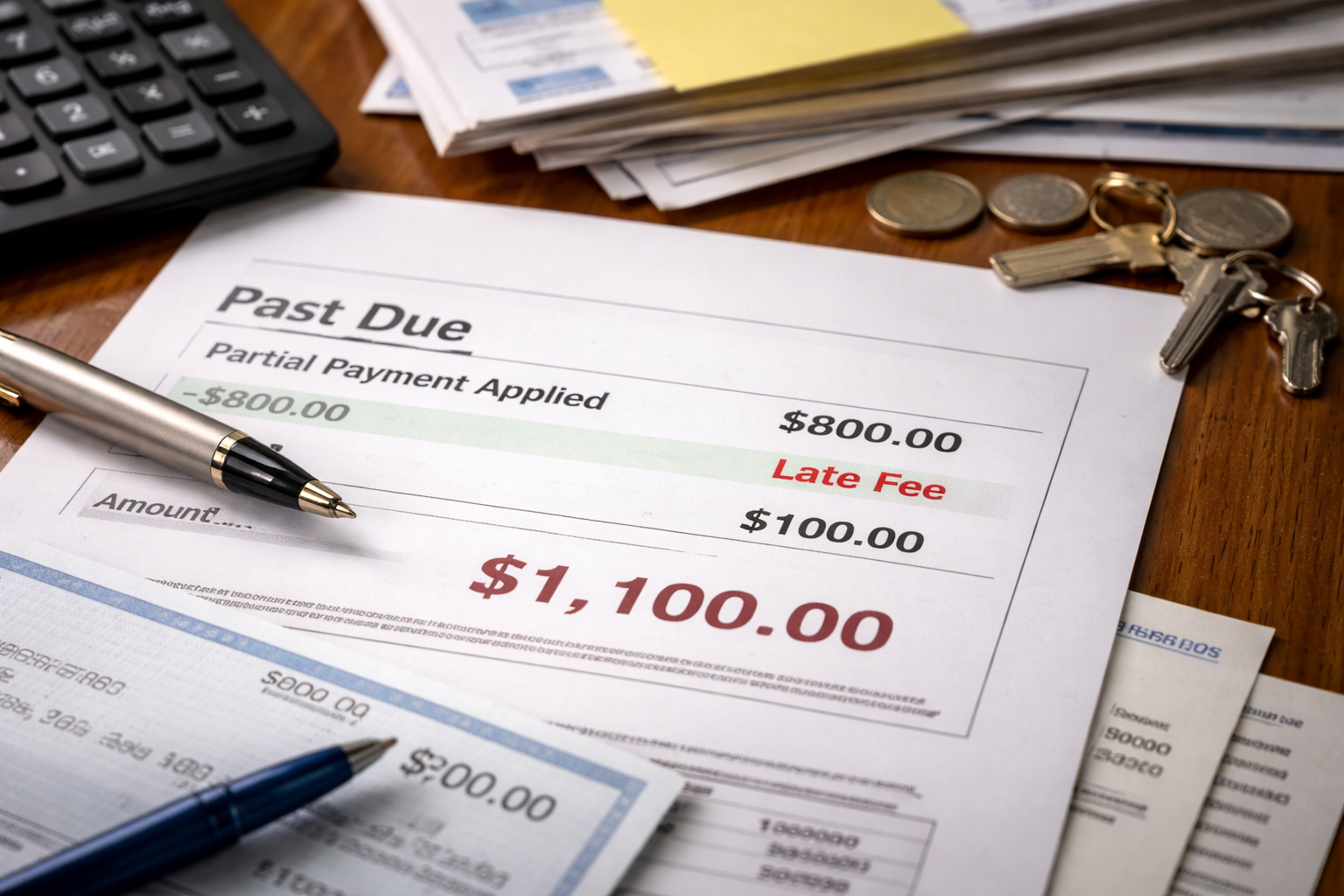
Landlord Applied Partial Payment but Still Charged Full Late Fee was the exact problem sitting on my screen when I logged into the rent portal after work. The payment I had made was there. The transaction history showed money received. My bank account balance was lower. But the total due still looked wrong, and right underneath it was a late fee charged as if the system had ignored everything I had just paid.
It was not the kind of mistake that makes noise right away. It was worse than that. It looked official. Clean numbers. A neat ledger. A portal status that seemed final. The system had accepted part of my payment, but it was still treating me like I had failed to pay rent on time in full. That is the moment this issue becomes serious, because once the ledger labels you late, every next step gets harder: notices, extra fees, collection risk, and arguments that start with “the system shows.”
If you are dealing with Landlord Applied Partial Payment but Still Charged Full Late Fee, the most important thing to understand is that this usually is not a random typo. It is often the result of how rent systems are programmed, how leases define “timely payment,” and how landlords apply money when the full balance is not covered by the due date.
Before going further, start with the closest hub page on how rent posting issues happen inside rental systems. It will help you understand the logic behind what you are seeing:
Read this first if you need the big-picture system view behind rent ledger errors and posting delays.
Why this happens even when you paid something
When Landlord Applied Partial Payment but Still Charged Full Late Fee happens, tenants usually assume the landlord ignored the payment. Sometimes that is true, but often the real problem is narrower and more mechanical. The payment was received, but the system did not consider the rent obligation fully satisfied by the deadline.
In many rental systems, there are only two practical statuses that matter for monthly rent:
Paid in full by the required deadline.
Not paid in full by the required deadline.
There is often no middle setting where “mostly paid” avoids a penalty. If the lease and the software both expect the full monthly amount by a specific date, a partial payment may reduce the balance but still trigger the same late fee that would apply to a larger unpaid balance.
That is why Landlord Applied Partial Payment but Still Charged Full Late Fee can happen even when your payment was real, timely, and visible on your bank statement. The money and the compliance status are not always treated as the same thing.
What the landlord system may have done with your money
One reason Landlord Applied Partial Payment but Still Charged Full Late Fee is so confusing is that the portal may show one number while the internal allocation logic follows a completely different sequence. Your payment may not have gone where you assumed it went.
Depending on the lease, the ledger rules, and the property manager’s software settings, a partial payment may have been applied in one of several ways:
Allocation path 1: Old balance first
If you had any prior unpaid balance, even a small one, the payment may have been routed there before touching this month’s rent.
Allocation path 2: Fees first
Some systems apply incoming money to late fees, utilities, legal charges, or other non-rent items before current rent.
Allocation path 3: Current rent but still below threshold
The money may have gone to current rent, but because the full amount was still not satisfied by the deadline, the late fee rule triggered anyway.
Allocation path 4: Holding or pending status
The system may have received the payment but not finalized posting before the cutoff time used for late fee calculation.
Allocation path 5: Split ledger issue
In some buildings, rent, concessions, parking, utilities, and fees are tracked separately. A payment can look posted in one area while another area still causes the account to be marked delinquent.
Until you know exactly how the money was allocated, you do not really know why the late fee appeared. That is the difference between a frustrating situation and a solvable one.
The most common versions of this problem
Landlord Applied Partial Payment but Still Charged Full Late Fee is one search phrase, but in practice it usually falls into several distinct patterns. Knowing which one you are in will tell you how to respond.
Version A: You paid after the due date, but before the landlord noticed
The payment was accepted, but the system had already triggered the late fee. In this version, the landlord may say the charge is proper because the lease only protects you if the full amount arrives before the due date or before the grace period ends.
Version B: You paid before the deadline, but the portal posted later
This is more favorable for the tenant. If you can show timestamp proof that the payment was initiated before the cutoff, you may have a stronger argument that the fee should be reversed.
Version C: You paid part of the rent during a difficult month
This is one of the hardest versions emotionally because the payment reflects good-faith effort, but the ledger may still apply the same penalty as though nothing meaningful was paid. The question here is whether the lease permits that result, and whether the landlord followed the lease exactly.
Version D: The landlord accepted a payment arrangement verbally
You were told it would be “fine” to send part now and the rest later, but the ledger still added a full late fee. If the arrangement was not entered into the system or confirmed in writing, the account may have defaulted back to the standard lease rules.
Version E: The money was applied to the wrong charge category
This is where the payment exists, but current rent still looks unpaid because the system first satisfied fees or earlier balances. This version can often be documented and challenged more effectively than a simple “I paid late but not by much” argument.
What the lease usually controls
Tenants often approach this issue from a fairness angle. That makes sense, but fairness does not always move a ledger. Contract language does. When Landlord Applied Partial Payment but Still Charged Full Late Fee happens, the lease usually controls three things that matter immediately:
The date rent is due.
Whether there is a grace period.
How and when late fees may be charged.
Some leases are very clear that rent must be paid in full by a specific date, and that partial payment does not waive penalties or default status. Others are less precise, which may give you room to dispute the fee if the landlord’s system applied a rule more aggressively than the lease allows.
The most important sentence in your lease is often not the late fee amount. It is the sentence that explains whether full payment is required to avoid default.
If the lease says the full rent amount must be received by a certain date, then a partial payment may reduce what you owe while still leaving the late fee intact. If the lease is ambiguous, the landlord’s automatic system may not deserve the last word.
How landlords usually see this situation
It helps to understand the landlord side, not because they are always right, but because it explains the response you are likely to get. When Landlord Applied Partial Payment but Still Charged Full Late Fee appears on the ledger, property managers usually see one of the following:
The tenant did not satisfy the full rent obligation by the deadline.
The software applied the standard late fee rule.
The account is technically not current, regardless of partial payment.
That means you may get a short response such as “partial payment does not stop late charges” or “the account was not paid in full.” From their perspective, the issue is already resolved by the lease and the system settings.
But that does not mean the ledger is beyond challenge. If the landlord accepted a specific arrangement, misapplied the payment, posted it late internally, or charged in a way the lease does not support, the fact that the portal shows a number does not make that number untouchable.
How to figure out whether this is a true error or just a harsh rule
This is the step most tenants skip, and it is the reason they lose time arguing in the wrong direction. To determine whether Landlord Applied Partial Payment but Still Charged Full Late Fee is an actual billing error or a strict lease outcome, you need four pieces of information:
1. Payment timestamp
When was the payment initiated, and when was it actually posted?
2. Allocation record
Where exactly did the money go first?
3. Lease language
Does the lease require full payment to avoid a fee? Does it mention grace periods or allocation rules?
4. Prior balance history
Was there any unpaid amount from before that the payment may have been absorbed into?
If the payment was timely, allocated incorrectly, or charged contrary to the lease language, that is a dispute with substance. If the lease clearly requires full monthly payment and your payment did not satisfy that threshold, you may still ask for a courtesy reversal, but the argument is different.
What to do right away
If you are in the middle of Landlord Applied Partial Payment but Still Charged Full Late Fee, do not start with a long emotional explanation. Start with documentation and sequencing.
Step 1: Save proof of payment
Download the payment confirmation, bank transaction, portal screenshot, and any email receipt.
Step 2: Request the full ledger in writing
Ask for a written rent ledger showing all current charges, prior balances, payment dates, and how the payment was applied.
Step 3: Compare the ledger to the lease
Look for due date language, grace period language, and whether the lease addresses partial payments or the order of application.
Step 4: Write a narrow dispute
Do not write “this is unfair.” Write: “Please confirm how my payment dated [date] was applied and explain the basis for the full late fee under the lease.”
Step 5: Act before the next notice cycle
If this stays unchallenged, it can lead to additional fees, pay-or-quit notices, or downstream collection problems.
The longer an incorrect ledger sits, the easier it becomes for the landlord to treat it as settled history.
If your payment was applied to the wrong place
Some of the strongest disputes arise when Landlord Applied Partial Payment but Still Charged Full Late Fee happened because the payment was routed somewhere other than current rent. That does not automatically mean the landlord acted unlawfully, but it does mean you need clarity before accepting the late fee as valid.
If the system applied the payment to old rent, miscoded charges, or administrative fees first, current rent could remain short on paper even though you believed you were paying this month’s obligation. That is why a payment can feel “counted” and “not counted” at the same time.
If your facts point in that direction, this related article may help you compare what happened in your own account:
Use this if you suspect your payment was received but redirected away from current rent.
Mistakes that weaken your position
When Landlord Applied Partial Payment but Still Charged Full Late Fee happens, tenants often make the situation harder by doing one of the following:
Assuming the portal tells the full story.
Relying on a phone call rather than getting the explanation in writing.
Paying additional amounts without first confirming the ledger structure.
Ignoring the issue because the late fee looks small compared to rent.
Waiting until an eviction notice or collection letter arrives.
A late fee is not always just a fee. Sometimes it is the first visible sign that the account is being coded as delinquent in a way that can create bigger problems later.
For a general HUD overview on renter and tenant rights, including how rights are often governed by state law and where to find additional housing counseling resources, see:
HUD FAQ: What rights do I have as a tenant or renter?
When this starts turning into an eviction problem
One reason Landlord Applied Partial Payment but Still Charged Full Late Fee deserves fast attention is that partial payment disputes can turn into notice disputes quickly. In some situations, a tenant believes the account is mostly current, while the landlord system sees unpaid rent plus late charges. That gap matters.
If you have already received a pay-or-quit notice, nonpayment warning, or eviction-related communication after making a partial payment, read this next because the timeline changes once notices start moving:
This next guide is the right follow-up if your late-fee dispute is starting to overlap with nonpayment enforcement.
Key Takeaways
Landlord Applied Partial Payment but Still Charged Full Late Fee usually means the system recognized the payment but did not recognize full compliance with the lease deadline.
Partial payment does not always reduce or prevent late fees, especially when the lease requires the full rent amount by a specific date.
Your payment may have been applied to old balances, fees, or another ledger category before touching current rent.
The right question is not only “did I pay?” but also “how was my payment applied, and what does the lease say that should have happened next?”
The fastest path to fixing this is to get the written ledger, match it against your lease, and dispute the exact allocation or fee basis in writing right away.
FAQ
Can a landlord charge a full late fee even if I paid most of the rent?
Yes, that can happen if the lease requires the full monthly rent amount to be paid by the due date or by the end of the grace period. A partial payment may reduce the outstanding balance without changing the account’s late status.
Does accepting a partial payment mean the landlord waived the late fee?
Not necessarily. Acceptance of a partial payment does not always waive penalties, default status, or future enforcement unless the landlord agreed to that in writing or the lease says otherwise.
What if the rent portal posted my payment late even though I paid on time?
That can matter. Keep timestamp evidence, payment confirmations, and bank records. If the payment was initiated before the deadline but posted later due to internal processing, you may have a better argument for fee reversal.
What if my payment was applied to fees or an older balance first?
Then the current month may still appear unpaid on the ledger, which can trigger a late fee. Request the written allocation history so you can see exactly what happened.
Should I just pay the late fee now and argue later?
That depends on your risk level and notice status, but you should understand the ledger first. In some situations paying quickly may reduce escalation risk, but you should still preserve your written dispute and documentation.
Conclusion
The worst part of Landlord Applied Partial Payment but Still Charged Full Late Fee is that it makes you doubt your own records. You know money left your account. You know you made an effort to cover rent. But the ledger presents a different version of the story, one that can start shaping what happens next unless you challenge it with better documentation.
This issue is fixable when you treat it as a system and contract question instead of a personal argument. Pull the payment proof, request the full ledger, compare it to the lease, and force the landlord or manager to explain exactly why the full late fee was charged. Do that now, in writing, before this turns into a bigger balance problem than it needs to be.