
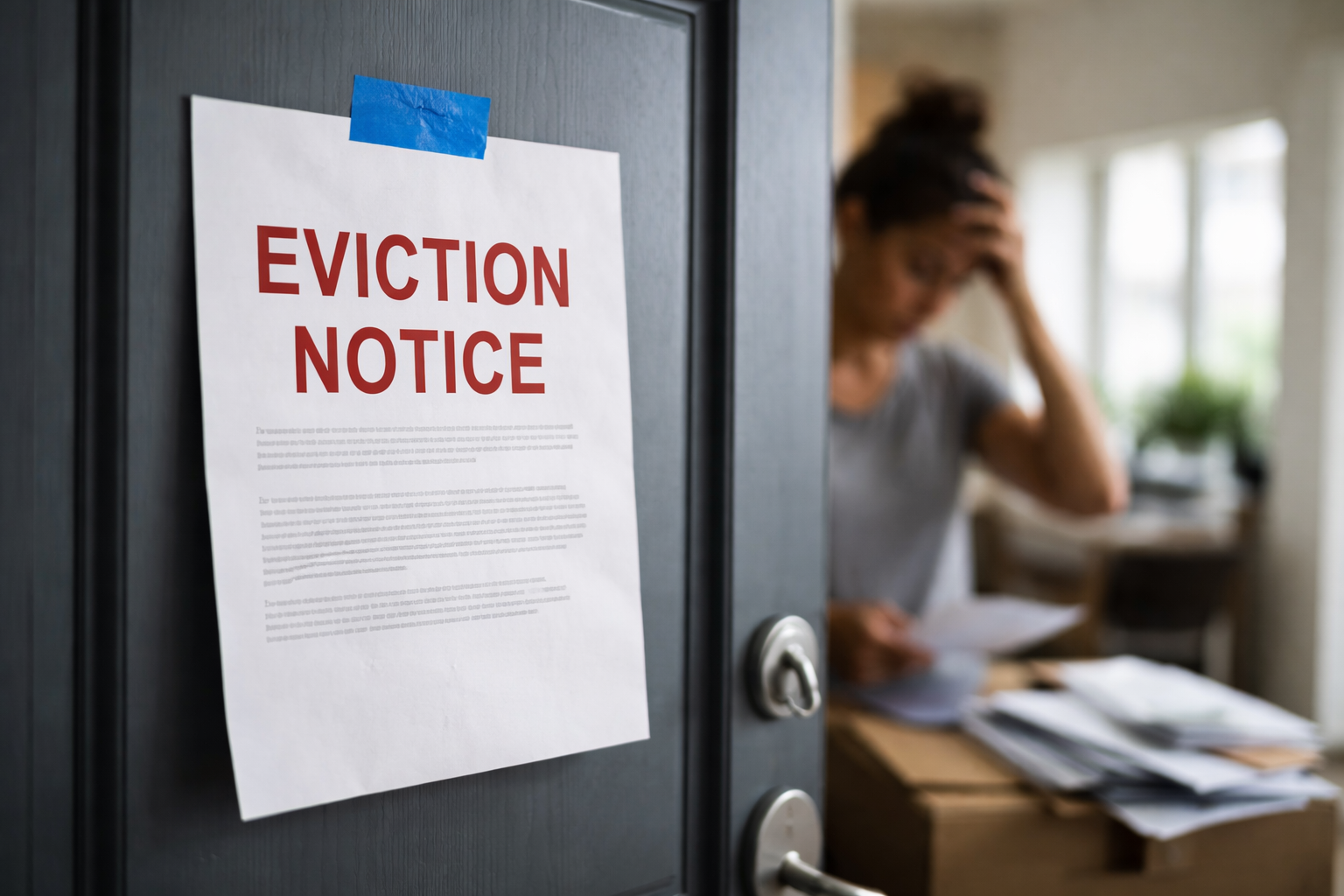
Eviction Notice for Unpaid Rent After Partial Payment hit me in the gut because it felt like I had done the responsible thing. I didn’t disappear. I didn’t dodge calls. I paid what I could—immediately—thinking that would “reset” the situation. Then I saw the notice. Same threat. Same deadline. Same warning about court.
I remember standing in the hallway with my phone open to my bank app, zooming in on the transaction like the screen itself could argue for me. When you’ve paid part of the rent and still received a notice, the next 24–72 hours are about evidence, timing, and written positioning—not hope.
If your landlord is claiming your rent is unpaid even though your payment shows as processed or pending, start here because it overlaps with how landlords build their ledger:
Why This Notice Can Still Be “Valid” After You Paid Something
An Eviction Notice for Unpaid Rent After Partial Payment often continues because many states treat partial payment as “not cured” unless the full amount demanded is paid by the notice deadline. In plain terms: the landlord’s legal claim is usually “rent is still owed,” not “tenant paid nothing.” That difference matters because courts care about whether the default was fully fixed within the required window.
But there’s a second layer that tenants miss: the landlord’s conduct after accepting partial money can sometimes change the landlord’s ability to rely on the notice, depending on state law and how the payment was accepted. This is why your receipts, messages, and the exact timeline are not “nice to have.” They’re the foundation.
Think of it like this: a notice is a legal step. Partial payment is a financial step. Your job is to connect them with documentation so the court (or the landlord) can’t pretend the partial payment never happened.
Fast Checklist: Pin Down Your “Timeline” Before You Do Anything Else
Before you call anyone, build a one-page timeline. You’ll use it for negotiation, mediation, and court if it gets that far.
- Notice date: When the notice was served (door, mail, email, portal)
- Deadline date: The last day to pay or cure (as written on the notice)
- Payment date/time: When you initiated the partial payment
- Payment method: Zelle, ACH, portal, cashier’s check, money order, cash
- Acceptance proof: Receipt, portal confirmation, bank settlement, text acknowledgment
- Communication: Any landlord response about “balance still owed” or “payment refused”
If you cannot clearly answer “Was my payment made before the deadline, and was it accepted?” you’re negotiating blind.
Your Partial Payment Changes Things Only in Certain Scenarios
Case 1 — You paid partial rent BEFORE the notice deadline AND the landlord accepted it with no warning.
This is the best leverage scenario. In some states, accepting partial rent without a clear reservation (“this does not waive eviction”) can weaken the landlord’s ability to claim the notice remains fully enforceable. It does not guarantee the eviction stops, but it may support a defense or push the landlord to resolve through agreement rather than court.
Case 2 — You paid partial rent BEFORE the deadline, but the landlord accepted it while stating “balance still due / eviction continues.”
This is common with portals that automatically issue receipts. If the landlord’s written communication clearly says the notice continues unless paid in full, your partial payment usually does not stop the timeline. Your best move is to either pay the remaining amount within the deadline or get a written settlement agreement.
Case 3 — You paid partial rent AFTER the deadline listed on the notice.
The landlord can argue you failed to cure in time. Acceptance after the deadline may be treated as “credit toward balance,” not a cancellation of the notice. Your leverage shifts to negotiating a dismissal or a move-out plan that avoids judgment.
Case 4 — You paid partial rent AFTER the landlord already filed in court.
At this point, the notice is usually no longer the main issue—the court case is. Partial payment may not pause proceedings unless the landlord agrees in writing to dismiss or the court requires mediation. Your focus becomes: answer deadlines, proof of payment, and settlement terms.
Case 5 — The landlord REFUSED the partial payment (or returned it) but you can prove you tried.
This can help you argue good-faith effort and may influence a judge’s view or a mediator’s recommendation. It won’t erase arrears, but it can prevent the “tenant ignored everything” narrative.
Case 6 — Your payment shows “pending” or “processing,” and the landlord claims it never arrived.
This overlaps with payment processing disputes. You need written confirmation of transaction ID, and you should request the landlord’s ledger and portal history. Processing delays can destroy your timeline if you don’t document them immediately.
Notice how each case changes what you should do next. An Eviction Notice for Unpaid Rent After Partial Payment is not a single situation—it’s a category of situations. The right response depends on which box you’re in.
What Landlords Usually Do (So You Can Predict the Next Move)
Landlords are often following a playbook: serve notice, wait for cure period, then file if balance remains. Partial payment creates uncertainty for them, so many landlords respond by tightening documentation—issuing ledgers, clarifying “balance still owed,” and moving forward unless they receive the full amount.
Here’s what you should assume unless you have written confirmation otherwise:
- The landlord will treat partial payment as a reduction, not a cure.
- The notice deadline still matters even if money changed hands.
- If filing is cheap and fast in your area, they may file quickly.
Your advantage comes from being the person with clean records and clear asks.
Your Rights as a Tenant (Without the Textbook Lecture)
You don’t need a legal essay—you need the practical leverage points:
- Right to a ledger: You can request a detailed breakdown of rent, late fees, credits, and the remaining balance.
- Right to dispute errors: If the ledger is wrong (misapplied payment, duplicate fee), you can challenge it in writing.
- Right to notice and process: Many evictions require proper service and timing. If the landlord jumps steps, that matters.
- Right to be heard: If a court case exists, you typically have a deadline to respond. Missing it is dangerous.
For an official federal resource on tenant rights and rental assistance information, you can reference HUD:
The “48-Hour Plan” That Works in Most States
If an Eviction Notice for Unpaid Rent After Partial Payment is sitting in your hands, do this in order. Not later. Not after you “calm down.” In order.
- Get the ledger in writing. Ask: “Please send the current rent ledger showing charges, credits, and remaining balance as of today.”
- Confirm whether a court filing exists. Ask directly: “Has an eviction been filed in court yet?” If yes, request the case number.
- Send a written payment confirmation. Include date/time, amount, method, transaction ID, and a screenshot.
- Ask one clear question. “If I pay the remaining balance by [date], will you confirm in writing that the notice will be withdrawn or the filing dismissed?”
- Set your “stop-loss.” If you cannot pay in full, decide what you can do: payment plan, rental assistance, mediation, or move-out plan to avoid judgment.
The goal is to force clarity: either cure the balance fully or convert this into a written agreement that prevents a judgment.
If You Can Pay the Remaining Balance: Do It the “Court-Proof” Way
When the balance can be paid, speed and proof matter. Choose methods that generate strong documentation.
- Best: portal payment with receipt + bank settlement
- Strong: cashier’s check/money order with copy + delivery proof
- Risky: cash without a detailed receipt
If you pay, send one short written message immediately after:
- “I paid the remaining balance of $___ on ___ at ___. Please confirm receipt and confirm the notice is withdrawn.”
Polite, short, written. That’s what holds up.
If You Cannot Pay in Full: The Negotiation Angle That Actually Moves Landlords
Landlords are not persuaded by long stories. They respond to certainty. If you can’t pay in full, your job is to offer a plan that is more predictable than court.
Use this structure:
- State the exact remaining balance you are requesting
- Propose dates and amounts (not “soon”)
- Offer a one-time partial now + fixed dates later
- Ask for a written agreement to pause/dismiss eviction
If you want a deeper negotiation playbook for remaining balances, use this related guide:
In an Eviction Notice for Unpaid Rent After Partial Payment situation, negotiation works best when you can show:
- you already paid something
- you have a realistic timeline for the rest
- you want a written resolution
Do Not Make These Mistakes (They Blow Up Otherwise Winnable Situations)
- Waiting for the landlord to “update the system.” If the deadline hits first, your payment may not protect you.
- Relying on a verbal promise. “Don’t worry” is not a legal defense.
- Paying without specifying what it’s for. If you owe fees and rent, you want your payment applied to rent first.
- Missing your court response deadline. This is how defaults happen.
- Sending emotional messages. Keep it factual and short.
The fastest way to lose is to treat this like a normal billing problem instead of a legal-timing problem.
How to Tell If This Will Turn Into Collections (And How to Block That Path)
Even if you move out or settle later, unpaid rent can sometimes end up in collections, especially after a judgment. If you see signs that the landlord is turning the balance into a third-party debt, you need to tighten your documentation now.
Collections risk rises when:
- you stop communicating
- a judgment is entered
- the landlord’s ledger remains disputed but unresolved
Preventing a judgment is often the difference between a painful month and a multi-year credit issue.
FAQ
Does partial payment automatically stop an eviction?
Usually no. Many notices require full payment by the deadline to cure the default.
Can a landlord accept partial rent and still file?
Often yes, especially if they clearly state the balance is still owed or the acceptance is not a waiver.
What if I paid before the deadline but still got served?
Document the payment and demand a ledger. Ask for written confirmation whether the notice is withdrawn. If filing happens, bring proof.
What if my payment is pending?
Get transaction IDs and screenshots. Send written notice to the landlord immediately and request a ledger to confirm posting.
Key Takeaways
- Eviction Notice for Unpaid Rent After Partial Payment is mainly about deadlines and proof.
- Partial payment helps your narrative, but it does not always cure the default.
- Written ledger + written confirmation creates leverage fast.
- Your best outcomes come from paying in full or getting a written settlement before court.
If you already paid and still received a notice, you may also want to compare your situation to the “already paid” scenario so you can avoid mixing the two in court or negotiation:
Eviction Notice for Unpaid Rent After Partial Payment is one of those situations where being “mostly right” doesn’t protect you unless you can prove it and act within the timeline. You don’t need perfect wording—you need a clean record, a ledger, and a written yes/no answer about whether paying the remainder will end the process.
Here’s the safest next step: today, request the ledger, send your payment proof, and ask for written confirmation of the exact amount needed to cure. If you can pay the remainder, do it in a documented way and demand written confirmation the notice is withdrawn. If you can’t, propose a specific written plan that the landlord can accept instead of filing. That’s how you keep this from becoming a judgment and a long credit problem.