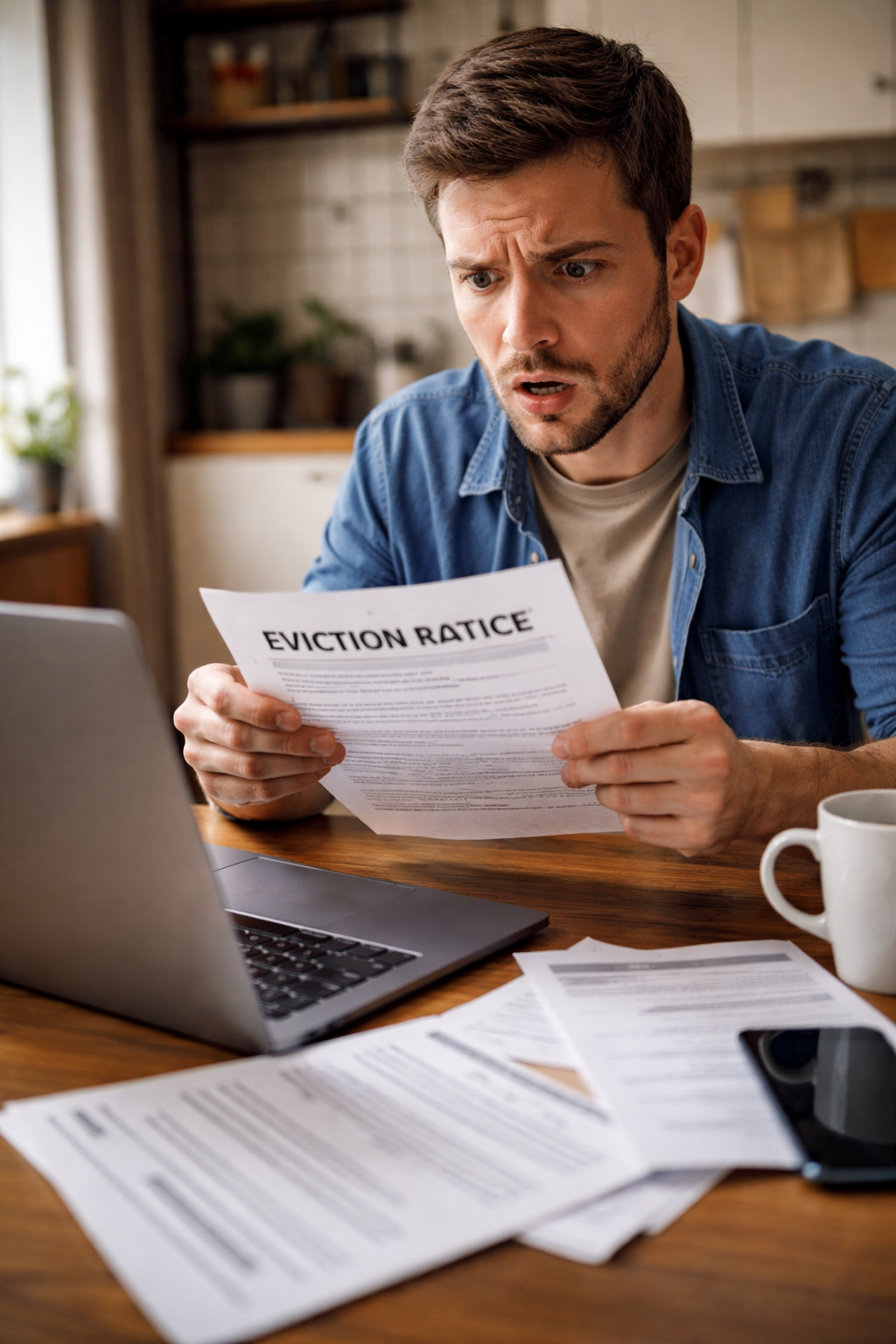
Rent payment triggered eviction filing due to system auto-status update before posting was not a sentence I expected to understand from experience. The first sign was small enough to ignore if I had wanted to: the portal still showed a balance even though my bank no longer did. I refreshed it once, then again, thinking it was the usual lag. A lot of tenant systems are slow. A lot of portals are messy. So when I saw the unpaid status sitting there after the payment had already left my account, I tried to talk myself into believing it was ordinary. Then the notice came through. Not a late reminder. Not a routine account message. A filing notice. That was the exact moment the situation changed from annoying to dangerous. The money had moved, but the system had already made a decision without waiting for the ledger to catch up.
Rent payment triggered eviction filing due to system auto-status update before posting is the kind of problem that makes tenants feel like they are losing an argument against a machine. You know you paid. Your bank proves it. The amount is gone. But the property system is not looking at your bank app. It is looking at an internal status field, a posting timestamp, a balance snapshot, and a compliance rule that may have fired hours before your payment was actually posted. Once that automated sequence starts, the issue is no longer just whether money was sent. The issue becomes whether the system recognized that money before the eviction workflow was allowed to run.
If you want the closest foundation article first, this hub explains how posting errors start, how they spread across landlord systems, and why they can become much more serious than a simple display problem:
What usually happened before you ever saw the notice
Rent payment triggered eviction filing due to system auto-status update before posting usually begins long before a tenant realizes there is a problem. The payment event and the rent-account event do not happen at the same time. In many systems, they are not even controlled by the same platform.
A payment may pass through several stages:
the tenant initiates payment, the bank authorizes or settles it, the processor sends a file or signal to the management software, the ledger receives the amount, and then the account status updates. If any one of those steps lags, the account can still appear unpaid even though the tenant has already done what they were supposed to do.
This is the core danger: payment reality and account reality are often separated by hours, sometimes by a full business cycle, and automated legal or compliance actions can happen inside that gap.
That is why tenants get trapped by language like “completed,” “accepted,” “submitted,” or “processing.” Those words feel final. In many rent systems, they are not. They may only mean the payment entered the pipeline, not that it reached the ledger that determines whether the account is safe from escalation.
Why the system cared more about posting than about your bank
Rent payment triggered eviction filing due to system auto-status update before posting does not usually happen because someone personally reviewed your bank activity and ignored it. It happens because the system is built to act on internal posting rules, not on external payment proof.
From the landlord or property manager side, the operational question is often simple: did the ledger show the required amount by the cutoff that controls delinquency status? If the answer inside the software was no, the system may have been allowed to switch the account into a more severe status automatically.
That status may trigger a chain like this:
balance due → delinquent status → default status → legal review queue → filing preparation → notice or filing submission
Once the account crossed the system’s threshold, your payment could still be real and still be too late for that particular automated checkpoint.
This explains why tenants hear frustrating statements that sound contradictory but are technically true:
“Yes, we see the payment now.”
“Unfortunately, the filing had already started.”
“The account was unpaid at the time of review.”
“We need time to reverse the status.”
All of that can happen in the same case because the system tracks events by timestamps, not by fairness.
The timing traps that create the biggest damage
Rent payment triggered eviction filing due to system auto-status update before posting is most often driven by one of a few timing traps. These traps matter because they determine how you frame the problem when you contact management.
You paid on the due date or right before the grace period ended, but after the landlord system’s posting cutoff. Your bank activity looked current, but the ledger snapshot used for delinquency review had already been taken.
Translation: you were late only from the system’s point of view, not necessarily from the tenant’s point of view.
You paid on Friday night, Saturday, Sunday, or near a holiday. The bank confirmation appeared, but the property software did not update until the next business day. The automated status job, however, still ran on schedule.
Translation: the payment existed, but the ledger stayed stale long enough to trigger escalation.
The payment processor accepted the transaction and marked it successful, but the property manager’s ledger had not received or reconciled the file yet.
Translation: the payment was alive in one system and invisible in the one that mattered most.
Your payment may have been routed for review because of a partial amount, a prior NSF history, a mismatched unit number, a payer-name inconsistency, or a duplicate-detection flag. During that review, the account remained exposed.
Translation: the system froze the payment pathway without freezing the eviction pathway.
Detailed situation mapping so you can identify your version fast
Rent payment triggered eviction filing due to system auto-status update before posting is not one single fact pattern. The details matter, because the strongest argument changes depending on when and how you paid.
This usually points to a posting pipeline failure, file transfer delay, wrong-account routing, or duplicate/exception review. Your strongest angle is that the payment should have protected the account before any delinquency status was triggered.
What to gather immediately:
• bank timestamp
• payment confirmation number
• screenshot of portal status
• any email proving successful submission
Your central point here is not “I intended to pay.” It is “the payment existed before the system escalated me.”
This is the most common grey-zone version. You may have paid within what felt like the allowed time, but the landlord’s internal cutoff may have been earlier than midnight, earlier than the portal implied, or tied to a business-day close. Your strongest angle is timing mismatch, not innocence narrative.
What to focus on:
• exact payment initiation time
• whether the lease or portal disclosed a cutoff
• whether the grace period language was clear
• whether the payment method normally posts same day or next day
The system may already have pushed your account into a legal-prep queue before the ledger updated. Your strongest angle is to show the payment reached the system before actual filing completion, service, or further action.
This version is about interrupting escalation quickly, not arguing over whether the account was ever marked delinquent.
Third-party payments create more delay points: approval delay, remittance delay, matching delay, and ledger application delay. The account may have been technically unpaid in the landlord system even while assistance was already in motion.
Your strongest angle is documentation of the remittance timeline and proof that the landlord had notice of incoming funds or already received them.
Why property managers often sound unhelpful even when they are not ignoring you
Rent payment triggered eviction filing due to system auto-status update before posting often turns into a communication problem because front-office staff may not control the part of the process that hurt you.
The leasing office or property manager may be able to see that a payment is now present. But they may not be the ones who can remove legal flags, cancel filing requests, or unwind a compliance status. In larger operations, those functions may belong to regional management, centralized accounting, or outside counsel.
This is why simple conversations at the front desk often go nowhere: the person speaking to you may see the problem but not have authority to reverse the workflow that already started.
That does not mean you stop there. It means you need your request framed correctly. You are not just asking, “Can you see that I paid?” You are asking for an account-status correction, a timestamp review, and if necessary, a legal-queue hold or withdrawal request based on the payment timeline.
The exact proof that matters most
Rent payment triggered eviction filing due to system auto-status update before posting is one of those disputes where vague proof is not enough. “I paid” is too general. “Here is the timestamp, confirmation number, payment method, amount, and portal status before and after” is much stronger.
The most useful proof usually includes:
• the exact date and time the payment was initiated
• the exact amount sent
• the payment method used
• the bank or processor confirmation
• screenshots showing the portal still reflected a due balance
• any notice showing when the account moved into eviction or legal status
You are building a timeline, not a complaint.
That timeline matters because it lets you ask the right question: when did the system change my account status relative to when my payment was initiated, accepted, received, and posted?
If your account still shows money missing or in limbo rather than fully posted, this companion article helps explain that middle stage clearly:
What tenants often do wrong in the first 24 hours
Rent payment triggered eviction filing due to system auto-status update before posting gets worse when tenants react emotionally without organizing the sequence of events.
Common mistakes include:
calling repeatedly without sending documentation, arguing about fairness before proving the timestamps, assuming the system will fix itself overnight, making a second payment without understanding what the first one is doing, or ignoring early legal language because the bank already shows the payment went through.
The most expensive mistake is waiting for the portal to “catch up” while the filing side keeps moving forward.
A second common mistake is focusing only on the landlord’s conduct and not on the system structure. You may eventually have legal or procedural arguments, but the immediate goal is simpler: stop further automated harm, correct the account status, and create a written record that ties your payment to the escalation error.
What to do right now if this is happening to you
Rent payment triggered eviction filing due to system auto-status update before posting needs fast, structured action. The safest immediate sequence looks like this:
First, save every timestamp you can find right now. Do not assume you will be able to reconstruct them later from memory. Take screenshots of your bank activity, confirmation email, payment portal, notice date, and any account messages.
Second, contact management in writing, not only by phone. Keep it short and factual. State that payment was initiated on a specific date and time, that the filing or eviction status appears to have been triggered before posting, and that you are requesting immediate review of the payment and account-status timeline.
Third, ask for three concrete things: confirmation of payment receipt status, confirmation of ledger posting time, and confirmation of whether the account has entered a legal or compliance queue.
Fourth, if the filing has already started, ask whether a hold, reversal, correction, withdrawal, or internal dispute review can be placed while the payment timeline is examined.
The key is to force the account side and the legal side to look at the same timeline at the same time.
How this issue differs from your other payment-error articles
This article is not centered on a simple balance mismatch, fee-first application, or payment pending screen. The core here is the trigger sequence: rent payment triggered eviction filing due to system auto-status update before posting. That means the article is structured around a more specific problem:
the system changed the account status first, and the payment posted later.
That is why it sits close to, but not on top of, articles about payment pending, payment applied to fees, or eviction after payment. Those pieces focus more on allocation or display. This one focuses on the automated status jump that starts legal risk before ledger recognition catches up.
Key Takeaways
• rent payment triggered eviction filing due to system auto-status update before posting is mainly a timing and system-recognition problem, not always a true nonpayment problem.
• A bank confirmation does not automatically protect you if the landlord system uses ledger posting time for delinquency and filing triggers.
• The most common causes are cutoff timing, weekend delays, processor-to-ledger lag, and exception review holds.
• The strongest response is a documented timeline with exact timestamps, not a general statement that you paid.
• Front-office staff may see the payment but still lack authority to reverse the legal or compliance workflow.
• Fast written escalation matters because automated processes often continue unless someone actively stops them.
FAQ
Can eviction really start even if my payment already left my bank?
Yes. In many systems, the account is judged by ledger posting or internal account status, not by your bank’s live transaction view.
Does a successful payment confirmation mean the rent was posted?
Not necessarily. A successful confirmation often means the payment entered processing or was accepted by a processor, not that it hit the landlord ledger in time.
Should I send another payment right away?
Not before understanding what the first payment is doing. A second payment can create new confusion, overpayment, reversal risk, or misapplication problems.
What is the most important thing to ask management?
Ask for the exact time the payment was received or posted and the exact time the account entered delinquent, default, legal, or eviction status.
Is there one official source I can cite for general tenant-rights information?
For a general federal housing information starting point, see the official HUD rental assistance and tenant information pages: U.S. Department of Housing and Urban Development.
Recommended Reading
If the system already moved far enough that a filing was created or threatened, this is the next article to read because it focuses on the part after payment and before the damage spreads further:
Rent payment triggered eviction filing due to system auto-status update before posting is hard precisely because it makes a tenant look late on paper while the payment timeline tells a different story. The account may appear simple from the outside, but inside the system it can pass through several clocks, several status fields, and several teams before anyone notices that the payment and the filing crossed each other. That is why this problem feels so unfair: the system often punishes the gap between recognition and reality, not the gap between intent and payment.
Do not wait for the portal to correct itself. Pull together the exact payment timestamp, the proof of submission, the notice date, and the current ledger status, then send a written request for immediate timeline review and account-status correction. If the account has already entered legal or eviction workflow, ask specifically whether the process can be paused, corrected, or withdrawn while the posting sequence is reviewed. Your next move should not be another guess. It should be a documented timeline that forces the landlord’s payment system and escalation system to answer to the same facts.