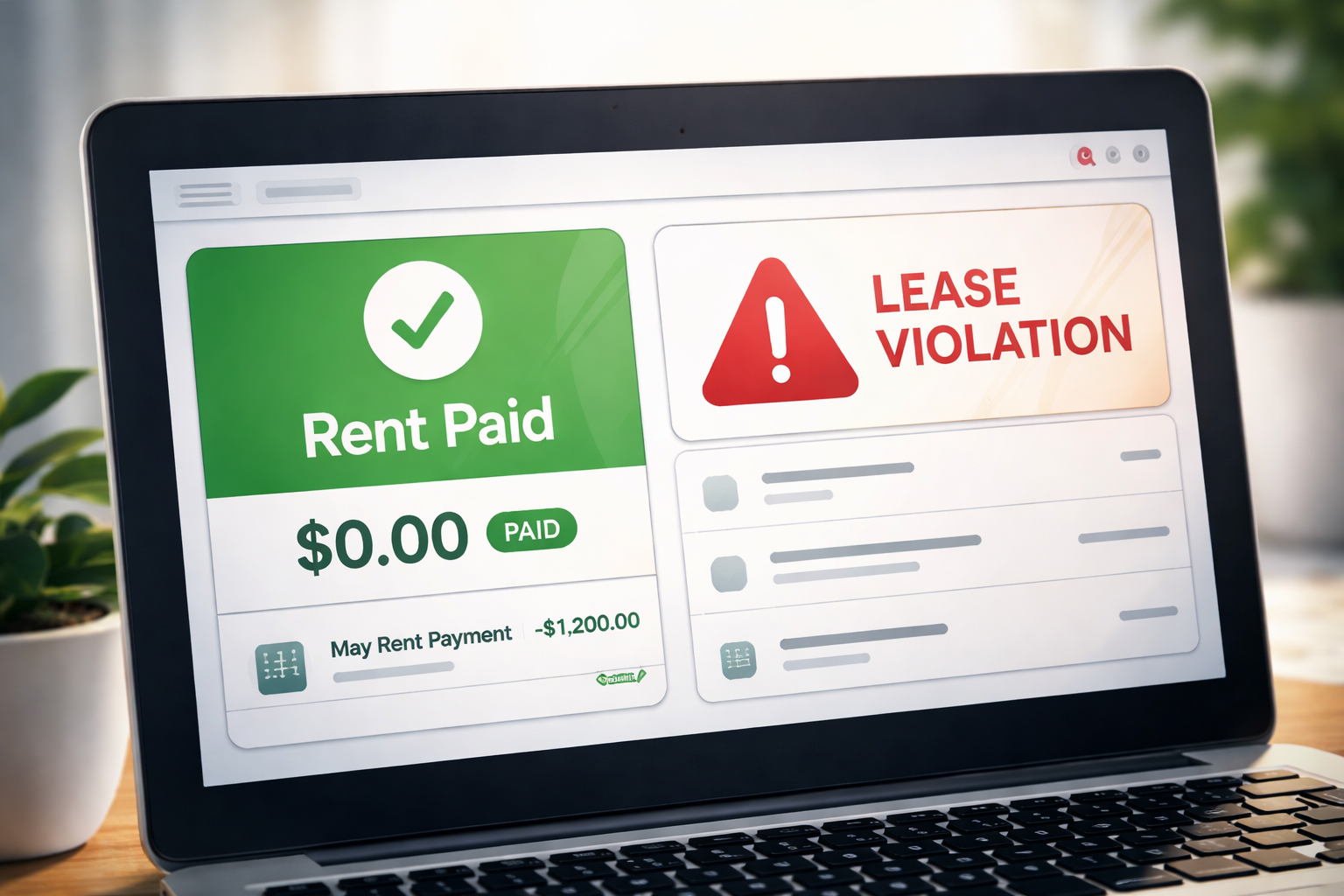
Rent payment accepted but account still shows lease violation or default status was the first thing I saw when I logged back into the portal after making the payment. The confirmation email had already arrived. My bank showed the transaction. The portal showed the amount received. But the warning banner was still there, and it was not subtle. It used words like “default,” “non-compliant,” and “lease violation,” as if the payment had not changed anything at all.
That was the moment this stopped feeling like a simple portal delay. Rent payment accepted but account still shows lease violation or default status is the kind of problem that looks administrative at first, but it can quietly trigger very real consequences behind the scenes. When the money is in one system and the violation flag is still active in another, the tenant is the one left exposed. That is why this issue has to be treated as a status-risk problem, not just a payment problem.
If you want the broader system behind rent posting mistakes first, this is the most relevant hub to compare your situation against before going deeper:
Why this problem is different
Rent payment accepted but account still shows lease violation or default status is different from a normal unpaid-rent dispute. In a regular posting issue, the main conflict is whether the money was received. Here, the money may already be recognized, but the account still carries a harmful label. That distinction matters because property management systems often separate financial posting from lease enforcement, resident compliance, notice generation, and escalation workflows.
In other words, your rent record can say one thing while your risk status says something else. A property manager may open your account and see payment activity, yet the screen or dashboard still highlights you as being in default. Another employee may only see the violation queue and assume your payment problem is unresolved. This is how a tenant can pay on time and still keep moving through an internal enforcement process that should have stopped.
That is also why this topic does not substantially overlap with your existing unpaid, pending, or balance-due posts. Those are mainly about payment recognition. This article is about what happens after recognition when the account status itself does not reset.
How the account gets stuck in default
Rent payment accepted but account still shows lease violation or default status usually happens when one of several account actions does not complete in sequence. Most rental operations do not run on a single screen or single database. They rely on connected modules: payment processor, resident ledger, notice engine, delinquency tracker, compliance logic, and staff task queue. A payment can update one module immediately and leave another untouched until overnight sync, manual review, or exception handling.
Common patterns include:
- The payment processor marks the transaction successful, but the delinquency engine only updates on a nightly batch.
- The ledger reflects the payment, but the lease violation flag was created earlier and requires manual clearance.
- The account had an older fee, utility charge, or prior balance, so the system still treats the tenant as being in default even though current rent was paid.
- The payment posted after a cutoff hour, so the status stayed in violation for the rest of the day and triggered automated activity before it could refresh.
- The property manager software uses a “status hold” or “exception” field that does not disappear automatically when money comes in.
Rent payment accepted but account still shows lease violation or default status often starts with timing, but it becomes dangerous because timing errors can turn into record errors.
What landlords and managers may see internally
From the tenant side, this often looks irrational. From the landlord side, the problem may look incomplete rather than irrational. One staff member may see the receipt and assume the matter is resolved. Another may be looking at a dashboard that still lists your unit under default, violation, or delinquency. A regional manager may receive only exception reports. A collections workflow may only read a status field. A notice system may only care whether the violation tag was removed before the scheduled run.
That internal fragmentation matters because the wrong screen can drive the next action. Rent payment accepted but account still shows lease violation or default status may lead to:
- an automated late fee even though rent was accepted,
- a pay-or-quit notice generated after payment,
- a warning letter that makes it sound like no cure happened,
- a collections or legal review queue staying open,
- an internal note that the resident remains non-compliant.
The real danger is not the wording on the portal itself. The real danger is what downstream action that wording may trigger.
Detailed case paths tenants should compare against
Path 1: Payment succeeded, but the violation flag never cleared
This is the cleanest version of the problem. The rent itself is accepted, the amount matches, and the ledger appears current, but the system still shows default or violation. This often points to a manual-clearance step that was missed.
Path 2: Payment was accepted, but part of it went somewhere else
The account may look paid from your perspective because the total money left your bank, but the system may have applied part of it to prior fees, old charges, or another balance category. The account then continues showing violation because rent was not fully satisfied the way the software expected.
Path 3: Payment arrived after the property’s daily cutoff
A portal can say completed while the landlord’s delinquency cycle has already run. The result is that the system keeps the violation status long enough to issue notices, late charges, or internal escalation even though the payment was already in motion.
Path 4: There was an earlier violation that payment did not automatically cure
Some lease violations are tied to nonpayment but are stored as separate workflow items. Paying the rent may stop future damage, but the violation entry itself can remain open until staff closes it.
Path 5: The account has mixed charges beyond base rent
Utilities, legal fees, damage charges, prior month carryovers, or payment reversals can cause the system to preserve a default label even after current rent was accepted. The tenant thinks the issue is “rent paid,” while the software is evaluating “account still delinquent overall.”
Path 6: The portal and the manager’s office are not using the same live view
Some resident portals lag behind internal management software. Others do the reverse. A tenant may see accepted payment while staff still sees default, or staff may say the payment is there while the tenant portal continues displaying violation language.
Rent payment accepted but account still shows lease violation or default status should always be analyzed through one of these paths before you decide what to send, dispute, or escalate.
How to tell whether the issue is cosmetic or dangerous
Not every alarming message is equally serious. Some are temporary interface remnants. Others are tied directly to enforcement. The fastest way to tell the difference is to stop looking only at the banner and start looking at the account behavior around it.
- Did a late fee appear after the payment was accepted?
- Did you receive a notice by email, text, or posted letter?
- Does the ledger show zero current rent but a separate delinquent total?
- Did the portal remove the balance but not the “default” language?
- Has staff confirmed payment but refused to confirm the status is cleared?
If the answer to any of those is yes, then rent payment accepted but account still shows lease violation or default status is not just cosmetic. It is attached to an active workflow or unresolved account rule.
If you need a mid-article comparison for a closely related symptom, this one helps identify whether the posting layer is still unstable:
What rights matter most here
For YMYL safety, this should be kept practical and document-based. Laws vary by state and city, but some basic principles matter almost everywhere. A payment confirmation, bank record, receipt, ledger copy, and written communication trail matter more than a lingering portal label by itself. A landlord or manager is generally not made automatically correct just because the software still displays default status. The actual payment facts still matter.
Rent payment accepted but account still shows lease violation or default status does not erase your evidence. If the money was accepted, that fact is still central. If a fee, notice, or escalation happened after the payment, the timeline becomes critical. Your best protection is not arguing emotionally with the label. It is proving the sequence of payment, posting, and continued wrong status in writing.
For general housing guidance, refer to:
HUD Housing Help Overview
What to do in the first 24 hours
Rent payment accepted but account still shows lease violation or default status should be handled like an account correction request, not a casual support question. The first day matters because many systems run notice and fee actions on fixed schedules.
- Take screenshots showing payment confirmation, transaction date, ledger, current balance, and the violation or default label.
- Download or save the bank confirmation if available.
- Email management the same day and ask for written confirmation that the account status will be corrected.
- Ask whether any automated late fee, notice, or legal step has already been triggered.
- Request a current ledger and a statement of exactly what charge is supposedly keeping the account in violation.
You are trying to force the landlord’s side to identify whether the issue is an uncured flag, an unresolved balance category, or a sync delay. Rent payment accepted but account still shows lease violation or default status is much easier to stop early than to unwind later.
What not to do
The most damaging mistakes are usually delay and assumption. Tenants often assume the status will disappear overnight because the money is already there. Sometimes it does. But when it does not, the delay can produce extra fees or documentation that later has to be disputed one piece at a time.
- Do not rely only on a phone call if the status is still showing violation.
- Do not assume a zero balance automatically means the default flag is harmless.
- Do not send a second payment unless you know exactly why the first one did not cure the account status.
- Do not ignore notices because you believe the payment “should speak for itself.”
- Do not argue only from fairness; argue from documentation and sequence.
Rent payment accepted but account still shows lease violation or default status becomes more expensive when tenants wait for the software to “figure it out.”
A quick self-check before you escalate
- Was the payment for the full amount the system expected?
- Did any of the money go to fees, old balances, or utilities?
- Was the payment made near end-of-day cutoff?
- Did you receive any default, pay-or-quit, or late-fee notice after the payment timestamp?
- Has the landlord confirmed the money but avoided confirming the status fix?
If several of those apply, then your issue is likely not just a display problem. Rent payment accepted but account still shows lease violation or default status is likely tied to workflow logic on the landlord’s side.
FAQ
Can a landlord still treat my account as in default after accepting payment?
They may continue showing that status in the system, but the payment evidence still matters and the status may be wrong or stale.
Does a zero balance automatically mean I am safe?
Not always. A zero balance can exist while a violation flag, notice workflow, or compliance hold remains open.
Should I wait one more day to see if it clears?
You can allow for normal processing time, but you should still document and notify management immediately.
What if they say the system just has not updated yet?
Ask whether any fees, notices, or escalations were triggered before the update. That answer matters more than the excuse.
Key Takeaways
- Rent payment accepted but account still shows lease violation or default status is mainly a status-clearing failure, not just a payment issue.
- The biggest risk is downstream action like fees, notices, or escalation.
- Account status and payment posting often run in different systems.
- Documentation, written notice, and timeline proof matter most.
Before this turns into a notice dispute or a bigger account fight, read this next if your payment proof is being ignored despite confirmation from your bank:
Rent payment accepted but account still shows lease violation or default status is one of those problems that can look small until the wrong automated step happens. If that status is still on your account today, do not leave it there and hope someone notices later. Make them correct it now, in writing, before the system acts on the wrong version of your account.