
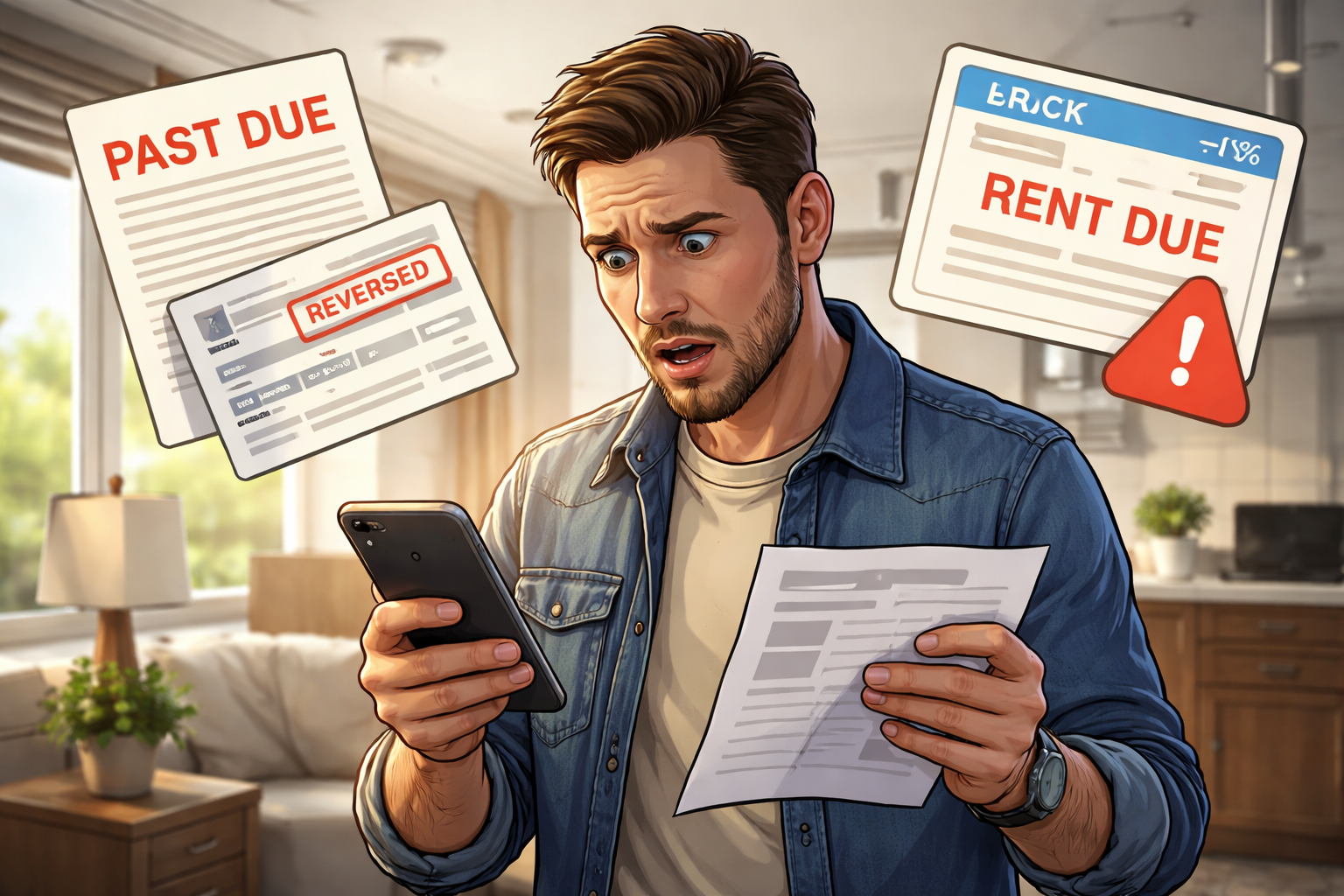
rent payment auto-reversal after posting without tenant notification was not something I knew could happen until it happened to me. I opened the portal to make sure rent had gone through, saw the payment marked as posted, saw the balance drop, and closed the tab. That should have been the end of it. I had already moved on to the rest of the month.
Then I checked again a few days later and the rent was back on the account like it had never been paid. The portal did not explain it. There was no clear warning, no detailed note, no message that said the earlier status had been reversed. Just a new balance, a late fee, and that familiar sinking feeling that comes from realizing the system changed after you stopped watching it. This is the kind of rent problem that becomes dangerous because it looks solved before it becomes a problem again.
If you need the bigger system background first, this is the closest hub to understand how these records move and why tenant-facing screens often lag behind internal ledger logic.
Why a posted rent payment can reverse later
rent payment auto-reversal after posting without tenant notification usually starts because the status you saw was never as final as it looked. In many rent systems, the portal is designed to show a payment as posted once the request is accepted and the landlord ledger is temporarily updated. But temporary posting and final settlement are not the same thing. That difference is exactly where trouble begins.
A rent portal may show one of several “good” statuses before the full transaction has finished moving through every layer. The payment processor may accept the request. The property management software may update your tenant screen. The landlord’s ledger may create a provisional entry. But the banking side can still reject, return, or reverse the transfer after that point. The posted status that reassured you may only have reflected a front-end ledger event, not the final banking outcome.
This tends to happen in a few common ways. One is when the ACH debit is accepted at first, but later returned by the bank because of an account restriction, a mismatch, insufficient collected funds, or a problem that only appears during settlement. Another is when the portal and the processor are not perfectly synchronized, so the tenant sees “posted” while the back-end system is still waiting on a later confirmation file. A third is when an auto-pay or queued transfer goes through after a change or cancellation request, then gets reversed when the system catches up with the updated instruction set. The official ACH framework maintained by NACHA helps explain why a payment can appear to move first and then be returned later.
What tenants usually see first
rent payment auto-reversal after posting without tenant notification rarely announces itself clearly. That is part of what makes it so disruptive. Most tenants do not receive a message saying, “Your payment was previously posted but later reversed because settlement failed.” Instead, they see fragments of the problem and have to guess what happened.
Sometimes the first sign is that the balance reappears with no explanation. Sometimes it is a late fee that should not be there. Sometimes it is an email warning about nonpayment even though the portal previously showed zero due. In more severe situations, the account may move into a collection or eviction workflow before the tenant even understands that the original payment status changed.
Common version 1:
Payment showed as posted on the due date, then the balance returned two to five days later.
Common version 2:
The tenant’s bank account showed money leaving, but the landlord system later treated the rent as unpaid.
Common version 3:
A late fee appeared after the reversal, as though the original payment never existed.
Common version 4:
An auto-pay appeared to run normally, then reversed after a cancellation or account update had already been submitted.
Common version 5:
The portal still showed a successful transaction record, but the main balance screen returned to “due.”
If your account history looks contradictory, that does not mean you imagined it. It usually means different parts of the system updated at different times.
Why landlords often act like the payment never happened
From the tenant side, rent payment auto-reversal after posting without tenant notification feels unfair because you saw a successful result and relied on it. From the landlord side, the system often collapses the situation into one simple conclusion: unpaid rent. That happens because many property platforms care most about the final settled status, not the intermediate status that the tenant saw earlier.
If the final processor report says the debit was reversed or returned, many systems automatically restore the balance and trigger downstream rules. Those rules can include a late fee, a delinquency status, an internal collection code, or even a pay-or-quit workflow. The software is not pausing to ask whether the tenant had good reason to think the payment was complete. It is only checking whether cleared funds were finally received.
This is also why tenants get trapped in frustrating conversations with leasing offices. A tenant says, “But I paid.” The office responds, “Our system shows unpaid.” Both sides are looking at different stages of the same transaction history. The real problem is not always disagreement over facts. It is that each side is seeing a different system snapshot.
If the issue is already moving toward formal notice territory, this related page is the closest mid-funnel support read.
How to tell which version of the problem you have
rent payment auto-reversal after posting without tenant notification is not one single problem. It is a family of problems that look similar from the outside. The fix depends on identifying which version happened.
If the bank shows the debit never truly settled:
This usually means the transaction was returned after provisional posting. In that situation, the landlord may be correct that final payment was not completed, but late fees and timing consequences may still be disputable depending on how the portal represented the payment.
If the bank shows the money left and stayed gone:
Then the issue may be a processor timing problem, a ledger mapping issue, or a landlord-side posting failure. This is a stronger documentation position for the tenant, because the funds movement supports the claim that the problem is not simple nonpayment.
If the payment method was auto-pay:
Check whether you changed funding sources, canceled auto-pay, replaced a bank account, or made a manual payment near the same time. Overlapping instructions can create duplicate transaction attempts and later reversals.
If the portal history still shows the original payment record:
That often means the visible transaction log and the live balance are not pulling from the same database event at the same time. In plain language, one screen is showing what was attempted, while the other is showing what finally counted.
If the landlord added late fees immediately:
That suggests the reversal fed directly into an automated delinquency rule. The faster you address it, the better your chance of stopping secondary damage.
What to do in the first 24 hours
rent payment auto-reversal after posting without tenant notification should be treated like a clock-start problem, not a wait-and-see problem. The first day matters because the longer the balance sits unresolved, the more likely it is that automated account actions continue stacking on top of it.
Start with your bank. Ask whether the original debit was fully settled, reversed, or returned, and ask for the reason in plain language. Do not settle for generic wording like “it didn’t go through.” You need to know whether the issue was insufficient collected funds, an account restriction, a returned ACH, a revoked authorization code, a processor rejection, or something else. Write down the exact answer.
Then log in and capture the landlord portal as it appears now. Save screenshots of the balance, transaction history, late fees, and any prior confirmation screen you still have. If you received an email or text confirming payment, save that too. The most useful evidence is not a long story. It is a clear timeline supported by screenshots and account records.
Next, contact the landlord or property manager in writing. Tell them the payment previously appeared posted, the account later reversed, and you are confirming the banking reason now. Ask for a current ledger and ask how the reversal was coded internally. That question matters because the internal code often reveals whether the account is being treated as NSF, returned ACH, unpaid rent, or general delinquency.
What to do if you still need to repay immediately
Sometimes rent payment auto-reversal after posting without tenant notification leaves you with no practical choice but to pay again quickly to stop escalation. If that is your situation, be strategic. Do not blindly repeat the same method without understanding why the first payment failed or reversed.
If the problem came from an ACH return, consider using certified funds, cashier’s check, money order, or another payment type the landlord accepts for same-day finality. If the issue may have involved a portal sync or processor mismatch, ask the landlord which payment method posts most cleanly in their system when an account is already under review. The goal is not just to send money again. The goal is to create a second payment path that is less likely to generate another reversal or further confusion.
When you repay, include a short written note or email stating that the replacement payment is being made while you dispute any fees or consequences related to the original reversal timing. That helps separate the urgent payment issue from the separate question of whether penalties were properly assessed.
What not to do
rent payment auto-reversal after posting without tenant notification becomes much harder to unwind when tenants make predictable mistakes under stress.
- Do not assume the issue will correct itself overnight.
- Do not rely only on a phone call if the account is already showing delinquency.
- Do not repay with the same method until you understand why the first payment reversed.
- Do not argue only from memory when screenshots and bank records are available.
- Do not ignore late fees, notice dates, or posting deadlines while trying to “figure it out.”
The biggest mistake is confusing visible portal activity with legally or financially final payment status.
When the real problem is the ledger, not the payment
There are situations where rent payment auto-reversal after posting without tenant notification is only the first layer of the problem. The second layer is that the landlord ledger remains wrong even after you repay or clarify the issue. This happens when the original reversal, the replacement payment, and the fee logic do not reconcile cleanly inside the account.
For example, a replacement payment may post to the current month while the reversed amount is left sitting in an older bucket. Or a late fee may remain even though the account was made whole immediately after the reversal notice. Or the transaction history may continue showing both the original posted payment and the reversal in a way that makes the balance screen misleading. In those situations, the problem is no longer just “pay rent.” It becomes “fix the ledger structure before this causes a bigger dispute next month.”
That is why this follow-up read works well near the conclusion. It helps when the account record itself refuses to normalize.
Key Takeaways
- rent payment auto-reversal after posting without tenant notification usually means the payment looked final before banking settlement truly finished.
- A posted status can be provisional even when the tenant reasonably thinks it is complete.
- Landlord systems often treat the final reversal as unpaid rent and trigger automatic fees or notices.
- The most important first steps are bank confirmation, screenshots, a written request for the ledger, and fast action on any replacement payment.
- If the balance stays wrong after repayment, the account may have a ledger problem that needs to be corrected separately.
FAQ
Why did my rent show posted and then disappear?
Because the system may have displayed a provisional posting before final settlement. The later reversal updated the account after the earlier status had already been shown.
Does this always mean I had insufficient funds?
No. A reversal can happen for several reasons, including account restrictions, processor issues, authorization problems, timing mismatches, or system conflicts between payment instructions.
Can a landlord charge late fees after this happens?
They often do, because the system treats the reversal as unpaid rent. Whether those fees are proper depends on timing, lease terms, local rules, and the documentation showing what you were told by the portal.
Should I just pay again immediately?
You may need to, but confirm the reversal reason first and choose a payment method less likely to create a second failure or more confusion.
What matters most if I have to dispute this later?
A clean timeline: screenshots of the posted status, bank confirmation, ledger request, notice dates, and proof of any replacement payment.
rent payment auto-reversal after posting without tenant notification is the kind of problem that catches good tenants off guard because it punishes them after they thought they had already done the responsible thing. You paid, checked the screen, saw it posted, and moved on. Then the system changed the story without giving you enough warning to protect yourself.
That is why this issue has to be handled fast and handled in writing. Call the bank and get the exact reason. Save screenshots of every status change. Request the current ledger. If the rent still has to be replaced, use a more reliable method and separate that payment from your dispute over fees and timing. Do not let a silent reversal turn into a late fee problem, a notice problem, or an eviction record problem just because the system updated after you stopped looking.