
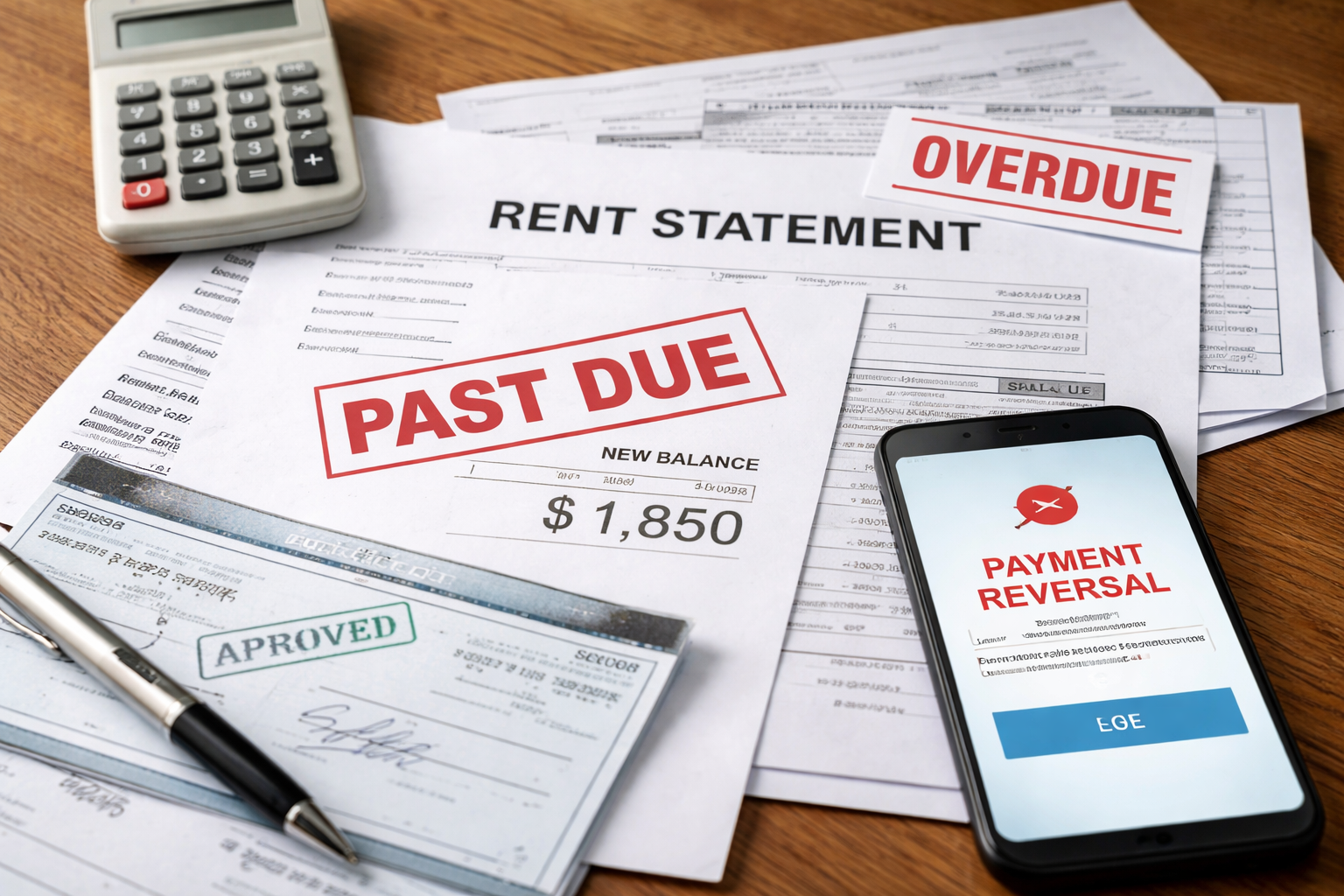
Landlord Charged Back Rent After Accepting Payment — I noticed it in the smallest, quietest way: the “rent paid” confirmation was still in my email, but my checking account suddenly showed a reversal. Five days earlier the payment had posted cleanly. The portal showed a receipt. I moved on with my week like the month was handled. Then that one line appeared: a debit reversal that made it look like nothing ever happened.
I opened the rent portal expecting to see the same history. Instead, it had flipped to “unpaid,” and the balance was back like a reset. I didn’t panic at first. I assumed it was a glitch. Then I saw the late-fee timer and realized what the system was about to do next. When the ledger changes, the building doesn’t treat it like a glitch — it treats it like a default. If Landlord Charged Back Rent After Accepting Payment is happening to you, your goal is to lock down the paper trail before notices, fees, or eviction automation starts moving.
Start Here: Identify What “Chargeback” Means in Your Setup
Landlord Charged Back Rent After Accepting Payment can look identical on your bank screen, but the cause changes what you should do next. The first step is to determine which lane you’re in, because each lane has a different fix and a different risk timeline.
Lane 1: Bank return (ACH) — Your bank shows a reversal/return, often after a “posted” status. This can happen if the payment processor later receives a return code.
Lane 2: Processor reversal — The payment portal (or third-party processor) voids the transaction due to verification, mismatch, or timing rules.
Lane 3: Management adjustment — The landlord/manager manually reverses the entry in the rent ledger, even though your bank payment went through.
Lane 4: Allocation shuffle — Your payment wasn’t reversed, but it was moved to a different bucket (fees, prior month, another unit), making the current month show unpaid.
You do not “solve” Landlord Charged Back Rent After Accepting Payment by arguing your feelings. You solve it by proving which lane you’re in.
Build a Proof Packet Before You Message Anyone
When Landlord Charged Back Rent After Accepting Payment happens, you need a proof packet that you can send repeatedly without rewriting the story each time. This prevents staff from re-framing the issue as “tenant confusion” or “payment failure.”
- Bank proof: screenshot or PDF showing (a) original rent debit, (b) reversal entry, and (c) any return description code.
- Portal proof: screenshot of payment confirmation, receipt number, date/time, and the “unpaid” screen.
- Lease proof: page showing rent due date, payment method rules, and late fee triggers.
- Communication proof: emails/texts from management acknowledging payment or issuing receipts.
Keep the story short: “Payment accepted on X date; reversed/changed on Y date; ledger now shows unpaid.” Landlord Charged Back Rent After Accepting Payment cases get messy when tenants add extra background that lets management avoid the main point.
If management refuses to provide a written ledger or updated statement, this internal guide is your fastest playbook:
Why Systems Flip “Paid” to “Unpaid” After the Fact
Landlord Charged Back Rent After Accepting Payment often starts as a back-office reconciliation event. Many U.S. property platforms run daily “posting batches” and then a later reconciliation that can reverse or re-allocate entries.
Common triggers include:
- Return codes: a later ACH return from the bank or processor.
- Name/account mismatch: payment originated from a different account holder than the lease file expects.
- Timing rules: payment posted after cutoff, then shifted to the next cycle.
- Prior balance: system auto-applies your payment to an older bucket first.
- Unit mapping errors: payment credited to the wrong unit or tenant profile.
The important thing is this: the system may not care that you intended it as rent for this month. Landlord Charged Back Rent After Accepting Payment is often an allocation and audit problem, not a “did you click submit” problem.
Match Your Situation Using This Quick Self-Check
Use this to locate your exact version of Landlord Charged Back Rent After Accepting Payment. This will tell you what to ask for in writing.
If your bank shows the money returned → Ask for the return code and the processor’s rejection reason. You’re in a bank/processor lane.
If your bank shows the money still gone but the portal says “unpaid” → You’re in a ledger adjustment lane. Demand written ledger and transaction mapping.
If the portal says “applied to fees” or “applied to prior month” → You’re in an allocation lane. Request a month-by-month ledger allocation history.
If the portal shows “pending” then flips → You’re in a payment status lane. Pull confirmation timestamps and settlement status.
Landlord Charged Back Rent After Accepting Payment becomes easier to resolve the moment you stop saying “I paid” and start asking, “Where did you allocate it, and what rule triggered that allocation?”
Lane-by-Lane Actions (Use the Box That Fits You)
Lane 1: ACH return after posting
- Call your bank and ask for the ACH return reason code (you want the code, not a summary).
- Ask whether the return was initiated by your bank, the processor, or the receiving party.
- Request a written note or secure message confirming the return reason.
Do not re-pay until you know whether the return was due to insufficient funds, mismatch, or processor rejection.
Lane 2: Processor reversal
- Ask the portal/processor for a settlement status report (paid, voided, reversed, returned).
- Request the transaction ID and the void/reversal timestamp.
- Ask if the payment was flagged for verification or risk screening.
Landlord Charged Back Rent After Accepting Payment is often blamed on “tenant error” until you force the processor record into view.
Lane 3: Management ledger adjustment
- Send a written request: “Please provide the rent ledger showing the reversal entry and the reason code.”
- Ask who authorized the change and on what date/time.
- Demand a corrected ledger within a defined timeframe (example: 3 business days).
If your bank shows funds still transferred, a ledger reversal without explanation is a serious accounting issue.
Lane 4: Allocation shuffle
- Request a line-item allocation: rent, fees, utilities, prior balance, and which month each part was applied to.
- Ask whether your payment was applied to the wrong unit or tenant profile.
- Request correction with “effective date” so the current month shows paid.
Allocation errors can mimic Landlord Charged Back Rent After Accepting Payment even when no money was returned.
If They Say “We Never Received It”
This is the most frustrating response because it ignores your receipt. When Landlord Charged Back Rent After Accepting Payment, “never received” may mean “never settled,” “was returned,” or “was moved.”
If the money was deducted but the system claims failure, compare your situation with this closely related guide:
Don’t accept “never received” as an explanation. Ask for the processor transaction trail and the ledger entry that shows where it went.
If a Late Fee or Notice Triggers While You’re Disputing
Landlord Charged Back Rent After Accepting Payment becomes urgent when automation triggers fees or a Pay or Quit notice. Your documentation needs to be positioned as a dispute record, not just “proof you paid.”
What to send with your dispute (keep it short):
- One-page timeline (payment accepted date, reversal date, notice date)
- Bank proof showing debit and reversal
- Portal receipt proof
- Written request for corrected ledger and fee freeze
If you already received a Pay or Quit notice after an online payment, use this guide to align your response language and timing:
Pay or Quit Notice After Online Rent Payment
Never assume “they’ll see it in the system later.” Landlord Charged Back Rent After Accepting Payment disputes are time-sensitive because notices have deadlines.
What Not to Do (These Moves Backfire)
- Don’t pay twice unless you clearly label the payment as “conditional” and get written confirmation of how it will be applied.
- Don’t send partial amounts hoping to “show good faith” — it can create a new unpaid balance narrative.
- Don’t rely on phone calls as your main record. Ask for email confirmation every time.
- Don’t let fees pile up without disputing the ledger entry in writing.
When Landlord Charged Back Rent After Accepting Payment, the worst mistake is trying to be “easy to work with” while your ledger is being coded as delinquent.
If It Threatens Collections or Credit Reporting
If management mentions collections, treat it as a timeline problem. Landlord Charged Back Rent After Accepting Payment can be “resolved” internally but still show up as a collection placement if no one closes the loop.
For an overview of how debt collection disputes work in the U.S., this official resource is a safe reference:
Consumer Financial Protection Bureau (CFPB) – Debt Collection
Once a file is placed with collections, you may need to dispute both the landlord ledger and the collector’s record.
FAQ
Can a landlord reverse rent after accepting it?
Sometimes the payment is reversed by the bank/processor, or the ledger is adjusted internally. The key is written accounting showing why the rent changed status.
Do I have to pay again immediately?
Not without a written explanation of what happened to the first payment and how a second payment would be applied.
What if the portal receipt shows paid but the ledger says unpaid?
Request the rent ledger and the processor transaction mapping. That mismatch is common in Landlord Charged Back Rent After Accepting Payment situations.
What if they applied my payment to a different month?
Ask for an allocation breakdown and request a correction with an effective date so the correct month shows paid.
What if I already got an eviction notice?
Respond within the notice deadline and attach your proof packet and timeline. Don’t ignore it because you feel it’s “obviously wrong.”
Key Takeaways
- Landlord Charged Back Rent After Accepting Payment is not one problem — identify your lane first.
- Build a proof packet: bank trail, portal receipt, and written ledger request.
- Demand allocation mapping and timestamps instead of accepting vague explanations.
- Dispute in writing before late fees, notices, or eviction automation triggers.
- Don’t pay twice without written clarity on how the payment will be applied.
Landlord Charged Back Rent After Accepting Payment didn’t feel like a “billing issue” when I saw it. It felt like someone had erased reality with one system entry. The most unsettling part was how quickly it could turn into a label: unpaid, late, delinquent. That’s why you work the record first, not the emotion.
If Landlord Charged Back Rent After Accepting Payment is happening to you, do this right now: download your bank proof, screenshot the portal receipt and the “unpaid” screen, and send a written request for the updated rent ledger plus the specific reversal reason. Ask for a fee freeze while the ledger is corrected, and do not submit a second payment until you receive written confirmation of how it will be applied. Those steps protect you today without letting the system quietly rewrite your month.