
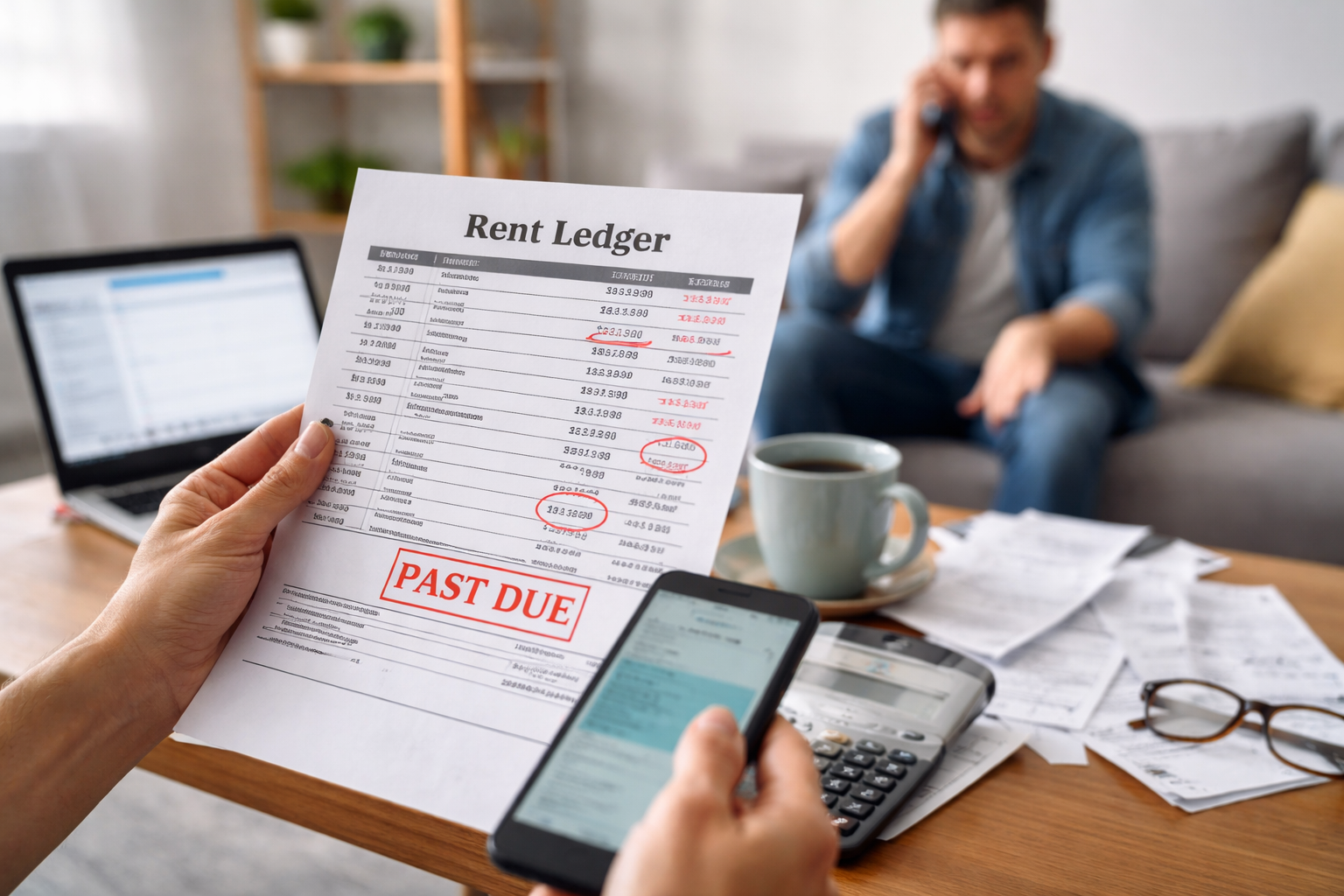
Rent Ledger Incorrect But Landlord Refuses to Fix was the first thing on my mind the second I opened the portal and saw “Past Due.” I didn’t feel dramatic. I felt stuck. I had paid on time. I had the confirmation email. And yet the system was acting like I had ignored rent completely.
At first I tried to be reasonable about it. “It’s probably a posting delay.” “Maybe it’ll reconcile overnight.” But then the ledger updated in the worst possible direction: it added a late fee, and the message tone changed from “balance due” to “notice.” That’s the part people don’t warn you about. When the rent ledger is wrong, the system doesn’t pause— it escalates. And when Rent Ledger Incorrect But Landlord Refuses to Fix becomes the pattern, you’re not dealing with a typo. You’re dealing with an internal record that can trigger automated enforcement.
This is a practical, U.S.-focused guide for what to do when Rent Ledger Incorrect But Landlord Refuses to Fix—without turning your situation into an unforced mistake. The goal is simple: get your ledger corrected, stop late fees from stacking, and prevent the error from spreading into notices, filings, or collections.
If you’re already seeing court language or threats tied to a paid month, read this first (it matches the escalation path):
What “the Ledger” Means to Them (Even When It’s Wrong)
Most landlords and property managers treat the ledger as the “official truth” because it feeds every downstream action: fees, notices, renewal holds, and sometimes the export file used for collections. When Rent Ledger Incorrect But Landlord Refuses to Fix, you’re usually arguing against a workflow, not a person. The on-site office may not even have the permission to edit the entries you’re looking at.
The mistake becomes dangerous when it is repeated across systems—portal, internal accounting, and the notice generator. That’s why your response has to be written, timestamped, and structured like a record correction request, not a complaint.
Before You Do Anything: Pull a “Proof Packet”
When Rent Ledger Incorrect But Landlord Refuses to Fix, speed matters, but sloppy speed backfires. Build a small packet you can attach to every message:
- Bank proof: transaction ID, amount, date, and the final “completed/posted” status (not just “initiated”).
- Portal screenshots: the incorrect charge line(s), late fee line(s), and the “as of” date/time if shown.
- Lease page: the section on rent due date, grace period, and acceptable payment methods.
- Any receipts: email confirmation from the portal, money order stub, cashier’s check copy, etc.
Your leverage increases when the proof packet makes it easy for accounting to say “yes” without extra back-and-forth.
Identify Which Error You’re Actually Facing
Pick the one that matches your ledger line-by-line:
- Case 1: Payment shows “completed” at your bank, but portal shows “unpaid.”
- Case 2: Payment posted, then disappeared later (ACH reversal / returned payment).
- Case 3: Payment posted, but applied to the wrong bucket (fees/utilities/old balance), leaving rent “unpaid.”
- Case 4: Ledger has duplicate rent charges (double-posted month, renewal, transfer).
- Case 5: Partial payment scenario (you paid part, but notices act like you paid nothing).
- Case 6: Roommate/co-tenant split confusion (liability, allocation, move-out).
- Case 7: Payment method mismatch (money order/cashier’s check “received” but not “applied”).
- Case 8: Portal outage or payment failed-but-money-deducted situation.
Once you identify your case, you can use the right language and avoid the wrong trap. Below are the detailed branches—this is where most people finally get traction when Rent Ledger Incorrect But Landlord Refuses to Fix.
Case 1: Bank Shows Paid, Ledger Shows Unpaid
This is the classic Rent Ledger Incorrect But Landlord Refuses to Fix scenario. The most common reason is that the payment exists in one system but didn’t map into the ledger batch. That mapping can fail if the resident ID changed, the unit number changed, or the portal vendor had a posting delay.
What to do:
- Email accounting (not only the leasing office) and ask for a “ledger correction” and “late fee reversal pending investigation.”
- Attach the proof packet and request a written confirmation within 24–48 hours.
- Ask them to confirm whether they received funds at the merchant/lockbox level (not just what the portal displays).
Key phrase that works: “Please confirm receipt of funds and correct the resident ledger to reflect payment posted on [date]. Please place a hold on late fees and notices while accounting verifies.”
If your portal specifically shows a “pending but landlord says unpaid” type status, this related guide often matches the logic of what you’re seeing:
Case 2: Payment Posted, Then Reversed (Returned ACH)
This one stings because it feels like a bait-and-switch. You paid, it looked fine, and then Rent Ledger Incorrect But Landlord Refuses to Fix reappears days later with extra fees. ACH can be returned after initiation if the bank rejects it, the account had insufficient funds at settlement, or the authorization fails.
What to do:
- Call your bank and confirm whether the ACH was returned (and the exact return date).
- Ask your landlord for the ACH return code or vendor confirmation (they often have a trace).
- Immediately pay using a guaranteed method (cashier’s check/money order) if the return is confirmed, but only after you get written instructions on how they will credit the ledger and waive duplicate fees.
Do not let them treat you like you “didn’t pay” if you initiated on time. Your goal is to document the timeline and get fee discretion applied where allowed.
Case 3: Payment Misapplied (Fees First, Rent Still “Unpaid”)
This is where a lot of tenants get blindsided. The payment is there, but the ledger allocates it to older fees or utilities first. So the system shows rent delinquent and triggers notices. When Rent Ledger Incorrect But Landlord Refuses to Fix in this form, the landlord may say, “You still owe rent,” even though your money was taken.
Allocation check: Look for a line item like “payment applied to charges” followed by old fees being cleared while current rent remains open.
What to do:
- Request an itemized ledger statement PDF showing allocation order.
- Ask for “reallocation” to current rent if permitted by the lease/state rules (some leases specify allocation order).
- If they refuse, your strategy changes: you document that payment was accepted and applied, and you dispute the remaining balance as a fee dispute rather than a rent nonpayment dispute.
Important: Do not assume allocation errors are “fixed automatically.” Often they are considered “working as designed.” Your leverage is the contract terms and written dispute trail.
Case 4: Duplicate Rent Charges (Double-Posted Month)
If Rent Ledger Incorrect But Landlord Refuses to Fix and you see two identical rent charges for the same month, treat it like a billing duplication. This happens around lease renewal, unit transfer, or when the management company changes software.
What to do:
- Screenshot both entries with dates and descriptions.
- Ask for a “duplicate charge reversal” and a corrected statement.
- Request a written “balance freeze” while they investigate—this prevents notices from auto-generating.
Ask one specific question: “Which charge is the authoritative monthly rent charge for [month/year], and which entry will be reversed?”
Case 5: Partial Payment, But Notices Act Like Zero
Partial payments can be interpreted harshly in some states and leases. Some systems treat anything under full rent as “unpaid,” which triggers pay-or-quit notices. This is where Rent Ledger Incorrect But Landlord Refuses to Fix becomes a timing problem: you need the ledger to show your partial payment and the remaining balance accurately, not as a total nonpayment.
What to do:
- Get the ledger statement showing partial payment posted.
- Confirm in writing what the remaining balance is and the deadline to cure it.
- Pay the remainder with a method that creates undeniable proof.
If you’re facing notices after an online payment, this related scenario can help you avoid escalation mistakes:
Case 6: Roommate Split, Move-Out, and Joint Liability Confusion
When Rent Ledger Incorrect But Landlord Refuses to Fix involves roommates, the ledger may show “unpaid” because the system assumes joint responsibility regardless of who paid. If a co-tenant moved out, the landlord may still enforce the full balance against whoever remains.
This is where people make the wrong argument. Instead of saying “my roommate didn’t pay,” you need to focus on: “the ledger should reflect receipt of total rent and the correct responsible parties under the lease.”
If your lease is joint, liability rules can be strict. Use this to understand how the system treats it:
Case 7: Money Order or Cashier’s Check “Received” but Not Applied
When payments go through a lockbox or third-party processing center, the front office may confirm they “got it,” but accounting hasn’t applied it. Rent Ledger Incorrect But Landlord Refuses to Fix happens because the processing workflow is separate from the leasing office.
What to do:
- Request confirmation of receipt with date/time and reference number.
- Provide the instrument number (money order/cashier’s check number).
- Ask for the “posting date” and “ledger effective date.” Those are often different.
Do not hand over a second payment without a written plan for how they will refund or credit a duplicate.
Case 8: Payment Failed but Money Was Deducted
This is the most confusing variation: your bank shows money left, but the portal says failed. Sometimes it’s a temporary authorization that drops off. Sometimes it’s a processor error that later corrects. Either way, Rent Ledger Incorrect But Landlord Refuses to Fix becomes a documentation race.
What to do:
- Ask your bank whether it is a pending authorization or a settled transfer.
- Request the payment processor trace from the portal vendor (if available).
- Ask the landlord to hold notices while the payment status is confirmed.
The Email Script That Actually Gets Action
When Rent Ledger Incorrect But Landlord Refuses to Fix, your message matters. Here’s the tone that works: calm, specific, and hard to ignore.
Subject: Ledger Correction Request — Rent Paid on [DATE], Balance Incorrect
Body: Hello, I am requesting a ledger correction. My rent payment of $[AMOUNT] was completed on [DATE] (proof attached). The tenant ledger currently shows an unpaid balance and has added fees/notices. Please (1) confirm receipt of funds, (2) correct the resident ledger to reflect the payment, and (3) place a hold on late fees/notices while accounting verifies. Please reply in writing with the corrected balance and effective posting date. Thank you.
This works because it gives them three clear actions and creates a written record.
What You Should Never Do in This Situation
- Don’t rely on a phone call only. If it matters, it must be in writing.
- Don’t ignore notices because “it’s obviously wrong.” Systems don’t interpret “obvious.”
- Don’t send a duplicate full payment without a written credit/refund plan.
- Don’t threaten legal action as your first move; it often shuts down cooperation.
- Don’t stop paying future rent out of anger unless a qualified local professional advises it.
The goal is to correct the record while keeping you protected from escalation.
If They Still Refuse: Escalation Without Self-Sabotage
If Rent Ledger Incorrect But Landlord Refuses to Fix even after you provide proof, escalate in this order:
- Ask for the property manager’s supervisor or corporate accounting email.
- Request a formal ledger statement and the specific line item they believe is unpaid.
- Send a second written notice labeled “Second Request: Ledger Correction + Hold on Notices.”
- Document every response and non-response.
At this stage, your best move is to prevent the error from spreading into collections. If you see any hint of that pipeline, revisit the mechanics here:
Official Government Tenant Rights Reference
If Rent Ledger Incorrect But Landlord Refuses to Fix escalates into a dispute you can’t resolve directly, it helps to understand your basic tenant rights under U.S. federal guidance. The official U.S. government portal provides a neutral overview of renter rights and steps you can take when disagreements with landlords occur.
U.S. Government – Tenant Rights & How to File a Complaint Against a Landlord
This official resource outlines how to raise complaints if your landlord will not fix billing or other rental record issues.
FAQ
Is the rent ledger the “legal truth”?
No. It’s a record. Your payment proof and the lease terms are evidence. But the ledger can still trigger automated actions, so you must correct it fast.
Should I pay again to stop eviction risk?
Only if you have written confirmation of how the extra payment will be credited or refunded. Otherwise you may create a second dispute.
What if they claim they never received the money?
Ask your bank for settlement confirmation and request the landlord’s vendor trace details. The mismatch is usually a posting or mapping issue.
Can this affect renewal or credit?
Yes. Some landlords export delinquency data. That’s why written disputes and corrected statements matter.
Key Takeaways
- Rent Ledger Incorrect But Landlord Refuses to Fix is dangerous because systems escalate automatically.
- Your best tool is a proof packet: bank proof + portal screenshots + lease terms.
- Identify the exact case type (mispost, reversal, misallocation, duplicate charge) before acting.
- Use written correction requests that demand confirmation, correction, and a notice hold.
- Never make it worse with duplicate payments or silence.
Rent Ledger Incorrect But Landlord Refuses to Fix stopped feeling like “a mistake” the day it started generating consequences. I learned quickly that the only thing that moved the needle was giving accounting something they could process: proof, dates, and a clear correction request.
If you do only one thing after reading this, do this now: send the written ledger correction request with your proof packet and ask for a hold on fees and notices. Then set a 48-hour follow-up deadline in writing. You’re not asking for a favor— you’re demanding that their record match the payment reality. And you shouldn’t have to carry the risk of their system error.