
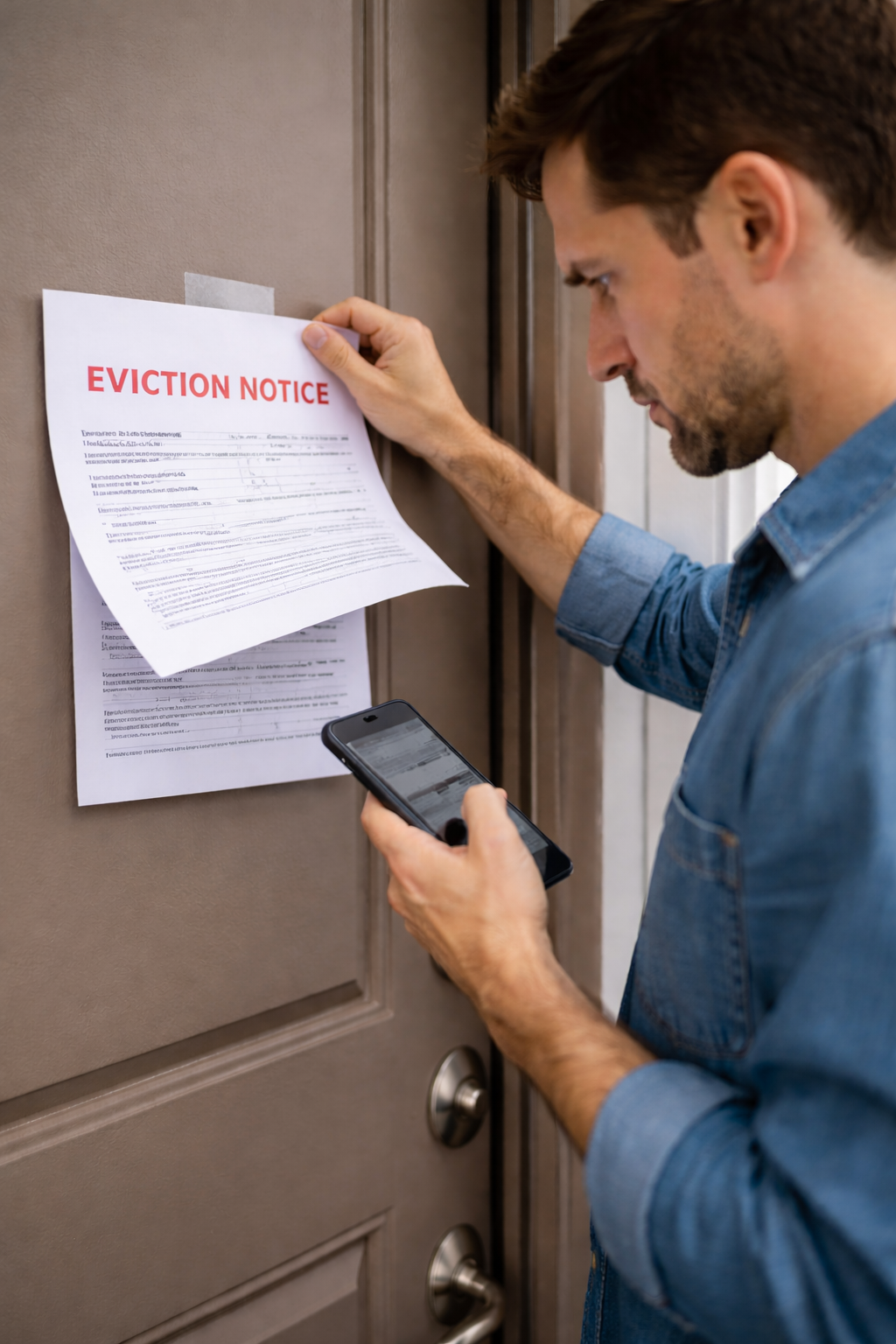
Eviction notice but already paid rent — I noticed it the second I stepped inside the building: that thin sheet of paper taped where it doesn’t belong. It wasn’t a reminder. It wasn’t a “please call the office.” It was an eviction notice for nonpayment. The part that made my stomach drop wasn’t the word “eviction.” It was the fact that I had already paid rent. I had the confirmation email, the bank record, and the portal receipt.
I didn’t argue with the paper. I opened my phone and started collecting proof. Because an eviction timeline doesn’t wait for your landlord to “figure it out.” If you’re searching eviction notice but already paid rent, the goal is not to be right later. The goal is to stop the process now—before a filing, before a hearing date, before your life becomes paperwork.
If your landlord claims your payment is “pending” or “not posted,” start here first because the fix is slightly different and often faster.
Is This a New “Problem Intent” or a Situation Version?
eviction notice but already paid rent is best understood as a high-intent situation version of a bigger category (nonpayment eviction). But it behaves like a separate intent because the searcher is saying: “The system is wrong, and I need a stop button.”
- General intent: “eviction notice for nonpayment” (broad, informational)
- This intent: “I paid already, and I need immediate steps” (urgent, procedural)
That urgency is exactly why this keyword can perform well even if raw search volume is not massive.
Why This Happens Even When You Paid
In an eviction notice but already paid rent scenario, the most common cause is not evil—it’s systems. Many property managers use software that auto-triggers notices when a ledger shows “unpaid” after a certain date.
Typical triggers:
- ACH or bank transfer delay (weekends/holidays)
- Portal shows “processing” but ledger shows “unpaid”
- Payment applied to the wrong unit, roommate, or prior balance
- Check or money order not matched correctly
- Returned payment (NSF) notice you didn’t see yet
- Late fee or other charge made the ledger appear short
The notice may be “standard procedure,” but it still creates real risk if you ignore it.
Understand the Clock: Notice vs Court Filing
Many tenants assume the notice is the same as an eviction. It isn’t. But it can be the start of it.
- Notice: the landlord’s formal warning step (often required before filing)
- Filing: when the landlord starts a court case (this is where stakes jump)
- Hearing: where you must show up with evidence
Your job is to prevent filing—or be ready before filing turns into a hearing.
Identify Your Exact Situation
Pick the branch that matches your reality. A strong eviction notice but already paid rent response is targeted, not generic.
Branch A — Payment Cleared Before the Notice Date
You paid on time, it cleared, and you have proof.
Best move: Send proof in writing and demand written withdrawal.
This is the cleanest win.
Branch B — Payment Pending / Processing
Funds left your bank, but the portal/ledger hasn’t posted it.
Best move: Send bank screenshot + portal status + expected posting date. Request a written hold on notices and filing.
Branch C — Payment Applied to the Wrong Place
Common with multiple units, co-tenants, or transfers between properties.
Best move: Ask for a full ledger and the “payment allocation details.” Request correction in writing and a re-issued ledger showing $0 due.
Branch D — “You Owe Because Fees Made You Short”
Landlord claims you are short due to late fees or other charges, even though base rent was paid.
Best move: Demand itemization. If fees are wrong, dispute them immediately and request a corrected balance.
Branch E — Landlord Claims Payment Was Returned (NSF / Reversed)
Sometimes the tenant sees an authorization or temporary posting and assumes it “cleared.”
Best move: Confirm final settlement with your bank and get the return reason in writing. If this is true, treat it like a cure-period issue and act same-day.
In every eviction notice but already paid rent case, the winning move is turning “I paid” into documented evidence + a written pause.
Your 24-Hour Action Plan
Do these steps in order. Don’t “wait to see what happens.”
- Gather proof: receipt email, portal screenshot, bank transaction detail (not just a summary line).
- Send one written message (email is ideal) with proof attached.
- Request a written withdrawal of the notice or written confirmation that filing will not proceed.
- Ask for the ledger showing how your payment was applied.
- Save everything: screenshots, PDFs, and timestamps.
Verbal reassurance is not a stop signal. You want a written record that the landlord’s office cannot “forget” next week.
A Message Template That Works (Short, Not Emotional)
Keep it clean and procedural. You’re building a record.
Copy/Paste Email (Edit Details)
Subject: Payment Proof — Request Written Withdrawal of Notice
Hello [Manager Name],
I received an eviction notice for nonpayment today. I have already paid rent for [Month] on [Date]. Attached are my payment confirmation and bank proof showing the transaction cleared/processed.
Please confirm in writing that (1) my account ledger will be corrected and (2) the notice will be withdrawn and no filing will proceed based on this payment.
Also please provide an updated ledger showing how the payment was applied.
Thank you,
[Your Name], [Unit], [Phone]
This is the tone that wins: factual, calm, documented.
Mid-Article Reality Check: When the Ledger Is the Real Problem
Many landlords don’t “review your receipt.” They review the ledger. If the ledger shows unpaid, their system treats it as unpaid. That’s why you request the ledger and force them to correct it.
If their ledger shows a fee you never agreed to, or a late fee charged in error, handle that dispute quickly because it can make the rent look “short.”
Do not let a mistaken fee become the reason they claim your rent was unpaid.
What to Do If Court Filing Already Happened
Sometimes you receive the notice after the landlord has already started filing steps. If you get court papers (summons/complaint), treat it as urgent.
- Do not miss the court date.
- Bring printed proof (not just phone screenshots).
- Bring your lease, payment history, and communications.
- Ask the clerk (or legal aid) if you should file an “answer” before the hearing (varies by state).
If you paid before the notice and have proof, many courts will not grant eviction for nonpayment. But you must show up and present the record.
Mistakes That Turn a Fixable Error Into a Disaster
- Ignoring the notice because you “know you paid”
- Only calling by phone and never sending proof in writing
- Paying twice without forcing the ledger to be corrected
- Letting the deadline pass because the office “promised” to fix it
- Being overly aggressive in messages (it can reduce cooperation and doesn’t improve your evidence)
The eviction process is paperwork-driven. Your strategy should be paperwork-driven too.
Official Eviction & Tenant Rights Resource (Validated)
For official guidance on eviction timelines, eviction notices, and tenant protections in the United States, start with this government resource. It explains the eviction process, your rights, and where to look for help.
This is a reliable reference for anyone facing eviction procedures.
Special Situations That Need Different Proof
Some versions of eviction notice but already paid rent require a different “best evidence.”
Cash Payment
Best evidence: receipt with date, amount, signature; text/email acknowledgment; bank withdrawal record.
If you have no receipt, focus on any written acknowledgment immediately.
Money Order
Best evidence: money order receipt + tracking proof it was cashed, and by whom.
Ask the issuer for proof of negotiation if needed.
Roommates / Co-Tenants
Best evidence: who is responsible under the lease and who actually paid.
Request ledger allocation by tenant name/unit. Misapplied roommate payments are common.
Rent Assistance / Third-Party Payment
Best evidence: agency payment confirmation and remittance details.
Ask landlord to confirm they posted it correctly; delays are common.
Key Takeaways
- eviction notice but already paid rent is usually a ledger or processing problem, not a true nonpayment issue.
- Act within 24 hours in writing and attach proof.
- Demand a written withdrawal or written confirmation that filing will not proceed.
- Request the ledger and payment allocation details; fix the record, not just the feeling.
- Never skip court if papers are filed, even if you are 100% correct.
FAQ
Can a landlord evict me if I already paid rent?
If you can prove timely payment, eviction for nonpayment typically fails, but you must respond and follow the process. Being right without acting can still create consequences.
Should I pay again to “avoid trouble”?
Usually no unless you have written agreement on how it will be refunded/credited. Double payment often creates a second dispute and does not fix the ledger problem.
What if the landlord says the payment was applied to fees, not rent?
Request itemization and dispute incorrect fees immediately. A fee error can make the ledger show rent unpaid even when you paid the correct rent amount.
What if my payment is pending?
Send the bank proof and portal status, request a written pause, and ask what date they will consider it posted. This is a common eviction notice but already paid rent branch.
Will this show on my credit?
Usually not unless it escalates into a judgment or collections. The best prevention is early written documentation and stopping the filing.
Next Step Before You Close This Tab
An eviction notice but already paid rent problem is fixable, but only if you treat it like a timeline issue. Send proof today, request written withdrawal today, and demand the ledger correction today.
If you do that, most of these cases end quietly—because once the ledger reflects reality, the “nonpayment” story collapses. Your job is to make sure the system sees what you already know: you paid.
Before you go, if you want another highly related scenario that often connects to payment-accounting conflicts, read this next and follow its documentation checklist.
And if you’re in the middle of this right now, do the one thing that changes outcomes: move the proof into writing and force a written response. That is how you stop the clock.