
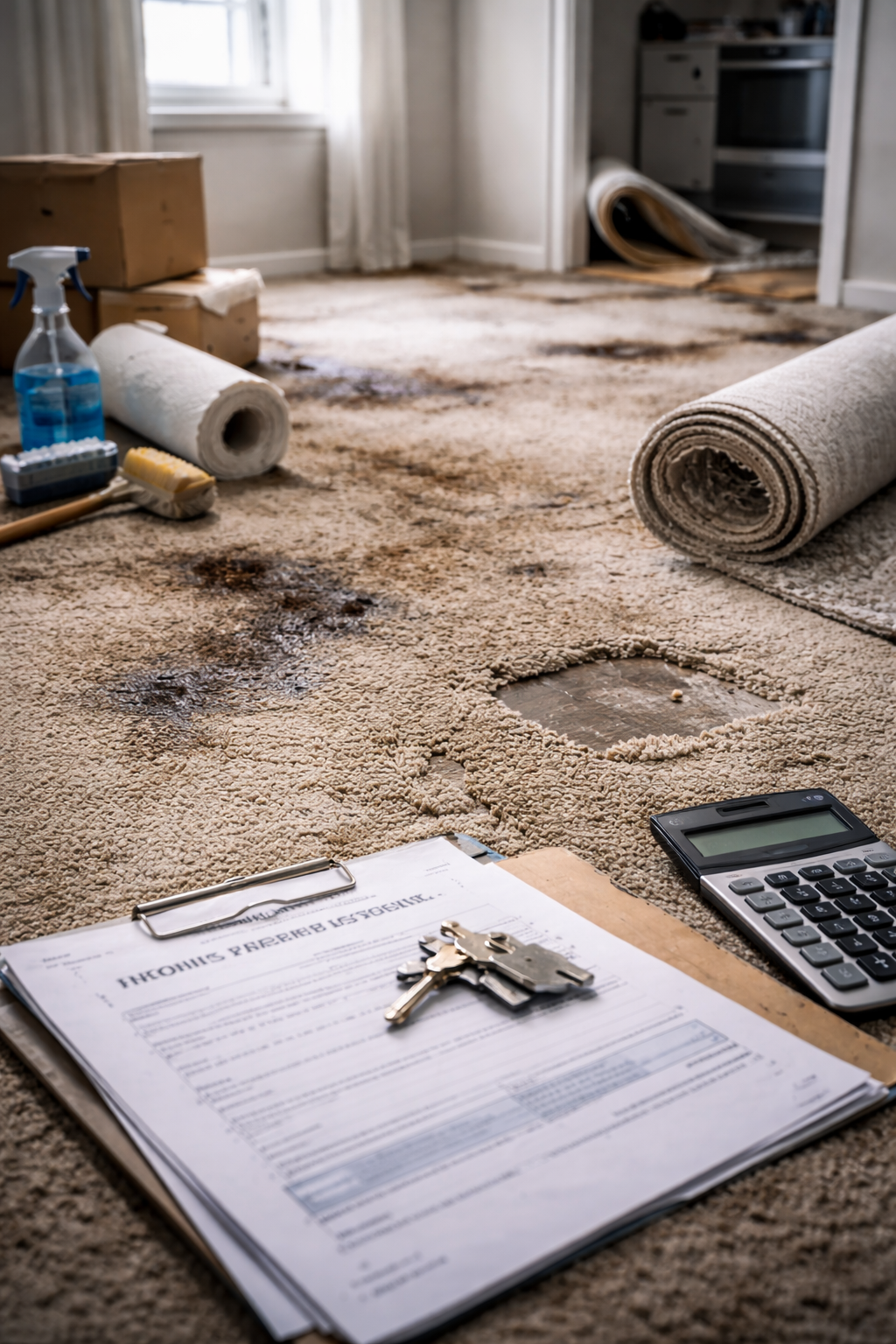
Landlord or tenant pays for carpet replacement — I didn’t even search it until the deposit statement landed in my inbox. One page, a few line items, and then the punch: “Carpet replacement: $1,740.” No photos attached. No age listed. No explanation why cleaning wasn’t enough. Just a number that felt like it was written to end the conversation.
I stared at it long enough to realize what was actually happening. This wasn’t about carpet. It was about leverage. If you accept the charge quietly, the landlord wins by default. If you respond with clean evidence and the right questions, the charge often shrinks — sometimes dramatically.
This guide is built for U.S. renters dealing with move-out deductions and landlords who want to apply costs fairly. If you’re asking landlord or tenant pays for carpet replacement, your outcome usually comes down to three things: what counts as normal wear, how depreciation is handled, and whether the landlord can prove the “why” behind full replacement.
First, if you want a fast baseline for how responsibility is typically separated in rentals, this hub-style post is the closest match in your library:
It helps you frame your dispute correctly before you focus on the carpet details.
The Decision Rule Most People Miss
When deciding landlord or tenant pays for carpet replacement, the key question is not “Is the carpet ugly?”
The question is:
Did the tenant cause damage beyond normal wear, and is the landlord charging only the remaining value (not a brand-new upgrade)?
Landlords can’t usually charge tenants for improvement. They can charge for loss. That difference is where disputes are won.
Fast Self-Assessment (So You Don’t Fight the Wrong Battle)
Answer these in order:
1) Was the carpet already worn when you moved in?
2) Do you have move-in photos or a condition checklist?
3) Is the landlord charging for the whole unit or one area?
4) Is the issue stains/odor/burns/tears (damage) or traffic lines (wear)?
5) Did the landlord provide an invoice and date of installation?
If you can’t see the carpet’s age and a real invoice, you don’t have enough proof to accept a full replacement charge.
People who win these disputes don’t start with “That’s unfair.” They start with “Show me the documentation.” That’s exactly how to handle landlord or tenant pays for carpet replacement.
Normal Wear vs Chargeable Damage (In Plain English)
• flattened fibers in walk paths
• mild fading from sunlight
• minor fraying at edges from ordinary use
• light discoloration over timeOften Chargeable Damage (Tenant Cost)
• large stains that cleaning can’t remove
• pet urine odor that soaks into pad/subfloor
• burns (iron/cigarette/candle)
• tears/pulls from moving furniture aggressively
• water damage from tenant overflow or neglectThe landlord’s strongest case is “preventable damage.” The tenant’s strongest defense is “ordinary aging + depreciation.”
So when you think about landlord or tenant pays for carpet replacement, don’t argue about appearance. Argue about category: wear vs damage.
Match Your Situation (This Is the Core of the Dispute)
CASE A — The Carpet Was Already Old
If the carpet was near end-of-life, a “full replacement” charge is usually inflated.
Ask for the installation date, brand/grade, and expected useful life used in their calculation.
You generally shouldn’t pay for a brand-new carpet replacing something already depreciated.
CASE B — One Room Looks Bad, Not the Whole Unit
Full-unit replacement for localized wear is frequently questioned.
Ask why patching/partial replacement was impossible and request photos showing unit-wide damage.
CASE C — Stains That Could Have Been Professionally Cleaned
If the landlord skipped cleaning and jumped to replacement, ask for proof that cleaning failed or was not viable.
Request the cleaning estimate they rejected (or why none was obtained).
CASE D — Pet Odor / Urine Damage
This is where landlords often have real leverage because odor can live in pad/subfloor.
If you had pets, ask for the contractor’s odor remediation notes and whether pad/subfloor replacement was needed.
Still request depreciation. Even with pet damage, full new cost may not be appropriate if the carpet was old.
CASE E — Burns, Tears, or Cuts
Landlords can often justify replacement if repair is impossible and damage is substantial.
But the charge should still reflect remaining value and actual cost, not a premium upgrade.
CASE F — “Upgrade Disguised as Replacement”
If the landlord installed higher-grade carpet or switched to vinyl, you are not responsible for the upgrade portion.
Ask: what was installed originally vs what was installed now, and the cost difference.
CASE G — You Lack Move-In Photos
This increases risk, but you still can dispute by forcing proof of the original condition and age.
Ask for their move-in inspection record and dated photos from before your tenancy.
These case splits exist because landlord or tenant pays for carpet replacement is rarely a single yes/no. It’s usually a calculation: damage type + documentation + age.
Depreciation Math (Use This to Stop “Full Price” Charges)
You don’t need to be aggressive. You just need to be specific.
Here’s a clean way to calculate a reasonable maximum charge when depreciation applies:
Simple Depreciation Example:
• Original carpet cost: $2,000
• Useful life used for rental accounting: 5 years
• Carpet age at move-out: 4 years
Remaining value = 1 year / 5 years = 20%
Estimated remaining value = $2,000 x 20% = $400
If the carpet was already largely “used up,” charging full replacement can be unreasonable.
Even if your state doesn’t explicitly say “5 years,” most disputes still revolve around the same fairness logic: you can’t be charged the new value of something the landlord already benefited from for years. This is a major reason landlord or tenant pays for carpet replacement is a winnable dispute.
The Evidence Pack That Changes Outcomes
If you do one thing well, do this: build an evidence pack. It makes your response look professional and credible.
Your Evidence Checklist:
• Move-in condition report (even if brief)
• Move-in photos (corners, seams, high-traffic areas)
• Move-out photos (same angles if possible)
• Any cleaning receipt or carpet shampoo rental receipt
• Landlord’s deduction statement
• Request/response emails (dates matter)
If you don’t have photos, ask for theirs. The burden shouldn’t be one-sided.
This is how you turn landlord or tenant pays for carpet replacement from a debate into a documentation review.
If your landlord is ignoring your questions or refusing details, this is the best supporting guide to escalate without blowing up the relationship:
It includes a calm “written-only” approach that often forces action.
A Dispute Script That Works (Short, Firm, Professional)
Copy/paste this message and replace the bracketed parts:
Dispute Message Template:
“Hi [Name], I’m disputing the carpet replacement deduction of [$X]. Please provide (1) the carpet installation date and useful-life schedule used, (2) photos documenting the specific damage beyond normal wear, (3) the itemized invoice for replacement, and (4) an explanation of why cleaning/partial repair was not feasible. If the carpet was not new at move-in, please apply depreciation so the charge reflects remaining value rather than full replacement cost.”
This message does two things: it requests proof and it introduces depreciation without sounding threatening.
Common Mistakes That Make Renters Lose
- Calling only (no written record)
- Arguing “it wasn’t that bad” without photos
- Accepting “carpet was ruined” with no invoice
- Missing dispute windows for deposit claims
- Letting the landlord frame it as “replacement equals your bill”
When money is involved, clarity beats intensity.
Official Source
Security deposit rules are state-based, but the overall framework—reasonable, itemized deductions and return timelines—is consistent in many places.
This official city FAQ explains security deposit rules, itemized deductions, and timing requirements when landlords retain funds for damage beyond normal wear.
FAQ
Can my landlord charge for brand-new carpet if mine was worn?
Often no. If the carpet was older, depreciation usually matters. Ask for the installation date and how they calculated the charge.
What if there’s one stain—can they replace the whole unit and bill me?
They can replace it, but billing the tenant for full-unit replacement may be challenged if damage is localized and partial repair/cleaning is reasonable.
What if I don’t have move-in photos?
Request the landlord’s pre-move-in inspection report and dated photos. You can still dispute by demanding proof of original condition and age.
Is pet damage always my responsibility?
Not always “full replacement.” Pet odor can justify more work, but the charge should still be itemized and often should reflect depreciation if carpet was old.
Key Takeaways
- landlord or tenant pays for carpet replacement usually depends on wear vs damage and the age of the carpet.
- Depreciation is the biggest lever against full-cost deductions.
- Request proof: installation date, photos, and itemized invoices.
- Keep disputes written, calm, and evidence-based.
- Localized issues often do not justify full-unit billing without explanation.
If your deposit is being withheld or delayed, this is the best “next action” guide to keep your timeline protected:
It helps you follow up the right way without weakening your position.
I’m not going to pretend these disputes feel small. The amounts are real, and the timing is usually when you’re already exhausted from moving. But the reason people win landlord or tenant pays for carpet replacement fights is that the process is predictable: proof, depreciation, and itemization.
If you received a carpet replacement charge today, do this now: send the dispute template in writing, request the carpet’s age and invoice, and ask for depreciation to be applied. You’re not asking for a favor—you’re asking for a reasonable, documented deduction. And that’s the fastest way to protect your money without turning the situation into a personal war.
landlord or tenant pays for carpet replacement