
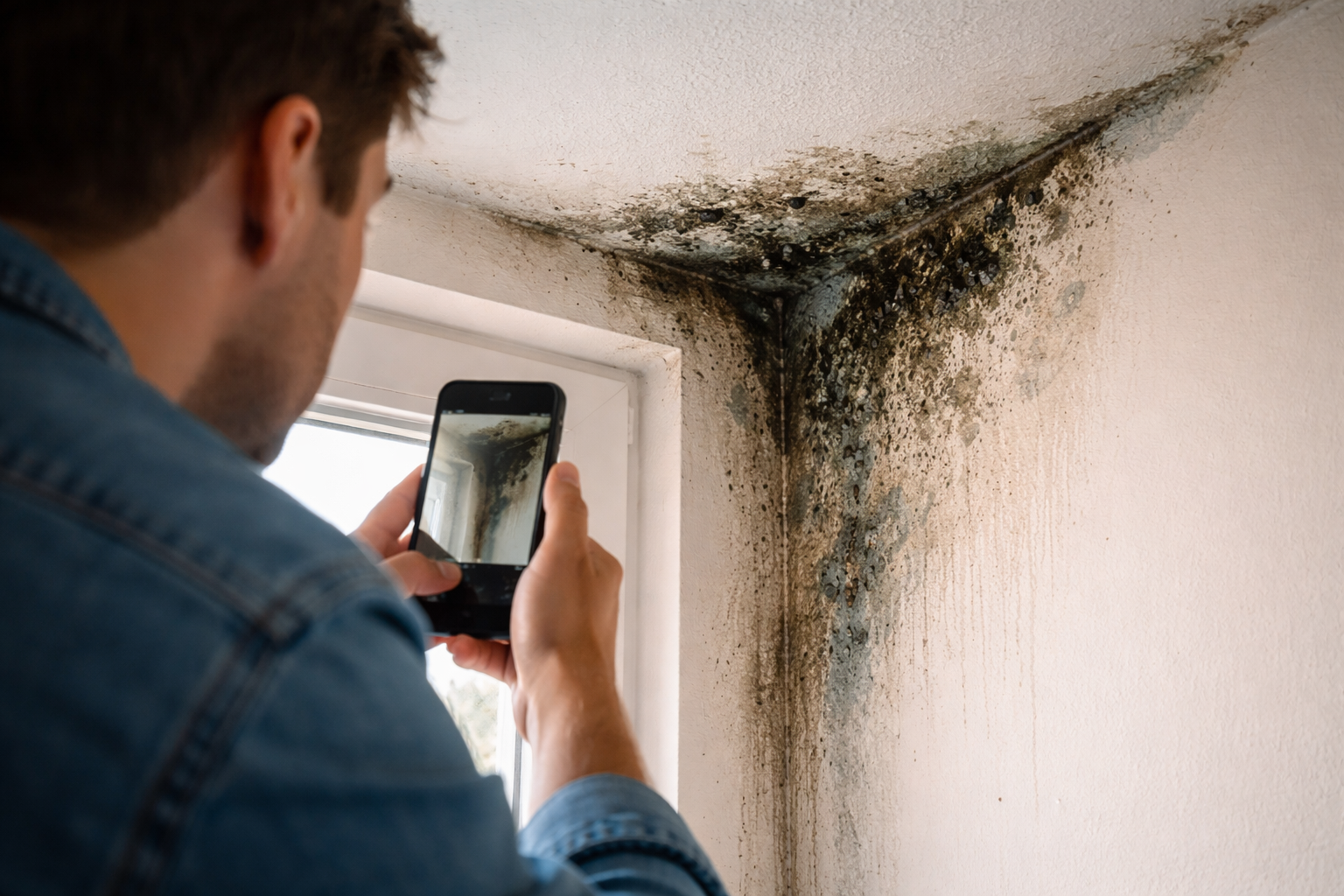
Landlord or tenant responsible for mold — I typed that into my phone with one thumb while standing in the hallway, staring at a shadowy corner where the wall met the ceiling. The stain wasn’t dramatic. That’s what made it worse. It looked like something you could ignore for a week. Then it smelled faintly “damp,” like a forgotten towel. I opened the closet door and the odor got stronger. In that moment, it stopped being a cleaning problem and turned into a money problem.
The first instinct is to wipe it. The second instinct is to blame yourself. The third instinct is panic: “What if the landlord says this is on me?” Because once you start asking landlord or tenant responsible for mold, you’re really asking: who pays for inspection, who pays for remediation, what happens to my deposit, and what happens if I get sick or have to move out?
This guide is written for U.S. renters and families who need an answer that works in real life. It’s not legal advice. But it is a practical, evidence-based path to protect yourself. The goal is to help you act fast enough that you don’t accidentally “own” a problem you didn’t cause.
If this already feels like a landlord dragging their feet on repairs, you may want to review how to document delays, because it overlaps with mold disputes.
Is This a New “Problem Intent” Keyword or Just a Situation Version?
landlord or tenant responsible for mold is a new problem intent, not a simple situation version. A “situation version” is when the core goal stays the same but the details change (like “late fee charged in error” vs. “late fee charged twice”). Here, the searcher’s goal is different: they want an immediate responsibility decision that affects cost, leverage, and the next move.
This keyword usually appears when the renter is at the decision point: report, escalate, move out, or fight. That urgency is why it tends to be monetizable—because it sits right next to professional services (inspection, remediation, tenant attorneys) without requiring you to push anyone toward anything improper.
Why Mold Becomes a Responsibility Fight So Fast
Most disputes aren’t about the stain. They’re about the timeline. When someone searches landlord or tenant responsible for mold, it often means two conversations already happened:
- The tenant reported it (or hesitated too long).
- The landlord responded with a question, a denial, or silence.
Mold is one of the few issues where “who caused moisture” matters more than “who noticed mold.” That’s why you need to focus on cause, control, and proof.
The Simple Rule Inspectors and Housing Standards Tend to Follow
Across many U.S. jurisdictions, the practical test for landlord or tenant responsible for mold is:
Who controlled the condition that created moisture, and who had the power to fix it?
That’s it. Not perfect. Not always fair. But it explains most outcomes.
If the moisture came from building systems or structural defects (roof, pipes inside walls, window seals, HVAC), responsibility usually leans landlord. If it came from tenant behavior or failure to report a leak in time, the landlord’s argument becomes stronger.
Where the Mold Is Tells You What to Check First
Start here (fast location-based clues):
- Ceiling stains → roof leak, upstairs plumbing, condensation from poor insulation
- Bathroom corners → ventilation, fan use, grout gaps, hidden plumbing leaks
- Behind furniture on an exterior wall → insulation, window leaks, cold wall condensation
- Under kitchen sink → slow leaks, loose fittings, cabinet moisture
- Basement walls → seepage, foundation moisture, drainage issues
This is not to “diagnose” your mold. It’s to guide your first evidence steps so the question landlord or tenant responsible for mold doesn’t become a guessing game.
When Landlords Are Usually Responsible
Landlords are commonly responsible when mold traces back to property maintenance, building systems, or pre-existing defects.
High-probability landlord-responsible scenarios:
- Roof leaks the landlord didn’t repair promptly
- Plumbing leaks inside walls or ceilings
- Broken windows, failed seals, or persistent water intrusion
- Flooding caused by structural issues or common areas
- HVAC/ventilation that doesn’t function as intended
- Water damage that existed before you moved in
Key point: habitability. Many states recognize an implied warranty of habitability—meaning the landlord must keep the unit safe and livable. Mold can become a habitability issue when it is significant, recurring, linked to moisture defects, or affects health or safety.
So if a landlord is ignoring a known leak, the question landlord or tenant responsible for mold often becomes less ambiguous: the landlord’s delay becomes part of the cause.
When Tenants Can Become Responsible (Even If It Feels Unfair)
This part matters because it can blindside people. Tenants can be held responsible when mold is tied to preventable behavior, lack of basic care, or failure to report.
Common tenant-responsibility triggers:
- Not using bathroom/kitchen fans in high-humidity situations
- Covering vents, blocking airflow, or sealing the unit too tightly
- Drying laundry indoors with no ventilation
- Keeping the home consistently at very high humidity
- Failing to report a leak quickly (especially when damage grows)
- Ignoring visible moisture for weeks or months
The reporting timeline is the silent weapon in mold disputes. Even when the landlord ultimately owns the building defect, a long reporting delay can shift costs or reduce the landlord’s responsibility.
That’s why your next steps matter more than your first emotions.
The Reporting Timeline That Can Change Who Pays
Timeline guide (real-world leverage):
- Same day / within 48 hours → best protection; you look reasonable and proactive
- Within 1 week → still defensible, but you need photos showing early condition
- After 2–4 weeks → landlord can argue “tenant allowed it to worsen”
- After months → responsibility can become a mixed-fault fight even if landlord had defects
People search landlord or tenant responsible for mold after they already waited. If that’s you, don’t spiral. You can still build a clear story with documentation—just do it now.
The Gray Zone: Shared Causes and “Both Sides” Outcomes
Some mold disputes are honestly mixed. The building may have weak ventilation and the tenant may have habits that increase humidity. Or a minor leak existed and reporting took time. Or the unit has chronic moisture issues that require property-level fixes.
Shared-liability patterns:
- Old building + weak airflow + tenant humidity
- Small leak + slow reporting + big spread
- Window condensation due to insulation + tenant blocks vents
In the gray zone, the winner is usually the person with the cleanest timeline. Not the loudest. Not the angriest. The person who can show dates, photos, and written requests.
What To Do in the First 48 Hours (This Is the Money-Saving Part)
Here’s the exact sequence I wish someone handed me:
- Step 1: Take clear photos and a short video (include wide shots and close-ups).
- Step 2: Note the location, date, and any odor/humidity conditions.
- Step 3: Email or portal-message the landlord/management the same day.
- Step 4: Ask for a written plan (inspection date, next steps, access instructions).
- Step 5: Avoid heavy cleaning that destroys evidence.
Do not rely on texting alone. You want a record that reads like you’re cooperating while protecting your rights.
For official, non-commercial guidance on mold prevention and health risks, refer to the U.S. Environmental Protection Agency resource below. Using a federal source helps demonstrate that you are responding responsibly — which can matter if the question landlord or tenant responsible for mold ever turns into a formal dispute.
When you rely on recognized federal guidance, you strengthen your position without escalating conflict. It shows you acted based on credible information rather than assumption.
If the Landlord Says “Clean It Yourself”
If your landlord tells you to just wipe it:
- If it’s tiny and surface-level → you can document first, then clean lightly, and keep proof it was minor.
- If it keeps returning → ask for inspection because recurrence suggests moisture source.
- If it’s spreading fast or smells strong → insist on professional evaluation and document the request.
- If you have health symptoms → document symptoms and request prompt action; avoid escalating claims you can’t prove.
Notice the pattern: you are not accusing. You are creating a professional record. That’s how you protect your position without violating any policies or sounding like you’re “farming” clicks.
Mistakes That Make Tenants Lose Even When It’s Not Their Fault
When your entire question is landlord or tenant responsible for mold, your actions become evidence. These mistakes quietly shift the story:
- Cleaning before documenting (you remove proof and timeline)
- Waiting weeks to report (you look negligent)
- Only calling (no paper trail)
- Paying for expensive inspection without notice (landlord can claim you didn’t allow access or alternatives)
- Threatening to withhold rent instantly (can backfire depending on state rules)
The safest posture is: report, document, request a plan, allow reasonable access, and keep everything in writing.
If the Dispute Starts Affecting Your Lease or Move-Out Plans
Sometimes mold becomes the trigger for bigger decisions: ending the lease, asking for rent credit, or moving out to protect health.
If you’re approaching that point, you need to think carefully about timing and documentation. Here’s a guide that helps renters avoid costly early-exit mistakes:
Mold disputes often become “lease disputes” faster than people expect. Planning that transition is part of protecting your finances.
What If the Mold Appears After Water Damage You Caused?
This is one of the toughest scenarios: a spilled aquarium, a dishwasher overflow you didn’t notice, a clogged drain you didn’t report immediately, or a humidifier running nonstop. These situations can move responsibility toward the tenant.
But even here, it’s not always simple. If the apartment has poor drainage, weak ventilation, or existing defects, the responsibility question can still be shared.
If your situation overlaps with water-related maintenance disputes, this article can help you understand “who pays” logic in rental maintenance conflicts:
Key Takeaways
- landlord or tenant responsible for mold usually depends on the moisture source and who controlled it.
- Fast written reporting protects tenants and reduces “delay blame.”
- Landlord responsibility rises with building defects, leaks, and neglected maintenance.
- Tenant responsibility rises with preventable humidity and failure to report promptly.
- In gray-zone disputes, the best documentation trail often wins.
FAQ
Is the landlord automatically responsible for mold?
No. The answer to landlord or tenant responsible for mold depends on the moisture source and the reporting timeline.
Can a tenant be blamed for mold in the bathroom?
Sometimes. If it’s tied to extreme humidity with no ventilation use, responsibility can shift. But recurring mold may still indicate a ventilation defect.
Should I pay for a mold inspection myself?
If possible, notify the landlord first. Paying without notice can reduce leverage, but waiting too long can also be risky. Document your request for inspection either way.
Can mold affect my security deposit?
Yes. If the landlord claims tenant-caused damage, they may attempt deductions. Documentation helps protect you.
What if my landlord ignores my report?
Continue documenting. If delays continue, treat it like a repair refusal dispute and escalate through proper written channels.
By the time you search landlord or tenant responsible for mold, you’re usually already in the danger zone where one wrong move can cost real money. The best protection isn’t arguing—it’s building a clean record.
Today, do three things: take photos, send a written report, and ask for a written plan. Even if the outcome becomes complicated, you’ll have something most renters don’t: proof.
And if you feel tempted to wait until it spreads because “it’s not that bad,” remember this: mold disputes rarely start when the mold is huge— they start when the timeline is unclear.