
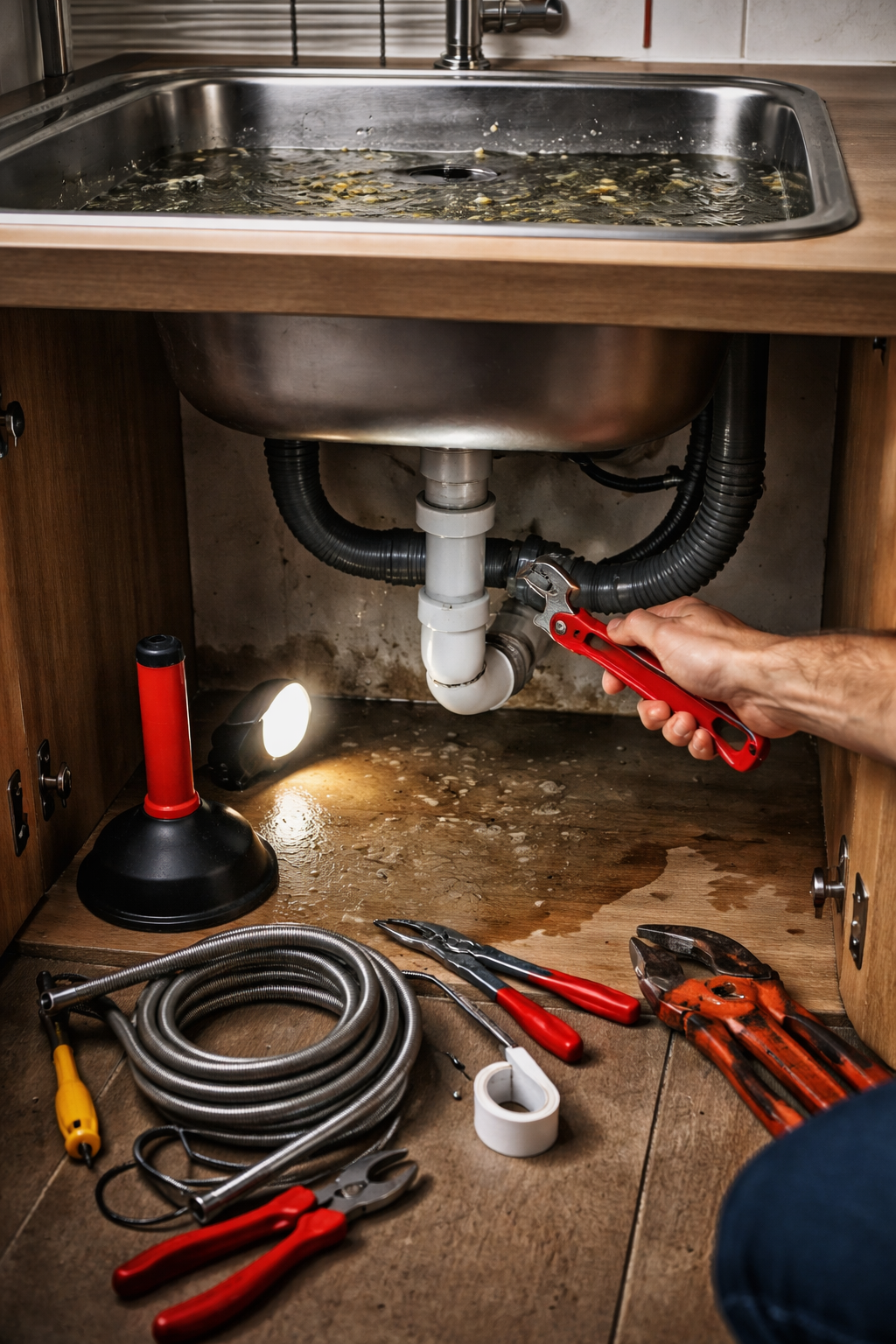
Landlord or tenant who pays for clogged drain is not a question you plan to Google. It usually happens in a normal moment—washing dishes, taking a quick shower, getting ready for work—until the water stops moving. The sink fills, then holds. The tub turns into a shallow pool. You wait for that slow swirl that never comes.
You try a plunger. Maybe a quick drain cleaner. Nothing changes. Then your phone buzzes after you message the landlord.
“Clogs are usually tenant responsibility.”
That’s the moment a plumbing issue turns into a money dispute. And if you make the wrong move in the next 30 minutes—calling a plumber too fast, admitting fault in writing, or letting it sit too long—you can end up paying for something you didn’t cause.
This guide is U.S.-focused and written for real renters dealing with a real backup. It’s general information, not legal advice. The goal is practical: help you answer landlord or tenant who pays for clogged drain using evidence, not guesses, and help you get the problem fixed without accidentally losing leverage.
If your landlord has a pattern of delaying maintenance, you’ll want to read this early so your messages stay clean and documented.
Why This One Problem Turns Into a Fight So Quickly
A clogged drain is rarely “just” a clogged drain. It hits daily life immediately: hygiene, cooking, laundry, guests, and basic comfort. Meanwhile, the risk grows quietly behind the scenes.
• Standing water can cause damage.
• A slow leak can expand into mold.
• A backup can affect neighbors or shared lines.
Because the consequences escalate, landlords and tenants often argue about cost before the pipe is even inspected. That’s why landlord or tenant who pays for clogged drain has such strong “immediate action” intent—people are searching while the situation is actively happening.
The One Decision Rule That Matters More Than Opinions
Here’s the rule that quietly decides most outcomes:
Who pays is usually tied to what caused the clog.
Not who noticed it first. Not who is more annoyed. Not who sends more messages.
Causation is the center of the dispute. So your job is to quickly collect clues that point to cause—before anyone pays an invoice.
Case Split Box: Identify Your Drain Type in 60 Seconds
Step 1: Which drain is it?
A) Kitchen sink only
Often suggests grease/food buildup, but can also be old pipe narrowing.
B) Bathroom sink only
Often hair/soap scum, but can also be poor venting or old traps.
C) Shower/tub only
Commonly hair + soap, but recurring backups can point to deeper line issues.
D) Toilet only
Could be “one-time blockage” (paper, objects) or a line problem—context matters.
E) Multiple fixtures in the same unit
Stronger signal the clog is deeper than a simple surface blockage.
F) You + neighbors (or multiple units)
Strongest signal of a main line / shared line issue.
This matters because landlord or tenant who pays for clogged drain changes dramatically when you move from “one fixture” to “multiple fixtures” to “multiple units.”
When the Landlord Is Often Responsible
In many U.S. rentals, landlords are expected to maintain the plumbing system in working order as part of habitability obligations. That doesn’t mean every clog is automatically their bill—but it does mean structural or system-level problems usually aren’t on you.
Landlord-leaning signals include:
• The drain was slow from move-in day.
• The clog keeps coming back every few weeks.
• Multiple drains are affected at once.
• Neighbors report the same problem.
• The issue appears after heavy rain (possible main line backup).
• You smell sewer gas or hear gurgling across fixtures.
Recurring clogs are rarely a single person’s “bad habit.” If you’re facing landlord or tenant who pays for clogged drain and the pattern looks structural, do not treat it like a simple one-time mess.
When the Tenant May Be Responsible
Some clogs really are usage-caused, and plumbers can sometimes identify it fast. If the clog is clearly linked to avoidable use, landlords often try to charge tenants, deduct from deposits, or request reimbursement.
Tenant-leaning signals include:
• Grease poured down the sink (even “a little”).
• “Flushable” wipes (often not actually flush-safe).
• Large food scraps without a disposal.
• Heavy hair buildup with no strainer.
• Objects dropped into the toilet (kids’ items happen more than you think).
Intent doesn’t matter—only what likely caused the blockage. That’s why landlord or tenant who pays for clogged drain is best answered by evidence and a calm timeline, not a debate.
Case Split Box: What a Plumber’s Notes Can Do to Your Case
Step 2: If a plumber is involved, their notes can decide who pays.
If the notes say: “hair and soap buildup near tub trap”
→ Many landlords argue tenant-caused maintenance.
If the notes say: “grease accumulation in kitchen line”
→ Often billed to tenant, especially if lease warns against grease.
If the notes say: “roots in main line” or “collapsed line”
→ Strong landlord responsibility signal.
If the notes say: “blockage beyond unit line / in building main”
→ Usually not a single-tenant issue.
Before you authorize work, think about what the written record will say.
This is why the question landlord or tenant who pays for clogged drain is really a documentation game. The invoice is one page. The cause narrative is everything.
The Biggest Money-Losing Mistake Renters Make
Most renters lose leverage in one of two ways:
1) They pay a plumber immediately without written notice.
When the landlord later refuses reimbursement, you have no clean proof you gave them a chance to fix it.
2) They wait too long because they’re afraid of being blamed.
Then the landlord claims the delay caused damage, turning a $200 snake into a much bigger bill.
The best path is usually: document → notify → request action → escalate only if necessary.
What to Do in the First 30 Minutes
If you are actively dealing with a backup, do this sequence. It’s designed to answer landlord or tenant who pays for clogged drain with fewer assumptions and more proof.
30-Minute Action Checklist
✔ Take photos/video of the clogged fixture and any standing water.
✔ Write down the exact time you noticed it.
✔ Test one other drain (to see if it’s isolated or broader).
✔ Stop using water in that area to prevent overflow.
✔ Notify the landlord in writing with a clear request and a short deadline.
✔ Do not admit fault (“I probably caused it”) even casually.
When you have timestamps and photos, conversations change.
A Message Template That Doesn’t Backfire
You want a message that is firm, factual, and leaves room for the correct party to act. Keep it short.
Example:
“Hi [Name], the [kitchen sink / tub] is fully clogged as of [time]. Water is not draining and I’m avoiding use to prevent overflow. Please arrange repair or advise next steps today. I can provide photos/video if helpful.”
This avoids blame language while clearly requesting action.
Gray-Zone Scenarios Where People Get Stuck Paying
Some cases aren’t clean. And these are the ones where landlord or tenant who pays for clogged drain becomes a real dispute:
• The drain was “kind of slow” for months.
• Prior tenant may have caused buildup.
• The building is old and pipes narrow easily.
• A shared line creates mixed responsibility.
• The landlord claims misuse without proof.
In gray zones, the winner is usually the person with better documentation and a clearer timeline.
If shared responsibility questions are already happening in your rental life, this related guide can help you handle “who pays” disputes without spiraling into blame.
What You Should Never Do (Even If You’re Angry)
These moves often feel satisfying short-term—and then become expensive:
• Threatening language (“I’ll sue you tomorrow”).
• Long emotional texts that blur facts.
• Hiring a contractor and sending an invoice without notice.
• Posting accusations publicly while the issue is unresolved.
• Withholding rent impulsively without understanding local rules.
Professional tone doesn’t mean you’re weak—it means you’re building a clean record.
One Official Reference That Helps Keep the Conversation Grounded
If you want a neutral, government-backed explanation of tenant protections and housing responsibility, this official guide is a safe reference during disputes.
How to Decide: Pay Now or Push Back First
Use this decision logic if you’re stuck between urgency and cost.
Decision Block
If water is actively overflowing / causing damage:
Stopping damage comes first. Notify landlord immediately in writing, then consider emergency service if they’re unreachable.
If it’s contained (slow drain, no overflow):
Document, notify, and give a short window for landlord action before you authorize repairs.
If multiple fixtures are affected:
Treat it as a deeper line issue. Stronger landlord responsibility signal—push for landlord-arranged repair.
If it’s clearly usage-caused (e.g., object dropped, wipes):
Prepare for a tenant-pay outcome, but still document and request landlord process first.
This is the practical way to handle landlord or tenant who pays for clogged drain without guessing and regretting it later.
Key Takeaways
• landlord or tenant who pays for clogged drain is usually determined by cause, not emotion.
• Single fixture clogs can lean tenant; multi-fixture/multi-unit problems often lean landlord.
• Plumber notes can make or break reimbursement disputes.
• Document first, notify in writing, then escalate if needed.
• Avoid messages or actions that accidentally admit fault.
FAQ
Can my landlord automatically charge me for a clogged drain?
Not automatically. Charges tend to depend on the cause and what the lease says, plus any documentation from repairs.
What if the landlord refuses to send anyone and the drain is unusable?
Start with written notice and clear documentation. If the issue affects basic habitability or risks damage, escalate using your documented timeline and local tenant resources.
What if the landlord says “you caused it” with no proof?
Ask for the repair report or evidence supporting that conclusion. Keep your communication factual and organized.
Do recurring clogs change who pays?
Yes. Recurrence can suggest a deeper maintenance issue rather than a single-incident mistake.
Is a slow drain the same as a clogged drain?
No. But a slow drain that worsens can become a clog, and your early documentation can help show it wasn’t sudden misuse.
Conclusion
landlord or tenant who pays for clogged drain feels like a simple question until you’re staring at standing water and realizing every option has a cost. Paying too fast can lock the bill onto you. Waiting too long can turn a small clog into a bigger incident.
The smartest move is to slow down just enough to document, notify, and protect the record—then get the problem fixed. You’re not trying to “win an argument.” You’re trying to prevent a preventable invoice from landing on the wrong person.
Before you take the next step, if money disputes start showing up in your rental situation, this is a useful “next action” guide for handling charges and pushback without escalating into chaos.
Handle it like a timeline, not a fight: facts, photos, written notice, then escalation only when necessary.